India’s landmark policy of strategic autonomy, rooted in non-alignment, remained a cornerstone of India’s foreign policy. It allowed India to manoeuvre in international relations and avoid external pressure without entering into binding alliances and taking sides. This was a masterstroke as it allowed India to maintain good relations with all major powers of the globe and pursue its own interests. India’s firm position during the Cold War displayed the effectiveness and practicality of this approach. However, over a period of time, changing global dynamics have caused this autonomy to appear more like ambiguity, where India’s foreign policy posture relied on unclear signalling rather than clearer geopolitical choices, and silence that kept its partners and allies guessing rather than having clear indications.
India’s first test for strategic autonomy came in 1998 after Pokhran-II, when the US sanctioned India, Blacklisted its 208 entities, blocked World Bank/IMF loans, and cut off defence and dual-use trade. India, however, sustained this pressure, and in the post 9/11 era, the United States’s priorities changed, and the Bush Administration signed a civil nuclear deal with India in 2008. Recognising India as a legitimate nuclear power outside of the NPT or CTBT.
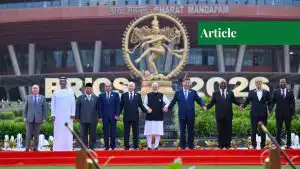
Since then, India has managed to avoid this stress by invoking policies such as non-alignment 2.0, multi-alignment, Quad and BRICS. India adopted a neutral stance in the Russia-Ukraine war and continued the purchase of Russian oil. India also made heavy investments in the Chabahar port of Iran without getting into conflict with its Trans-Atlantic Partners. This worked well until the most recent Trump tariff war.
This was the second and the hardest test for India’s strategic autonomy and was very different from 1998, as it was not based on some norms and values and could change with a change in administration, but based on a clear transactional demand that India should cut its Oil purchases from Russia and should abandon its ambitions in Chabahar. This pressure tactic by Trump came with a tariff blow of 50% that crippled Indian exports to the United States and threatened bilateral trade. Trump announced that India had agreed to cut its oil purchases from Russia, although India did not confirm, and this marked a new phase of Strategic ambiguity.
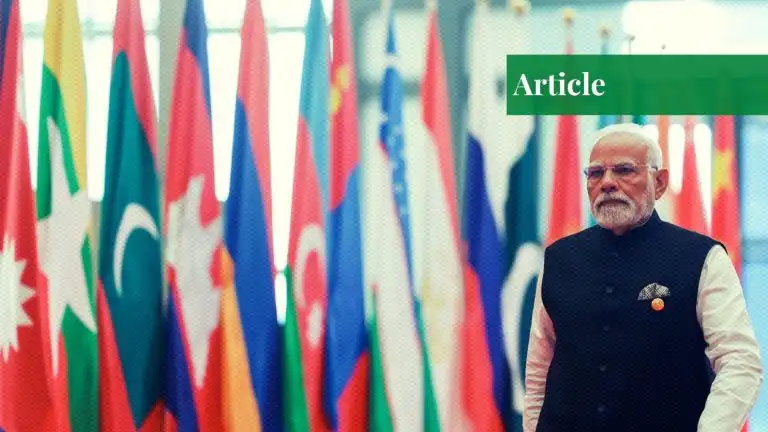
While relations with the US soured, Indian Prime Minister Modi visited China to head the SCO summit, which gave a visual embodiment of hedging instead of a clear choice. India has been a long-standing partner and an active member of the Quad, which was mainly focused on balancing China in the Indo-Pacific region, but pressure from the US allowed India to explore other avenues without opting out of its commitments as a partner in the Quad, following an ambiguous position.
The recent US-Israel campaign against Iran forces India to balance relations with Washington, Israel, and Tehran simultaneously. While India’s silence in the initial phase of the war and subsequent tilt towards Washington indicate autonomy tipped into ambiguity. India remained passive during the entire mediation efforts to reach a ceasefire agreement. Even the US attack on an Iranian Navy vessel near the Indian maritime border did not get a strong statement from the Indian Foreign Ministry. US strikes on commercial ships in the Strait of Hormuz killed several crew members who held Indian nationality. While the Ministry of External Affairs summoned a US diplomat and issued a muted call for the attacks to “cease and end,” this procedural response fell well short of any clear condemnation for the Indian population and families of the victims. This measured, non-committal response points towards a more ambiguous approach of India in this Middle Eastern conflict amid pressure from the Trump administration restricting India’s space to move effectively and pursue interests globally.
The Graham “Sanctioning Russia and Iran Act,” passed by the Senate 86-11, threatens tariffs of up to 100 percent on countries that continue to import Russian energy, placing India’s oil arithmetic under fresh scrutiny. Unlike the 1998 sanctions, which softened once Washington’s strategic priorities shifted, this bill signals a bipartisan consensus that is unlikely to reverse with a change of administration. It confronts India with the same unresolved question it deferred through the tariff war and the Iran conflict: whether continued ambiguity is sustainable when the price of hedging keeps rising with each successive test.
Collectively, these episodes reveal not isolated crises but a recurring pattern. Strategic autonomy was intended to provide India with the flexibility to navigate among great powers without being constrained by any single alliance. However, the current approach has evolved into a foreign policy characterised by deferring decisions, avoiding explicit statements, and allowing partners to infer India’s position. This strategy was effective when the costs of silence were minimal and major powers interpreted India’s restraint as prudence. However, it becomes increasingly risky when silence is perceived as indecision, prompting both Washington and Moscow, as well as Tel Aviv and Tehran, to assess India’s stance rather than await official clarification independently.
The principal risk for India is not the necessity of choosing sides; given India’s scale and ambitions, some degree of hedging will always be essential. The greater danger lies in unmanaged ambiguity, which can erode reliability. Strategic autonomy was never intended to equate to silence; rather, it was designed to enable India to articulate positions that differ from external expectations, on its own terms and timeline. To preserve the substance of this doctrine, New Delhi must distinguish between autonomy and ambiguity, and demonstrate, when confronted by future challenges such as the Graham Act, Trump tariffs, or incidents in the Strait of Hormuz, that it retains the capacity to make decisive choices.
If you want to submit your articles and/or research papers, please visit the Submissions page.
To stay updated with the latest jobs, CSS news, internships, scholarships, and current affairs articles, join our Community Forum!
The views and opinions expressed in this article/paper are the author’s own and do not necessarily reflect the editorial position of Paradigm Shift.

Muhammad Maroof Hassan is a scholar of International Relations from the National University of Modern Languages (NUML), Islamabad. His research interests include South Asian politics, counterterrorism, and the dynamics of war and conflict. He writes on regional security, great-power competition, and the evolving foreign policy postures of South Asian states at India Decode and the Asian Consortium for Regional Studies.