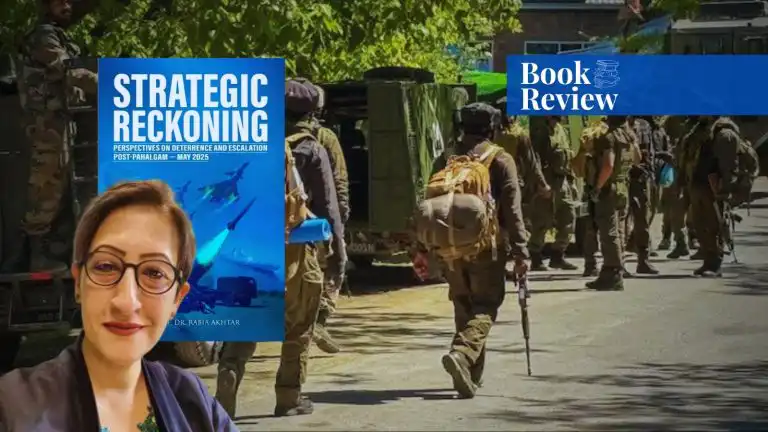

Strategic Reckoning: Perspectives on Deterrence and Escalation Post-Pahalgam – May 2025 provides a thorough examination of one of the most disastrous military confrontations in South Asia’s history. While highlighting the fallout of the 2025 Pahalgam crisis in Indian-occupied Jammu and Kashmir, the book elaborates on the crisis in the broader domain of India-Pakistan rivalry, nuclear deterrence posture, domestic political measures, and shifting international partnerships. It provides a multi-tiered account that is as much about South Asia’s strategic instability as it is about a single flashpoint event.
The Stability-Instability Paradox and Doctrinal Shifts
The central strength of the book lies in the analysis of deterrence under a pressure posture. The book describes the long-standing India-Pakistan dyad as a case of the “stability-instability” paradox. It explains the Cold Start Doctrine of India and its impact on the traditional deterrence framework. The book argues that technological advancements, such as information warfare, cyber operations, and precision strike capabilities in recent times, have compressed the timelines for decision-making, and the long-term impact of these measures on South Asia’s political posture will be drastic. Further, the thresholds of escalation have faded. Strategic Reckoning highlights that the Pahalgam crisis has given a reality check that sub-conventional violence keeps on going under the nuclear shadow. However, the presence of nuclear deterrence forbids full-scale war.
Military posturing during the time of crisis is particularly discussed. India’s post-2019 doctrinal shift, especially after the abrogation of Article 370, has been mentioned, and Pakistan’s emphasis on credible minimum deterrence and full-spectrum deterrence is analyzed not just as a declaratory policy but as a part of a signaling framework to deter limited war measures. By comparing the doctrinal shifts of both countries, the author argues that one side’s attempt to enhance the deterrence capability at the same time fuels the other’s threat perceptions. It elaborates on how contemporary conflicts are being shaped by changing warfare domains. The warfare between India and Pakistan is taken as an example, highlighting the changing domain of warfare from conventional to information warfare.
Domestic Pressures and the Kashmir Flashpoint
Attention towards the impact of domestic politics on decision-making is one of its important contributions. It argues that nationalist movements, disinformation, and political polarization close the gap for de-escalatory diplomacy measures. It explains the impacts of internal political pressure in shaping foreign policy measures. Resultantly, the local incidents become internationalized for the sake of domestic legitimacy battles.
It discusses the long-standing Kashmir issue and highlights its political as well as normative dimensions. Kashmir is described as a nuclear flashpoint in the region and a major driver for confrontation. The historical evolution of the dispute is highlighted while referring to the United Nations resolutions calling for a plebiscite. While examining the aftermath of the 2019 constitutional changes in IIOJK, Strategic Reckoning argues that these developments have changed the political landscape in such a way that they complicate conflict management. It suggests that the role of regional organizations such as SAARC should be redefined with the implementation of new risk reduction mechanisms.
The book argues about the limits of the external actor’s role in the May conflict of 2025. It states that mediation portrayed a great symbolic gesture rather than a preventive measure. Competing global interests and contradicting geopolitical interests have limited the mediation from international actors. Thus, it suggests that collective measures inside the region are more important than depending on outside actors to gain stability.
Grey Zone Warfare and the Search for a New Equilibrium
Strategic Reckoning examines the use of hybrid techniques and grey zone strategies in warfare. Political and military objectives are achieved by using these tools. It argues that these strategies, including the proxy engagements and information warfare, blur the line between peace and conflict. Further, it points out that grey zone strategies in the South Asian region are increasing the risk of miscalculation. Low-intensity conflicts are normalized, and the already weak deterrence posture is strained further.
It explains that these escalations at rapid instances are not related to the attainment of capabilities. These escalations are engraved from historical perspectives, past rivalries, and unresolved disputes. It further shapes the political posture, and the resulting military doctrines are formed on its basis. Particularly, historical mistrust shapes the mindset, and ultimately, these inherited perceptions narrow the space for diplomatic measures.
It states that the old equilibrium posture has not been able to maintain stability in the region. Thus, it should be replaced with a new equilibrium of deterrence. South Asia may deal with several military standoffs in the coming decade if the situation remains the same. A renewed appreciation for strategic clarity and restraint should be adopted. The arms race between two nuclear neighbors in terms of capabilities guarantees no one’s victory; it elongates the degree of loss.
While analyzing the volume, it can be extracted that the major strength of the book lies in its multidimensional approach. It covers the strategic and analytical depth and also talks about the historical approaches. It is suitable for both policymakers and academic audiences. It works as a descriptive set of pieces for critical thinkers and analysts who are keen on studying the changing dynamics of South Asia’s politics. The book elaborates on different dimensions of crisis, and the argumentation is structured logically, moving from narrative rebuilding to policy implications.
Strategic Reckoning situates the Pahalgam crisis within the lineage of earlier crises like the Mumbai attacks of 2008 and the 2019 Pulwama-Balakot event. Some critics may argue that Pakistan’s internal security challenges should have been given more space, but the author has focused on illustrating the impact of reactive policy-making on crisis cycles rather than assigning unilateral blame to a single party. Most importantly, the book argues that the strategic environment of South Asia has qualitatively changed. With respect to past decades, the environment has become more volatile following the interplay between rapid mobilization forces and information warfare. It highlights erosion in South Asia’s regional strategic stability and suggests different reliable measures for crisis management and risk reduction.
Ultimately, Strategic Reckoning is a remarkable contribution to South Asia’s security discourse. It reflects the fragility of deterrence in the era of rapid technological advancements. The volume calls for the fact that the end of the old equilibrium doesn’t mean everything is over, and nothing can be done; rather, new equilibrium measures should be introduced before any major crisis. The international system is already strained with regional conflicts, and South Asia remains a nuclear flashpoint with global implications.
Considering the rift in doctrinal shifts, South Asia’s next decade is considered to be a dark threshold if the restraint measures are not implemented. Rather than prescribing idealistic solutions, it advocates for the introduction of new confidence-building measures, preventive diplomacy, and crisis management mechanisms. The book is a remarkable contribution to contemporary strategic studies. It works as a reminder that deeper strategic tensions most often lead to a crisis. The message remains sobering yet constructive: if the situation is not controlled by the region’s leaders and stakeholders, then the equilibrium will just be remembered as a lost stability that is buried under the weight of strategic misadventure.
If you want to submit your articles and/or research papers, please visit the Submissions page.
To stay updated with the latest jobs, CSS news, internships, scholarships, and current affairs articles, join our Community Forum!
The views and opinions expressed in this article/paper are the author’s own and do not necessarily reflect the editorial position of Paradigm Shift.

Syed Hamza Mahroof is an international relations graduate from the University of Azad Jammu and Kashmir, Muzaffarabad. He is a research intern at the Centre for International Strategic Studies (AJK). He has practical experience in research encompassing the evolving geo-economic and political dynamics of South Asia, with a particular emphasis on climate resilience and climate change.