
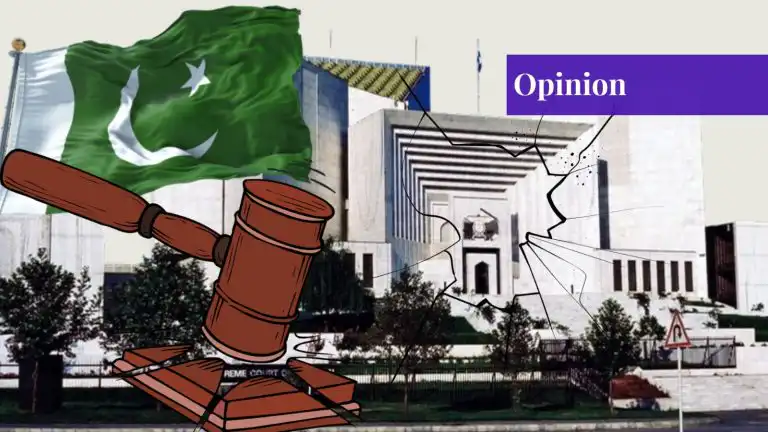
Mohsin Naqvi says Pakistan’s system has collapsed. For many of those who exercise power within it, however, it continues to function remarkably well.
Declaring collapse is easy. The important question, one that Interior Minister Mohsin Naqvi did not ask during the Pakistan Economic Summit on July 30, is who the system has actually collapsed for.
Addressing the Summit, Mohsin Naqvi argued the collapse of Pakistan’s system by saying, “the system we are living under has collapsed, and problems cannot be solved through it.” He said that a system that has not delivered for the last seven decades must be broken at its core. He gave the suggestion of forming new provinces or administrative units for better governance.
One can hardly ignore that something has failed in this system. Pakistan’s 2025 Corruption Perceptions Index score barely moved, up from 27 to 28, leaving the country ranked 136th out of 182 nations—below most of the world. A Transparency International Pakistan survey found that citizens see police as the most corrupt institution they deal with, and 77 percent of them were not satisfied with the way the government is handling corruption at all.
This does not surprise ordinary citizens. People do not need a minister at a summit to tell them that the system does not work for them. They already know this from their daily experiences—delayed files, long queues, unofficial payments, and public offices where getting something done often depends less on the rules than on personal connections.
This is where the idea of collapse becomes incomplete. The same system that frustrates and upsets ordinary citizens often seems to work very well for the people holding power and public offices. In 2025, federal ministers approved salary increases of up to 188 percent, with pay increasing from Rs 200,000 to Rs 519,000 a month; MNAs and senators received the same raise as well. Around the same time, the Punjab government quietly purchased a Gulfstream luxury jet reportedly worth more than Rs 10 billion for official use, with no public disclosure about its approval and financing, even as the country’s poverty rate hit an eleven-year high of 29 percent.
This does not look like a collapsed system from any angle. It looks more like a system that functions differently depending on who is using it. Ordinary citizens wait months for routine administrative matters, deal with offices where bribery is common, and struggle for basic services that should be straightforward. Those with power rarely experience these obstacles. When something needs to move quickly for someone with power, it moves quickly. This contrast cannot be ignored.
Moreover, this is not the first time government officials have argued that the existing system has failed. In the past, Ayub Khan, Zia-ul-Haq, and Pervez Musharraf each used arguments about institutional or political failure to justify fundamental changes in how the state was governed. Although Naqvi’s proposal for new provinces is not comparable in scale or nature to those military interventions, the relevance lies elsewhere: Pakistan has repeatedly responded to claims of systemic failures by changing structures at the top, while the everyday experience of ordinary citizens has often remained much the same.
That does not mean every part of Naqvi’s statement should be ignored. New provinces may well be necessary—Pakistan’s population has grown more than sevenfold since the country’s first census in 1951, from 33.7 million then to 241.5 million at the time of the 2023 census, while its provincial map has remained largely unchanged. Although better administrative representation is a legitimate debate, creating new provinces is not the same as changing how power is exercised within them.
Hence, real reform would look like reducing the distance between those who govern and those who are governed. Major government expenditures, official privileges, and self-approved salary increases should be subject to the same standards of public disclosure and scrutiny that the government expects from citizens. A new province built on the same unaccountable habits will only reproduce the same problems under a different administrative map.
It took some measure of political courage to call the system collapsed from such a stage, given how closely Naqvi’s own position is tied to the structure he was criticizing. But identifying the problem is easier than confronting its causes. Pakistan is not suffering simply because its institutions have stopped working; it is suffering because too many institutions work differently depending on who is standing before them. Until those who exercise power are held to the same standards they expect from everyone else, talk of institutional collapse will remain an incomplete diagnosis. Administrative maps can be redrawn, but accountability cannot.
If you want to submit your articles and/or research papers, please visit the Submissions page.
To stay updated with the latest jobs, CSS news, internships, scholarships, and current affairs articles, join our Community Forum!
The views and opinions expressed in this article/paper are the author’s own and do not necessarily reflect the editorial position of Paradigm Shift.

Aftab Ahmad is a BS English student at NUML, Islamabad, and is currently working as an Editorial Intern at the Institute of Policy Studies, Islamabad. His interests include governance, public accountability, and political and social issues in Pakistan.