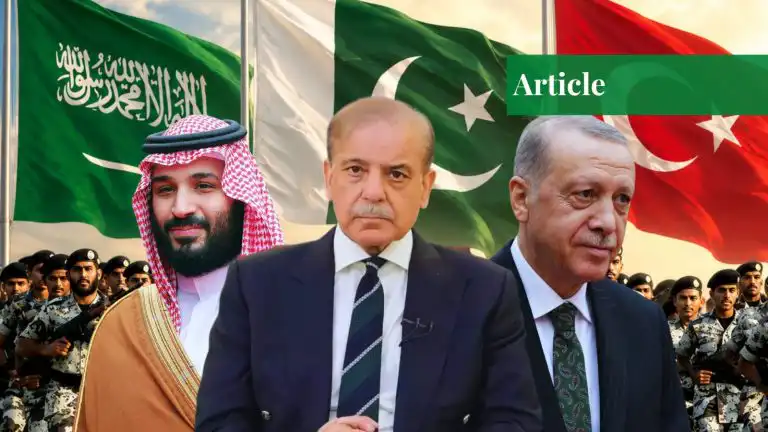
On 7 August 2026, three major Muslim states-Pakistan, Turkey, and Saudi Arabia have laid the groundwork for a NATO-style Muslim alliance by signing a defense agreement centered on collective security and collective defense. These three states have entered into a joint defense pact known as the “Mecca Joint Defense Agreement”, which was signed in Mecca, to reinforce security ties among the three nations, strengthen joint deterrence against external aggression, provide a security umbrella to one another, and expand collaboration in defense capabilities and security cooperation.
This is a trilateral defense pact among three powerful Muslim nations and a milestone and a historic achievement for the three states. Under the agreement, member states will protect one another from external threats and acts of aggression. Resultantly, it has laid the groundwork for the establishment of a NATO-style Muslim alliance because it stipulates the same stance of collective security and collective defense to counter aggression and address security threats faced by them.
The most significant clause, or the crux, of this historic pact lies in the provision that: “An armed attack against one state will be regarded as an attack against all three states”. This clause reflects Article 5 of the NATO Charter, which stipulates the same stance.
The prime purpose of signing this trilateral defense agreement is to deepen defense and military cooperation among the member states and to ensure collective deterrence if any external aggression occurs against any one of the three states.
The agreement is of great significance because all the Middle Eastern states are threatened by the Israeli expansionist agenda. As a result, the region lacks a security order. But this agreement could ensure peace and security and serve as a security provider across the region.
Keeping in view the current situation, the agreement could also encourage other regional and Muslim states to become a part of it by formally signing it. There is a likelihood of this because the entire region is in turmoil right now, and all regional states are threatened with being attacked at any time. So, they are seeking a potential security alliance to protect themselves. Thus, it can be said that it would expand in the near future. It could serve as a guarantor of the security of member states and a deterrent factor, and if further states join it over time, this could become a NATO-style Muslim alliance. However, it requires a commitment from member states to work together for their common goals.
The three states have very robust relations and share historic strategic ties, while they are also considered among the most influential Muslim nations of the world. This is also because these states maintain strong relations with the U.S and have close ties with Washington as well. Consequently, this agreement will significantly shape the regional politics and Balance of power.
This trilateral agreement is an extension of the Pakistan-Saudi Arabia mutual defense pact signed back in September 2025 amid Israeli strikes against Iran. Pakistan has gained so much international reputation since May 2025 due to its great victory against India in Operation Bunyan um Marsoos and its matchless role as a mediator in the current US-Iran conflict. As a result, Islamabad seems to be a regional stabilizing actor. As a result, this significant role of Pakistan as a peacemaker is persuading regional states to sign defense agreements with it.
This pact is also of great importance because it was concluded amid regional instability, where the entire Middle East is at war on multiple fronts. The three signatories of the pact are the most significant states in the region. Furthermore, the choice of the place for signing this agreement is so crucial. President Recep Tayyip Erdogan, Crown Prince Muhammad bin Salman, and Prime Minister Muhammad Shahbaz Sharif have gathered in Mecca, a holy site of Islam, to reach this historic agreement. Such a selection of a place matters a lot in international relations because it serves as a diplomatic gesture; in this case, it gives a sense of unity and cohesion.
Pakistan, being an established nuclear-armed state with the world’s best standing military force, can act constructively to ensure regional stability and security, and to promote cooperation in the region.
Saudi Arabia holds huge oil reserves and is the largest crude oil exporting country in the world. Additionally, Saudi Arabia is one of the important Muslim states, as holy sites of Islam such as Mecca Mukarrama and Medina are situated within its territory.
Likewise, Turkey also holds great strategic importance, as it is a member state of NATO, with advanced, sophisticated weapons and artillery, along with a large stockpile of drones.
Apart from that, the Mecca Joint Defense Agreement also demonstrates the lack of trust of the Middle Eastern states in the U.S. as a security guarantor after the U.S-Iran War of 2026. This is because, alongside this agreement, Kuwait has recently also signed a defense agreement with Pakistan amid regional turmoil and instability.
This all highlights the growing influence of Pakistan in the region as a net security provider and a stabilizing actor. Eventually, the trilateral defense agreement will definitely influence global politics and regional security architecture, and could contribute to the establishment of a NATO-style Muslim alliance.
If you want to submit your articles and/or research papers, please visit the Submissions page.
To stay updated with the latest jobs, CSS news, internships, scholarships, and current affairs articles, join our Community Forum!
The views and opinions expressed in this article/paper are the author’s own and do not necessarily reflect the editorial position of Paradigm Shift.

Muhammad Taha Hussain is a student of International Relations at the University of Sindh. He holds command of security studies and geopolitics. He can be reached at tahahussainseeker@gmail.com