
Explaining the Doomsday Clock
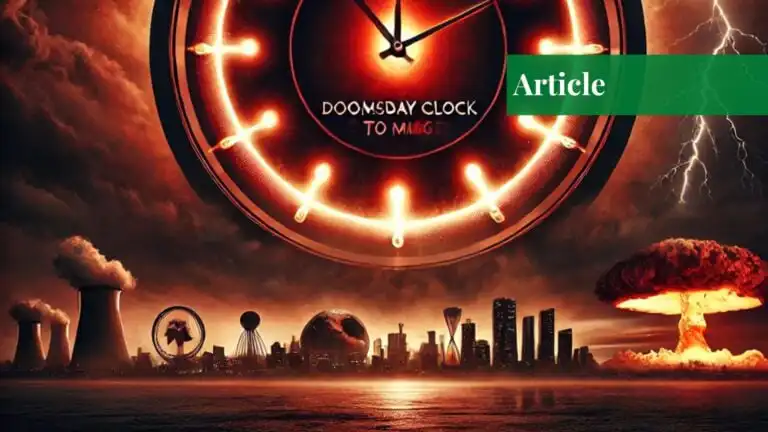
Ticking relentlessly toward midnight, the Doomsday Clock serves as a chilling reflection of humanity’s proximity to self-destruction, its hands moved by global choices, conflicts, and inaction. Designed by Martyl Langsdorf, it has been set at a record 100 seconds to midnight since 2020, highlighting the looming threats of nuclear proliferation and climate change. Mary Robinson, the former president of Ireland, emphasized the urgency of addressing these dangers.
The clock serves as a warning reminder created by the Bulletin of the Atomic Scientists that urges action before it is too late. A group of scientists involved in the Manhattan Project, many from the University of Chicago, established that clock. The clock was set in its early stages at seven minutes to midnight to signal that the time to control atomic weapons was running out.

The Doomsday Clock, conceived by the Bulletin of the Atomic Scientists (BAS), serves as a stark reminder of humanity’s proximity to self-destruction. This metaphorical clock has disturbed humanity since its creation in 1947, with the minute hand moving constantly closer to or even, at times, further away from midnight, which symbolizes the end of global catastrophe. The Doomsday Clock was envisioned to represent the immediate nuclear threat that the world faced after World War II but, over subsequent decades, has considerately taken heed of climate change and various other existential risks to human civilization.
Every year, a committee of experts assesses world events and adjusts the clock to reflect their best judgment about how close humanity may be to extinction. Though we hope never to reach midnight, the symbolic point of global catastrophe, it could occur through a nuclear war or another civilization-ending event. As Holz quoted:
“The purpose of the Doomsday Clock is to start a global conversation about the real existential threats that keep the world’s top scientists awake at night. National leaders must commence discussions about these global risks before it’s too late. Reflecting on these life-and-death issues and starting a dialogue are the first steps to turning back the clock and moving away from midnight.”
The historical evolution of the clock reflects shifting geopolitical tensions and global risks. The ups and downs of the threats of nuclear warfare (the Cuban missile crisis of 1962 and the highest chance of nuclear war) as a manifestation of war physics were written and devised by the scientific community quite soon after Hiroshima and Nagasaki became the testing grounds for this power. Seven minutes to midnight became the first actual time recorded, standing for an acknowledgment of man’s ability to actually fight back with such destructive force.
From 1947 to 1991, the Cold War clock’s hands swung from minute to minute, nearer to or farther from midnight due to international tension. During the détente periods (1974-1984) of relative cooperation, such as the signing of arms control treaties, enhancing mutual trust saw brief backswings of the clock’s hands.
In 1991, the clock was at a relatively high mark, as shown below, standing at 17 minutes to midnight. It was a rare situation when optimism prevailed, characterized by the end of the Cold War and the signing of the START treaty by the U.S. and USSR. However, the sense of optimism barely survived, for a multitude of complex and interlinked existential threats emerged with the dawn of a new century.

Closer than Ever: 89 Seconds to Midnight
In January 2025, the Bulletin of the Atomic Scientists delivered the most alarming update in the Doomsday Clock’s history. In the 2025 Doomsday Clock, the hands were advanced to 89 seconds to midnight, the closest the clock has ever been to the symbolic point of no return. This drastic adjustment reflects a convergence of scary global trends that pose an unprecedented threat to the continued flourishing of human civilization.
The various interconnected challenges were sobering enough to motivate the BAS decision. The interconnected problems have shifted the Doomsday Clock nearer to midnight. Extreme weather and temperature increases due to climate change pose dangerous existential threats that require urgent mitigation of emissions (as Europe is very active in this regard through the European Green Deal initiative).
Several geopolitical tensions further enhance nuclear dangers, with mighty nations increasing their arsenal (12,119 overall in 2024) to an all-time high because every state finds itself in a security dilemma, thereby rendering global stability even more unstable and fragile. Moreover, uncontrolled regulation of AI (artificial intelligence) and biotechnology’s rapid proliferation elevates the risks of their terrible misuse. All these threats pose a highly volatile situation that would require immediate collective action to avert any threatening consequences for civilization.

The ongoing war in Ukraine has reignited global fears of nuclear escalation, with Russia issuing aggressive and ambiguous threats regarding nuclear use. Simultaneously, unresolved tensions in the Middle East add to the instability. Countries like Iran, Saudi Arabia, Brazil, and South Africa are developing nuclear facilities under the premise of civilian energy production. However, history reveals a troubling pattern: many nuclear weapons programs originated as civil energy projects before being repurposed for deterrence or, in some cases, offensive capabilities. This has complicated matters, referring to the lack of real progress toward nuclear disarmament, making a highly volatile global environment that is dangerously close to triggering catastrophic human consequences.
Daniel Holz, chair of the Bulletin’s Science and Security Board, argued that “the countries that possess nuclear weapons are increasing the size and role of their arsenals, investing hundreds of billions of dollars in weapons that can destroy civilization many times over.” The US, China, and Russia, the BAS said, “have the collective power to destroy civilization,” adding that the three nations “have the prime responsibility to pull the world back from the brink.”
Dramatic manifestations of a rapidly changing climate are unmatched: record temperatures, and increasingly frequent and violent extreme weather events, indicating 2023 is the warmest year of 174 observational records. The need to recognize such an existential threat has hardly been pronounced. The BAS states that the greenhouse gas emissions currently being produced are undeniably far above those that could avert catastrophic consequences. “The continued warming of the world… underscores one clear fact: that nothing is fundamentally amiss with scientific understanding of climate physics,” maintained the Bulletin. The lack of action on climate change manifested itself through the unprecedented impacts of heat waves, floods, wildfires, and droughts.
Like a double-edged sword, technological advancement presents both risks and opportunities, especially in AI and biotechnology. In the absence of ethical norms and regulatory guidelines, this technology can be misused to cause catastrophic damage to the human race. The speed of advancement in these technologies is the corrosive influence of misinformation and disinformation.
The Trojan horse (hidden threat) of forceful misinformation and disinformation via social media and several other online platforms has emerged as a serious threat multiplier—a great influence in eroding public trust in scientific consensus and abilities to mitigate global challenges.
“Past experience has taught us, even during the most dismal periods of the Cold War, we can as a people come together to address our challenges.”
Rosner, former chair of the Bulletin’s science and security board
The erosion of trust in established institutions and the rise of conspiracy theories actively hinder cooperation. Holz argued that “all of these dangers are greatly enhanced by a potent threat multiplier, the spread of misinformation, disinformation, and conspiracy theories that degrade the communication ecosystem and increasingly blur the line between truth and falsehood.” It serves as a diagnostic tool, measuring the world’s proximity to existential threats; an analysis of a world involved in risk interconnectivity (mentioned above).
Symbolic Call for Action Against Existential Threats
The image of the clock seems to enhance communication; it urges us to enhance collective decisions, such as sustainable developmental goals, and makes us ponder what may come as a result of choice or inaction. Some have questioned what the symbolism of the clock represents, but its true value lies in its ability to sustain important dialogue and mobilize action on critical global issues. According to the BAS, the clock constitutes a call to action since it names only those threats made by human decisions capable of being effectively mitigated through joint action.
It is a 90-second warning not to preordain doom but to launch an appeal for immediate action. “If we act right now, we may still avoid some of the worst, civilization-threatening outcomes. Go for change! It’s not too late,” Holz said, emphasizing the importance of positive action if humanity chooses to do so. The Doomsday Clock thus stands as a vital witness to the fragile state of now. International cooperation and personal responsibility towards tackling the monumental, not impossible challenges facing the future of our planet and civilization are crucial. The Doomsday Clock isn’t just a symbol; it’s a call for global cooperation and immediate action to secure humanity’s future.
If you want to submit your articles, research papers, and book reviews, please check the Submissions page.
The views and opinions expressed in this article/paper are the author’s own and do not necessarily reflect the editorial position of Paradigm Shift.

He is a student of international relations at NUML Islamabad and a research intern at the Islamabad Policy Research Institute (IPRI), Islamabad. His areas of interest are Asian geopolitics, the South China Sea, territorial disputes, the rise of China, and U.S. foreign policy in Asia.
LinkedIn: //www.linkedin.com/in/muhammad-salman-1a77b8319?utm_source=share&utm_campaign=share_via&utm_content=profile&utm_medium=android_app