
The political temperature of the country has risen quite exponentially as winter (and smog) descends upon the cities and villages of Pakistan. The political instability borne out of the foreign-encouraged and native elite-sponsored coup of April 2022 refuses to go away, as for the first time in Pakistan’s history, a popular leader stood his ground and nonchalantly confronted the “state” from a prison cell smaller than the toilet of a lower-level civil servant’s office. Unfortunately, what is called the “state” in most of the so-called Islamic world is no more than a thin veneer provided to the slaves of Western Colonialism so that the latter can maintain both its iron grip and plausible deniability while looting and tyrannizing us.
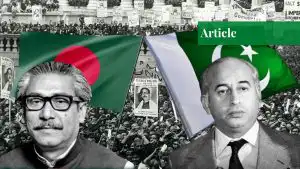
In this heated atmosphere, many followers of Imran Khan (and he himself allegedly) have begun painting Sheikh Mujib as something of a tragic hero who was betrayed by a power-hungry establishment. This picture is dangerously oversimplified. For example, Badruddin Umar, a Bangladeshi intellectual (and no friend of the Pakistani establishment), has mentioned in his book, “The Emergence of Bangladesh,” that Sheikh Mujib had been begging India for help in breaking Pakistan up since 1963! High treason by any definition.
Every Pakistani, especially Imran Khan (with plenty of time in jail, though the unavailability of books due to the execrability of the jailers remains an issue), should read the history of 1971 in detail. Just because Yahya and Musharraf were bigger villains doesn’t mean that men like Mujib and Akbar Bugti were heroes. The history of Pakistan has few heroes. And those few who dare are betrayed by a nation whose defining characteristics are cowardice and hypocrisy. However, even though Mujib was a traitor to Pakistan, the bigger villains were those who left no option for the Bengalis of East Pakistan other than Mujib.
From Fazlul Huq to Suhrawardy to Nazimuddin and Nurul Amin, every significant Bengali leader was treated as a threat and wrongly branded as a traitor. Who branded them as traitors? Who repressed them and the people they represented? It was those who call themselves the state but, in reality, serve as mercenaries of Western neocolonialism. Unfortunately, 1947 didn’t change the colonial institutions. The members of those institutions continued to follow “orders,” whether it was fighting battles in 1917 to enable the British to promulgate more than a century of genocide in Palestine or firing at their own people after denying them their right to participate in governing their own country after a national election in March 1971.
Mujib wasn’t a hero. He was a product of a warped reality created by servants of neocolonialism in Pakistan that made it clear to the Bengalis that only an amoral leader in the service of a powerful foreign nation could lead them in a fight against amoral servants of neocolonialism. Akbar Bugti was a similar case. Both Mujib and Bugti had tried to participate in the neocolonial mechanisms to gain power but had failed. Why did they fail? The answer is obvious to those who know the ethnic and social makeup of the colonialist/neocolonialist institutions of Pakistan.
Bugti’s ethnicity was ‘’wrong” whereas Mujib was “wrong” vis-à-vis both ethnicity and social status (Mujib’s failings in two key “merits” in Pakistan’s neocolonial hierarchy meant that his attempt to gain power under the “system” was much less successful than Bugti’s). Nevertheless, after failing to satiate their ambitions, both of them then tried the way of treason and collaboration with foreign agents. It worked.
On the other hand, the servants of neocolonialism had “successfully” curbed every leader who had tried to play on the turf of patriotism and declined to become a pawn of foreign powers. The careful observer can recognize Mujib/Bugti and Musharraf/Yahya as sides of the same coin. Serving foreign masters, creating tyrannies while denying any space for Pakistan’s original ideology (as defined by Iqbal) and the patriotism inspired by it. It’s easy to appreciate that both these “sides” consider Pakistan’s ideology and any patriotic leaders inspired by it as a much bigger threat than anything else (even each other).
For Mujib, Professor Ghulam Azam and the Jamaat-e-Islami were an even bigger foe than the Establishment. For the Establishment, Suhrawardy (with his all-Pakistan appeal) and Maulana Maududi (with his Islamic following and ideology) were bigger threats than separatism. A Pakistan broken through civil war was acceptable to both the Establishment and Mujib (and the West Pakistani civilian elite represented by Bhutto). But a sovereign Pakistan in which ideology and the law derived from that ideology (instead of their own whims) reigned supreme was an anathema and absolutely unacceptable to both sides.
Alhazar! Aaeen-e-Peghambar se sou bar Alhazar
Hafiz-e-namoos-e-zan, Mard azma, Mard-e-Afreen!
Mout ka pegham har Nou-e-Ghulami ke liye,
Nay koi Faghfoor-o-Khaqan, Nay Faqeer-e-Rah Nasheen!
(Beware, a hundred times beware, of the Law of the Prophet SAW! The Protector of women’s honour, the tester of men’s abilities, the rearer of worthy men! The death to all kinds of slavery, no sovereigns and no kings, no mendicants begging!)
This mechanism is what brings “khooni liberals” like Nadeem Farooq Paracha and the scions of the present establishment on the “same page”. We have been fighting and losing the same battle against these forces for so long because we are cowards and hypocrites and don’t care as long as our personal affairs don’t suffer. If we are ever to win, we have to understand that the mechanism has to be broken, not any single person or even any single institution. If Imran Khan and his followers (who form the vast majority of the people of Pakistan) understand this, there might be some hope of reviving Iqbal’s dream and Jinnah’s Pakistan (stillborn in 1947 and kept strangled through neocolonial slave elite capture). Otherwise Götterdämmerung!
If you want to submit your articles and/or research papers, please visit the Submissions page.
To stay updated with the latest jobs, CSS news, internships, scholarships, and current affairs articles, join our Community Forum!
The views and opinions expressed in this article/paper are the author’s own and do not necessarily reflect the editorial position of Paradigm Shift.

Dr Hassaan Bokhari is a graduate of Rawalpindi Medical College, Rawalpindi. In 2018-19, he cleared the CSS exam and was 34th in Pakistan. However, he declined to join the civil service in order to pursue his passion for the study and analysis of history more freely. Presently, he is running a YouTube channel "Tareekh aur Tajziya (History and Analysis)" which focuses on the objective analysis of history and current affairs. Dr. Hassaan Bokhari has authored a book titled "Forks in the Road" about the 1971 fratricide and has also headed the India Desk at South Asia Times Islamabad. He aims to play a part in the process of enabling the nation to understand its history in a perspective marked by objectivity, honesty, and confidence.