

From its inception, the American presidency has bound immense destructive capacity to the temperament of a single individual. It is an office that concentrates not only authority but impulse, placing the machinery of war in the hands of an individual. The result is a system as mesmerizing as it is perilous.
Alice Roosevelt once distilled this dynamic with biting precision, remarking that her father (Theodore Roosevelt) wished “to be the corpse at every funeral, the bride at every wedding, and the baby at every christening.” Beneath the wit lay an indictment of ego untethered from restraint.
Today, that strain of vanity appears meekly quaint. It has been eclipsed by Donald Trump, where ego is not a trait but an overarching principle. It has converted statecraft into a spectacle. Personal whims are treated as reality, and any contradiction as a threat. What emerges is more than political volatility; it is a destabilization that seeps outward, unsettling the fragile architecture of international order.
This pathology is not confined to one geography. In South Asia, Narendra Modi’s initiation of the failed Operation Sindhoor reflected a lethally untethered instinct. It manufactures crises on absolute concoctions just to consolidate its political position. In a nuclearized region, such theatrics are extremely reckless. It places millions of lives within the blast radius of a narcissist’s urge to appear unassailable.
Traversing to farther shores, clinical insight offers a useful lens. Mary Trump is a psychologist and Donald Trump’s niece. She describes a “monstrous ego” that has reduced the presidency into an arena of impulse and dominance. She argues that Trump’s core team is not a cabinet of peers but a collection of enablers. She calls them “weaker, more craven and just as desperate.”
Within such a structure, advisers cease to function as restraints. They become amplifiers and loyalists selected less for judgment than for their willingness to reflect and reinforce. The foregone conclusion sees policy becoming inseparable from personal validation.
The fallout sees governance morphing into spectacle. Its logic is laid bare in self-inscribed tokens of power like Trump’s commemorative gold coins, his signatures emblazoned on future currency notes. Contagious, it results in loyalists curating the same iconography. Kash Patel’s personalized sneakers emblazoned with FBI and his initials, to Pete Hegseth’s conspicuous tattoos, reduce governance to an orbit of narcissism.
The most dangerous aspect of this dogma is what psychologists identify as narcissistic injury. This is the moment when reality refuses to conform to the illusion. Within an individual, the fallout is contained. In a president, it is externalized with ruinous consequences. Slights are magnified, setbacks personalized, and responses try to undo the inevitable. Decision-making, under these conditions, is less a calculation of consequence than a destructive reflex of conserving self-image.
In such conditions, truth inevitably becomes malleable. It is distorted, diluted, or outrightly discarded. The pattern is not new. The claims of WMDs that initiated the 2003 Iraq invasion were totally fabricated. The tragedy that saw over a million perish was irreversible. This demonstrates the disastrous consequences when deception is institutionalized to validate the self at all costs.
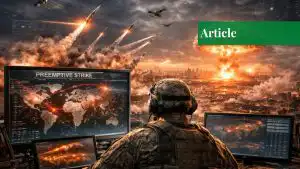
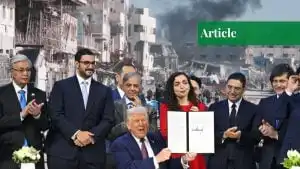
This paradigm is starkly visible again in the narratives enabling the Gaza genocide and the strikes on Iran. Curated intelligence reports and the ever-shifting justifications make a mockery of facts. The result is not merely deception but disorientation. When reality is subordinated to delusions, policy loses hold of consequences.
In “The Second Coming”, Yeats foresaw the darkest incarnation of ruin: “What rough beast, its hour come round at last, slouches towards Bethlehem to be born?” In his vision, the disintegration of order did not herald a new one but the emergence of something unrestrained and primal. Yet, the destruction wrought by narcissism is far more insidious. It does not merely emerge from chaos; it engineers it. Conflict becomes an assertion of self; disorder, an instrument. Through it, a single one asserts itself as an unyielding and unquestioned destiny.
History offers fewer poetic parallels. Caligula governed through spectacle and fear, collapsing authority into performance. His invocation of oderint dum metuant – let them hate, so long as they fear me- captures this mindset. It is a logic that reduces human life to an inconsequential entity.
In the modern era, such a mindset carries unprecedented stakes. The fusion of personal volatility with nuclear capability renders miscalculation existential. John Kennedy warned of a Pax Americana reduced to annihilation or subjugation. He described it as “the peace of the grave or the security of the slave.” This is the unhinged binary we see now. In such a mindset, de-escalation is not prudence; it is humiliation.
Nowhere is this more dangerous than in the Middle East. Here, escalation compounds rather than being contained. The strikes on Iran and the retaliation they have provoked starkly illustrate how quickly provocation and response can spiral beyond initial intent. What began as an assertion of might has morphed into entanglement. In such an environment, the inability to absorb defiance is not only a psychological flaw but a strategic liability.
While the world remains riveted on Iran, Gaza becomes a quieter tragedy. Its suffering is ongoing, yet increasingly sidelined. In one case, resistance commands attention; in the other, endurance slips from view. Together, they reveal the defining pathology of our age: narcissism as tyranny, where power is not exercised for the people but over them. This is to satiate an impulse that cannot bear what it sees as the ignominy of being diminished. In this vortex, catastrophe is not a failure of leadership; it is the ultimate expression of Trump’s Imperium of Ego.
If you want to submit your articles and/or research papers, please visit the Submissions page.
To stay updated with the latest jobs, CSS news, internships, scholarships, and current affairs articles, join our Community Forum!
The views and opinions expressed in this article/paper are the author’s own and do not necessarily reflect the editorial position of Paradigm Shift.

Mir Adnan Aziz is a columnist whose writing explores the forces that shape power, belief, and society.