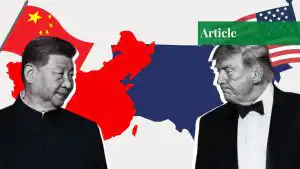
When President Donald Trump returned to office in his second term, many Indians celebrated. Today, the Indian Prime Minister Narendra Modi and Trump’s brotherhood has taken a backseat, leading to a significant downturn in the bilateral ties between the United States and India. This shift has raised crucial questions about how the relationship deteriorated and what the future holds for these two global powers. Initially, the bond between Modi and Trump was strong, with both leaders publicly endorsing each other’s campaigns and even participating in joint rallies. Their shared conservative ideologies and grand promises of victories for their respective nations seemed to align perfectly. And while Trump’s first term in office proved better for the US-India relations, the same cannot be said about the second term.
The United States is one of India’s top five trading partners, with a combined trade volume exceeding $71.39 billion in 2023. This robust economic relationship is particularly significant in the pharmaceutical sector, where the United States accounts for nearly one-third of Indian pharmaceutical exports. Additionally, Electronics, jewellery, textiles, and gems are among the top exports from India to the United States, of which electronics led the way with a staggering $15.46 billion in trade, followed by gems and jewellery, which contributed substantially by bringing in approximately $12 billion, while textiles and apparels brought their figure to $10.3 billion in the fiscal year 2024-25. Each of these figures represents the importance of this trade relation to its respective economies.
The Tariff Strategy of US President Donald Trump
The return of the Trump administration to the White House earlier this year was marked by a clear and ambitious vision to implement and achieve the nationalist ideology and slogan: “Make America Great Again.” One of the President’s strategies to achieve this feat includes the imposition of tariffs upon trading partners. Tariffs are essentially taxes or duties imposed on imported goods and services, adding cost for importers. The percentage of these tariffs can vary, and their impact can be significant, affecting everything from consumer prices to business operations, and as a result, this strategy has major repercussions on international trade markets and ripple effects on global economies.
While governments can impose tariffs for multiple purposes, including increasing government revenue, supporting local businesses, or correcting trade imbalances, in this occurrence, they were used mainly as a means of gaining political influence or to sway the actions of foreign governments to their advantage. The Trump administration’s approach to using tariffs as a political weapon has had mixed outcomes, offering both advantages and disadvantages. This approach has led to such a political environment where gaining or losing political points in Trump’s book can directly influence whether the tariffs imposed on a state are increased or decreased. This ordeal has caused uncertainty in the US-India relations, where trade is critical to their relationship.
India’s Vision & Stalled Negotiations
India had a set vision for its future with the United States, especially with Trump’s second term in motion. This optimism was the result of trade and partnership deals that began when Modi became the fourth head of state to visit the White House since the transfer of power.
The visit was seen as a step in strengthening ties. Since then, six months have passed, and there have been multiple visits by state officials between the two countries, each aiming to advance the stalled trade negotiations.
Despite these efforts, officials from both nations have struggled to finalise a trade deal, with discussions focusing on various clauses. While significant progress was made on certain issues, key sticking points remained unresolved, particularly in the agriculture and dairy sectors. The United States sought more concessions than India was willing to offer, leading to an impasse in the negotiations. Mark Linscott, a former US Trade Representative, revealed that a crucial missing element in the unsuccessful negotiations was a direct communication channel between President Trump and Prime Minister Modi.
From India’s perspective, the 25% tariff to be imposed from August 1st was a complete surprise, as they had expected a significantly lower figure. The unexpected nature of the tariff increase caught Indian officials off guard and raised concerns about the future of bilateral trade relations. Trump further expressed his disappointment with India for Russian oil imports amid the ongoing conflict in Ukraine, accusing India of not aligning with Western sanctions against Russia. India quickly pointed out the hypocrisy in this stance, noting that both the European Union and the United States have also engaged in trade with Russia. This accusation undermines the moral authority of the US position and complicates diplomatic efforts. New Delhi referred to the targeting of India as “unjustified and unreasonable,” highlighting the double standards at play. The tariffs are not simply a trade dispute but a clear signal that the US is using its economic power to pressure India on its foreign policy choices, particularly its relationship with Russia.
The Penalty Tariff: A 50% Blow to India-US Trade
Then came the penalty tariff, which was announced on August 6, with the additional 25% tariff, bringing the total to 50%, among the highest of any US trading partner, and is set to take effect after a 21-day period, starting on August 27, 2025. This 21-day gap between the announcement and implementation of the additional tariff, from August 6th to August 27th, 2025, is seen as an opportunity for extensive diplomatic discussions between New Delhi and Washington. Moreover, the penalty came with some exemptions. The US tech giant Apple has claimed that by the end of next year, all USA-bound iPhones will be assembled in India, and conveniently so, the electronics sector was exempted. Other sectors, such as pharmaceuticals and energy, are categories of Indian goods that were exempted from both the initial and the additional tariffs, with a 0% tariff rate. This reveals that Trump is trying to manoeuvre India’s foreign policy without putting too much strain on certain favourable sectors.
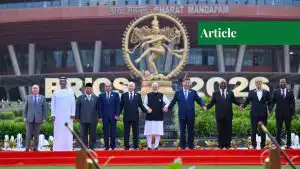
President Trump has repeatedly stated that his tariffs are aimed at reducing US trade deficits, and India has a $41.18 billion merchandise trade surplus for the fiscal year 2024-25, which can add to the perception of Trump’s hypocrisy. The US has long sought to address its trade imbalance with India, and the imposition of high tariffs can be seen as a means to achieve this goal. However, such measures risk damaging the broader partnership between the two nations, which has been carefully cultivated over the past two decades. President Trump announced that “anti-American” policies of the BRICS organisation will not be tolerated, indicating that this penalty was partly due to India’s involvement in it.
The Implication and Future of US-India Ties
Just like his American counterpart, the Indian PM had an initiative set for his country called “Made in India”, which has faced a substantial disappointment due to the surprise 25% penalty. The extra cost for US importers will make Indian goods less attractive to them and lead them to find their deals elsewhere. The majority of India’s exports are produced in other countries, such as textiles in Pakistan. This can lower the share of Indian exports in the world’s largest markets, ultimately hindering the goal of turning India into a global production house and increasing exports. Moreover, international companies like Apple, which were looking to shift their entire production line to India to serve the American markets, now face uncertainty. Without exemptions, this uncertainty can force businesses to reevaluate their stay in India while also having ripple effects on the Indian economy, such as a reduction in foreign direct investment (FDI), employment opportunities, and impacting millions of lives within India. This blow to the manufacturing and export sector will require the government’s support to redirect Indian goods to markets other than the US.
A turn both states can take is a shift in trade deals. Both countries can establish deals with other economic partners to fulfil the roles that each of them was playing in each other’s economies. For instance, the US could redirect its focus and investments towards other markets, such as Vietnam or Indonesia, while India might deepen its economic ties with China and the UK. This international power struggle puts India on a delicate crossroads, upon which the next step can either be giving in to Trump’s demands or maintaining its autonomy. India’s decision can let the US dictate its foreign policy while abandoning its trade with Russia, or it can face the severe economic consequences of the tariffs and an uptight relationship with the US.
The strain that Trump’s policies and speech are placing on US-India bilateral ties cannot be ignored and will undoubtedly have lasting effects. Trump’s constant criticism of India and his invitation to Pakistan’s COAS to the White House have worsened tensions over the once-promising partnership. These actions not only put stress on an established relationship but also send a clear message to other potential trading partners about the unpredictability of US foreign policy under Trump’s leadership.
If you want to submit your articles and/or research papers, please visit the Submissions page.
To stay updated with the latest jobs, CSS news, internships, scholarships, and current affairs articles, join our Community Forum!
The views and opinions expressed in this article/paper are the author’s own and do not necessarily reflect the editorial position of Paradigm Shift.

Manhal Zaka Khan is a writer currently interning at Paradigm Shift. She is pursuing a bachelor's degree in social sciences at SZABIST Karachi, majoring in international relations. Her writing interests encompass all areas of the social sciences, as she explores and examines the world through a critical and analytical perspective.