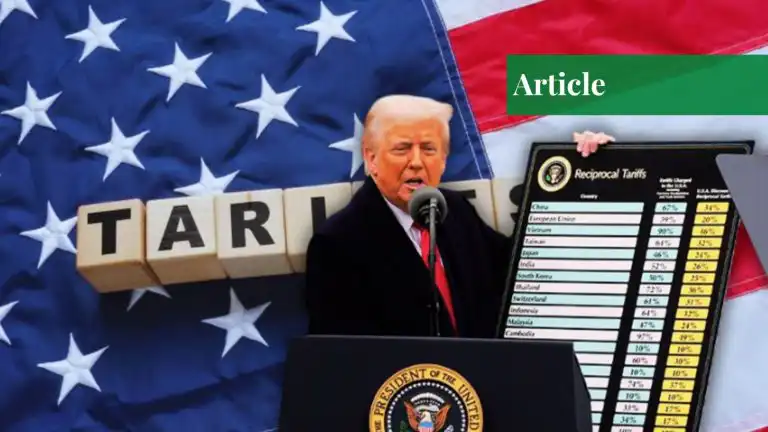
The topic of tariffs was once largely seen as dull and technical. They were the kind of policy detail discussed by finance ministries, included in trade negotiations, and buried in customs forms or economics textbooks, not something that made headline news. That has changed dramatically. Over the past two years, tariffs have emerged as one of the most visible tools of foreign policy, used not only to restrict imports but also to pressure entire countries, often for reasons that extend well beyond trade itself.
India faced a 50 percent tariff in August 2025, not because of unfair trade practices, but because it continued buying discounted Russian oil. Mexico and Canada, meanwhile, were threatened with tariffs over concerns related to fentanyl trafficking and border security rather than traditional trade disputes such as steel dumping. China has spent much of the past two years in a tariff confrontation with Washington that has affected everything from soybeans and rare earth magnets to semiconductor equipment. At its core, this is about far more than economics; it is about leverage.
This is the story of how the tariff, a tool that used to live quietly in trade policy, became a frontline weapon in a much larger contest over global power.
From Protecting Industries to Punishing Behavior
A tariff is, in simple terms, a tax placed on imported goods. Governments have used tariffs for centuries for two main purposes: to generate revenue and to shield domestic industries from cheaper foreign competition. Steel tariffs are meant to protect steel producers and workers. Agricultural tariffs are designed to support farmers. That is the traditional textbook explanation, and to some extent, it still holds today.
What has changed is the second use, which has grown until it sometimes swallows the first. Tariffs are now being used explicitly to change a foreign government’s behavior on matters that have nothing to do with trade imbalances: oil purchases, immigration enforcement, drug trafficking, military alliances, and rare earth exports. They are functioning less like a finance ministry tool and more like a sanction.
It is easy to understand once you see it from the perspective of a president or a prime minister. A tariff can be imposed by executive order, often overnight, without needing congressional approval or a coalition of allies. It does not require troops, and unlike a financial sanction, it does not require freezing anyone’s assets or excluding a bank from a payments system. It just raises a number on a customs form. And because the cost shows up gradually, in slightly higher prices on store shelves, it is far easier to sell domestically than a war or even a full sanctions regime would be.
That is the trade-off baked into the tool from the start. Cheap to deploy, politically satisfying to announce, and as the past two years have shown, pretty clearly often disconnected from whether it actually works.
The US-China Tariff War: A Case Study in Escalation and Exhaustion
The perfect example of how trade can be turned into a political weapon is the US-China relationship since early 2025. By now, the pattern is familiar: one side raises tariffs, the other retaliates, both sides pause briefly, and then the cycle begins again.
The escalation started quickly. On February 1, 2025, President Trump signed an order imposing a 10 percent tariff on Chinese imports, citing concerns over fentanyl trafficking. China responded within days with tariffs on American coal, liquefied natural gas, and agricultural equipment. By March, the US tariff had doubled to 20 percent, while China imposed additional duties on products such as chicken, pork, soybeans, and beef, alongside new restrictions affecting business with American companies.
The conflict intensified even further in April. By early April 2025, US tariffs on Chinese goods had climbed to 145 percent, while China responded with tariffs of 125 percent on American exports. These are not the kinds of figures normally associated with trade policy. They are levels designed to severely restrict, if not effectively halt, trade between the world’s two largest economies.
What followed was a long series of truces, each one buying a few more months of calm before the next deadline loomed. The two sides agreed in May 2025 to bring tariffs down to a more survivable 30 percent on Chinese goods and 10 percent on American exports, and have spent the time since extending that arrangement again and again, on August 12 and then on November 10, rather than letting the whole structure collapse back toward triple digits. The most recent high-profile moment came at a May 2026 summit in Beijing, where Trump and Xi discussed everything from agricultural purchases to rare earths to Taiwan against the backdrop of the war in Iran. The summit produced headlines but, as with most of these meetings, fairly little in the way of binding commitments.
Here is the part that should give pause to anyone who thinks the tariffs are working as intended. Despite two years of escalating duties aimed explicitly at shrinking the US trade deficit with China and pressuring Beijing on everything from intellectual property to Taiwan, China posted a record $1.189 trillion trade surplus in 2025, with exports still growing even as the US share of them shrank. Chinese exporters simply rerouted toward the EU and Southeast Asia. The tariffs changed where China sells, not really whether it can sell.
Meanwhile, in February 2026, the US Supreme Court ruled the legal basis for many of these tariffs unlawful, forcing the administration to scramble toward narrower legal authorities — Section 122, Section 301, Section 232 investigations — to keep a version of the policy alive. The Tax Foundation, tracking the whole mess, describes the result as the largest US tax increase as a share of GDP since 1993.
Beyond China: Tariffs as Leverage for Almost Anything
The China relationship gets the headlines, but it is the use of tariffs against countries with no real trade grievance against the US that best shows how far the tool has drifted from its original purpose.
India is the clearest example. In August 2025, Washington imposed a 25 percent tariff on Indian goods, then doubled it to 50 percent within weeks, not because of anything India was doing in its trade relationship with the US, but specifically because India kept buying discounted Russian oil. This made India’s tariff rate, for a period, the highest of any US trading partner anywhere in the world. A New Delhi-based trade research group estimated the move would hit $48 billion worth of exports, threatening jobs in textiles, gems, jewelry, and leather goods sectors that had nothing to do with the Ukraine war that supposedly justified the punishment. A retired Indian security official called it what it was, describing the US as having chosen to “weaponize trade tariffs in a unilateral and abrasive manner.”
The standoff eventually eased. By February 2026, after India agreed to scale back its Russian oil purchases, Trump cut the tariff rate from 50 percent to 18 percent. Whether that was a tariff success story or simply a costly six-month detour that India would have preferred to avoid entirely depends a great deal on who you ask. Either way, the tariff did the job a sanction would normally do: it pressured a third country over its relationship with a sanctioned state, without the US ever having to call it a sanction.
Canada and Mexico went through a similar experience earlier, in February 2025, when Trump used emergency economic powers to impose 25 percent tariffs on both countries, explicitly framed around fentanyl trafficking and border security, well outside the renegotiated terms of their own trade agreement with Washington. The message in all these cases is consistent: tariffs are no longer reserved for trade disputes. They are now a general-purpose pressure tool, used whenever a government wants leverage over another country’s foreign policy, energy choices, or border enforcement, and does not want to go through the slower, more multilateral process that a formal sanctions regime usually requires.
Who Actually Pays for All This
What often gets overlooked in the geopolitical debate is a basic fact: tariffs are taxes, and someone has to pay them. In most cases, a large share of that cost falls on American businesses and consumers. The New York Federal Reserve found in February 2026 that US consumers and companies were absorbing nearly 90 percent of tariff costs, not foreign exporters, as the political rhetoric around tariffs often implies. The Tax Foundation calculated that 2025’s tariffs amounted to roughly a $1,000 tax increase for the average American household, easing slightly to around $700 in 2026 as some measures expired or were struck down. A separate March 2026 analysis from Yale’s Budget Lab put the 2026 household cost closer to $570, with economists noting that lower-income households tend to feel the pinch more, since they spend a larger share of their income on the kinds of goods, furniture, electronics, and car parts that have been hit hardest.
The inflation effects are real, if a bit slower to show up than headline coverage sometimes suggests. The Dallas Fed found that core inflation in March 2026 would have been roughly 0.8 percentage points lower without tariffs, and St. Louis Fed researchers found companies were passing through about 35 percent of tariff costs to consumers in mid-2025, with Goldman Sachs projecting that figure could eventually climb to 55 percent as firms run out of room to absorb the costs through their own margins. Not every economist agrees on exactly how much of the broader inflation picture tariffs explain, and the Minneapolis Fed has pushed back on claims that tariffs are the dominant driver of the recent inflation overshoot. But almost nobody disputes the basic mechanism: someone pays more, and it is rarely the government imposing the tariff.
And it is worth being honest about how scattered the awareness of this actually is. A consumer survey from Simon-Kucher found that only about a third of Americans report a strong understanding of how tariffs actually affect the prices they pay. People notice prices going up. Few connect it to a specific tariff announcement made eighteen months earlier over an unrelated foreign policy dispute. That gap between cause and perceived cause is, in its own quiet way, part of what makes the tool politically convenient.
The Rest of the World Is Not Waiting Around
Perhaps the most interesting development of the past year is not anything Washington has done, but how everyone else has responded. Rather than simply absorbing the tariffs and hoping for a better deal, much of the world has spent 2025 and 2026 quietly building an alternative.
The clearest symbol of this shift is the EU-Mercosur trade agreement, which finally crossed the finish line in January 2026 after roughly twenty-five years of on-and-off negotiation. The deal creates one of the largest free-trade zones in the world, covering more than 700 million people and roughly 20 percent of global GDP, and it gives the EU somewhere to go besides Washington or Beijing. Brazil, one of the bloc’s members, posted record exports of $348.7 billion in 2025 despite a 6.6 percent drop in shipments specifically to the United States, about as clean an illustration as one will find of a country routing around a tariff wall instead of waiting for it to come down.
The EU has not stopped there. According to the Cato Institute’s tracking of global trade activity, Brussels has also concluded new agreements with Mexico, Indonesia, and Switzerland, and is pushing toward a deal with India. The UK-India trade agreement, signed in May 2025, cut Indian tariffs on most British goods and slashed auto tariffs from over 100 percent to 10 percent. The UK has also joined the CPTPP, the Pacific trade pact, giving it tariff-free access to members including Japan, Vietnam, and Chile.
A 2026 analysis from the Policy Center for the New South describes the result as a fragmentation of the old, single global trading system into what it calls three overlapping regimes, with most of the world, everyone except the US and China, increasingly trading more with each other and now accounting for as much as 75 percent of world trade among themselves. This represents a genuine shift from a decade ago, when American and Chinese markets sat much closer to the center of everyone else’s trade strategy.
None of this means the tariffs have failed to hurt their targets. China’s surplus with the US specifically did shrink, even as its overall surplus grew. India did feel real pain during its six months at a 50 percent tariff rate. But the broader trend is unmistakable: the tool is accelerating exactly the kind of trade diversification that reduces its own future effectiveness. Every country that signs a new trade deal with someone other than the US has one less reason to fear the next round of tariffs.
Conclusion
If the goal was to extract specific, narrow concessions, the record is mixed but not empty. India did scale back its Russian oil purchases. China did agree, at various points, to buy more US agricultural products and ease some rare earth restrictions, even if those commitments have a habit of being vaguer in practice than in the headlines announcing them. Tariffs, like sanctions, can sometimes move the needle on a specific, bounded task, especially against a country with a single major export market.
If the goal was to reshape the broader balance of economic power, to bring manufacturing home, shrink trade deficits, or force China into fundamental behavioral change, the results look considerably weaker. China’s trade surplus reached a record in the very year it was supposedly being squeezed hardest. The structural reliance on Chinese processing capacity for things like rare earths has not meaningfully changed. And the tariffs have visibly accelerated a global hedging strategy that leaves the US a little more on the outside of new trade architecture than it was three years ago.
What is harder to dispute is who bears the most immediate cost while these larger questions get sorted out. It is the American household paying a few hundred dollars more a year without fully understanding why. It is the Indian garment worker whose factory lost orders during a six-month tariff spike triggered by a dispute over oil purchases an ocean away. It is the small importer trying to plan a year when the rules can change with a single executive order and a press conference.
Tariffs have become geopolitical tools because they are fast, visible, and politically rewarding to deploy. Whether they are effective tools of geopolitics, as opposed to effective tools of domestic political theater, is a separate question. On the evidence of the past two years, the honest answer leans toward theater.
If you want to submit your articles and/or research papers, please visit the Submissions page.
To stay updated with the latest jobs, CSS news, internships, scholarships, and current affairs articles, join our Community Forum!
The views and opinions expressed in this article/paper are the author’s own and do not necessarily reflect the editorial position of Paradigm Shift.

Kainat Farooq is a passionate International Relations student with a strong interest in diplomacy, policy, and global affairs. She is dedicated to contributing thoughtful analysis and research on international issues.