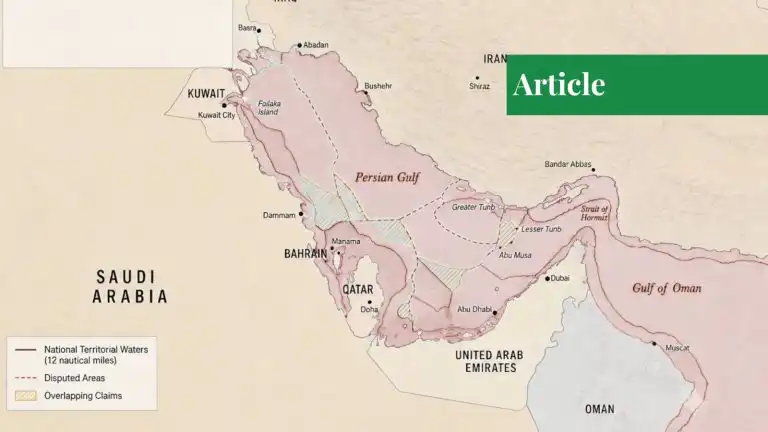
The Persian Gulf is not merely a body of water; it is where geography, energy, and geopolitics converge
The Iran – US/Israeli war continues and has continued – continues again. What began on the 28th of February later succumbed to the many false overtures towards peace, and the conflict that started then prevailed over all efforts to end it. A ceasefire was announced, backchannel meetings were ongoing and probably still are, a Memorandum of Understanding was signed by Iran and the US, with Pakistan endorsing it as a witness but not as a mediator. However, nothing seemed to hold, and animosity and physical conflict only escalated. Now it’s the 21st of July 2026, and matters have only gone from bad to worse. All sides wanted a negotiated settlement on their own terms, but were in search of a decision in their favour, from a position of strength. The US never got the upper hand, and Iran never dominated the conflict beyond staging unprecedented responses to US belligerence.
Today Iran stands firm and does not appear to be anywhere nearer to acquiescing to US demands even after 12 days of horrendous bombing in an unprecedented air campaign. Iran has instead responded through an array of ballistic missile attacks on the regional Gulf States, Syria and Jordan. Iran has shown remarkable composure as opposed to Donald Trump’s vacillations, meteoric outbursts, inconsistent behaviour and ambiguity. Some have even said that Trump is displaying controlled madness to influence negotiations. Observations related to the current air campaign mounted by the US indicate an attempt at the isolation of specific coastal towns such as Bandar Abbas and Chabahar, as well as infrastructural damage to water, energy, and bridges all over Iran. The former points towards the possibility of a ground invasion by the US, and the latter, trying to shake Iranian resolve. At this moment, a ground invasion of the Iranian coastline would be an unmitigated disaster for the US Military for several reasons, but essentially due to lack of sustainability by US troops in the face of a barrage of short-range missiles. If the US does manage to capture any ground along the Coast, it is obvious that Iran would resort to a scorched-earth strategy, leaving the US troops with nothing in hand and in a highly vulnerable position.
Why did Trump suggest an MOU in the first place? It appeared to be more of a surrender document where Iran walked away with all that they asked for and the US got nothing. Why Trump signed such a deal was probably to put into effect a ceasefire that the US needed at the time. However, if the US wanted to continue prosecuting war, why work a deal to bring about a ceasefire at all? The first probable reason is logistics, i.e., there are reliable sources stating that the US was running out of interceptors and missiles. Time was needed to top up, and it appears that the US now has a new operational lease on life for another three weeks, of which 12 days have already been consumed. The second probability was Trump playing to the world stock and oil prices, which have been driving his operational decisions all along. The third is that the US itself had dipped too much into its oil reserves and needed to bring them up to pre-war levels. Probably all three factors came into play, and Trump played out the MOU drama with premeditated deceit, never intending to uphold his commitments. A deliberate confusion was created over the routes to be adopted by commercial naval vessels in the Hormuz Straits. The US violated the MOU understanding, where instead of relinquishing control of the Straits to Iran and Oman, they decided to exercise their own control over all shipping. It was by design and was calculated to trigger the conflict into a shooting war through a considered method.
On the other hand, the MOU’s first article clearly stated the containment of operations in Lebanon, which Israel refused to act upon and the US failed to enforce. This became the second violation, which would obviously lead to further conflict. The MOU allowed Pakistan to come out of this negotiated
settlement as the biggest diplomatic winner, the Iranians with the biggest economic gains, the US with the biggest security gain, but Israel was left with the least benefits that it was aspiring for. As already explained before, this war in the Persian Gulf was more of an Israeli initiative in search of a Greater Israel. Those goals and objectives now seemed to be totally out of place, since Iran, which was supposed to be made dysfunctional, pliant, and truncated, instead, now appeared to be coming out of this war as a regional power and far more dominant than before. Israel could never allow the war to end without some visible gain, which is why it was obvious that neither did it agree with the ceasefire nor the MOU. The MOU became controversial from the very outset and, from a too-good-to-be-true agreement, eventually became a document of no consequence, leading to the present conflict, which has now escalated to another level.
Iran has shown remarkable resilience as well as restraint in the face of an unprecedented aerial bombardment, and despite tremendous infrastructural damage and loss to human life, they have remained composed, determined, and upright with an unprecedented display of moral dignity. Their ability to strike back has been a surprise for many military analysts, and they have yet to actually display their full potential. Iran has attacked the Gulf States, focusing mostly on the US bases, making them dysfunctional. Some infrastructural damage to desalination plants and energy installations has taken place, but not as much as Iran can actually do with the potential it has – this is where the restraint comes into play – leaving room for future reconciliation rather than going for annihilation. The Gulf States, in fearful anticipation of Iran’s capability, are now desperately looking for some sort of relief from Iran, which will not be easily forthcoming till they publicly announce the expulsion of the US. In the meantime, Iraq, Syria and Jordan too have been attacked by ballistic missiles, with Jordan getting the worst of it. So much so that the US had to relocate its strategic aerial-refuellers in Israel, prompting an Israeli Minister to complain that it would attract Iranian attention. Netanyahu had to intervene to allow the US planes space on the Israeli bases.
New developments are that the Houthis of Yemen have now occupied positions to interdict the Bab al Mandab, at the mouth of the Red Sea. Together with Hormuz being shut along with the Red Sea, it spells disaster for the global economy in the coming days if the conflict does not conclude soon – we could soon see a barrel of oil go well beyond the $100-dollar mark. In the meantime, Saudi Arabia’s attempt at using pipelines to transport oil towards the western coasts on the Red Sea, overland, has been disrupted by the Houthis. This escalates the crisis, now including the Houthis against the Saudis on behalf of Iran, making this a broader regional conflict – with a very dangerous outlook for the region. The environment is further aggravated by the US offering the Saudi’s a civilian nuclear capability; probably to pre-empt any overtures to China or Russia, but Saudi Arabia is now firmly in the US Camp. This would work towards dividing the region further and polarising it even more than what it was before. The other disturbing matter is that Turkey has offered its S-400 air-defence and Long-range missile system to the UAE. Russia and Iran have a written agreement where Article 3 clearly specifies that one country would not support the enemy of the other. Whether this deal is allowed by Russia is now a question, but in the unlikely event it does, trust amongst Russian allies would be shaken – China and North Korea would display their disappointment. So the region is still very volatile and fluid, where a definite prediction related to the future is very difficult.
The Iranian character and nature of war has so far been determined by:
- Preparing Hormuz. The capacity, method, and execution of blocking the Hormuz Straits was undertaken as a deliberate plan, decades ago. It involves underground tunnels, naval assets, coastal caves allowing access to the sea, monitoring and engaging targets at will. The concept was developed having clearly understood its
strategic implications and the global impact it would have if it was blocked. The matter was underplayed and never talked about, but when it was time to execute, it was played. Surprisingly, the US never appreciated the value of the Hormuz Straits, nor did they prepare to retain control. With the US the only Global Hegemon, controlling an asset that affected the global economy was a strategic necessity. They failed to do so, thereby forfeiting the perception that the US controlled international trade and was the leader in Global affairs. It has thus become crucial for the US to somehow free the Hormuz from Iranian Control and to be able to manage the Straits, restoring their global status. The Hormuz, never anticipated by the US, is now the centre of gravity for the war between the US and Iran and a legitimate objective.
- Mosaic Strategy. The Iranians used the better part of 40 years in establishing autonomous military districts – about 80 such independent entities. Each district was decentralised for execution and application. The process involved putting military infrastructure either underground or within mountain tunnels. Each district was self-sustained and prepared against redundancy for a war that could go beyond a year or so. They also catered for depth in decapitation of the leadership, and an independent hierarchy was put into place. Iran also had a detailed logistic plan, based on multiple access, integrating Russia and China, where a steady supply of hardware was reliably forthcoming.
- Proxy War. Iran’s capacity to expand the War horizontally through its proxies is phenomenal. Hezbollah in Lebanon and Hamas in Gaza have meaningfully engaged Israel. Smaller groups have been effective in Iraq and Syria, making US assets dysfunctional. Israel has been effectively contained, limited to its immediate region and borders, and has no longer been seen as involved in direct attacks on Iran. Iran, in the meantime, has begun to dismantle US warfighting capability around the Gulf and is gradually destroying RADAR and interception capacity between itself and Israel. In an escalatory manoeuvre, Iran has now triggered the Houthi capability of disrupting the routes across the Bab-el-Mandeb. Together with the Hormuz Straits, this will affect 30% of the global oil and create havoc to international trade, stocks and financial well-being. Iran has effectively kept the conflict spread over a large area, taking the heat off its own doorstep.
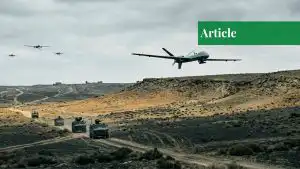
- Asymmetric War. There is no comparison to US military might; the 12 aircraft carriers that project power all over the world through CENTCOM and PACOM are unique and solely a US capability, unparalleled by any other state as yet. However, the application of this military capability was severely contained and degraded by the peculiarities of the Persian Gulf. US military commanders never catered for this nor planned for it, and as such the power-potential remained unrealised and latent – the US leadership was never in a position to apply their potential – mainly due to incompetence, arrogance and underestimating the enemy. The aircraft carriers were exposed in the open seas and subject to ballistic missile threats, while the expenditure of ammunition and other war material started to take effect. This is primarily because the US warfighting capacity revolves around swift, short engagements that conclude at the most within a month. The Persian Gulf conflict never unfolded as anticipated, thus challenging the US capacity to prosecute war over long durations. On the other hand, the Iranians had the benefit of the Chinese Bidou Satellite system that enveloped the conflict zone in its entirety. It provided early warning against incoming missile attacks; its digital warfare capacity was intrusive enough to spoof enemy assets, misdirect, and jam their ability to function freely.
The system also allowed Iran to launch medium and long-range ballistic missiles with extraordinary accuracy after absorbing, jamming, and making interception dysfunctional. In short, Iran enjoyed liberty of action and freedom of manoeuvre in the battle zone, in the air and the sea. The conflict proved that Iran had superior technology as far as missile warfare was concerned. Also, what must be understood is that because of this accuracy, Iran focused on military objectives and dismantled US warfighting capability – they did not attack personnel. The US instead carpet-bombed, attacking people rather than capability. Finally, the Iranians strengthened their allies by their actions, while the US weakened theirs – US allies found themselves woefully exposed and vulnerable without any operational support. Thus the battlefield influence of the US consistently diminished while that of Iran expanded.
What is clearly visible now is how Israel, after embroiling the US in the Persian Gulf, conveniently withdrew from the Gulf Region itself. Instead, Israel is now focusing on Lebanon, Syria, Gaza and the West Bank. Questions are being asked as to why Iran has ceased its aggressive ballistic offensive against Israel. The answer to such a query is based on an analytical conclusion that Iran is first sanitising the areas around it, leading to Israel, in a graduated method, secondly, trying to knock the US out of this war in the process, would isolate Israel. After having achieved both, it will have a relatively freer hand in dealing with Israel. The best of Iran’s arsenal is probably reserved for Israel, and it’s not a question of if, but when, the onslaught begins. In the meantime, Hezbollah, as they have done in the past, have taken a serious account of the Israeli ground forces, causing attrition like Israel has never experienced before.
The US is responsible for initiating two conflicts on the Globe, i.e., the War in Ukraine and the War in the Persian Gulf. Both wars were forced, one on Russia and the other on Iran, where both tried their best to resolve the matter without a physical conflict. Both wars were about oil, energy, and the trade routes. In Europe, it is about the Black Sea and the Baltics; in the Persian Gulf it’s about the Straits of Hormuz and the Red Sea. In both wars, the US, as well as its allies, have taken a thorough beating. Whereas in Europe, the leadership, mostly globalists, are trapped in their own rhetoric and cannot withdraw from this war because of political repercussions; similarly, it is the case with Trump.
Trump’s additional vulnerability lies in the body-bags syndrome, which is mounting, the Wall Street – Stock Exchange and growing economic expenditure leading to recession – these matters cause severe frustration to a man with an obvious narcissistic orientation, watching his political mileage gradually vanish. It is this frustration which may force Trump to look for a deal or escalate. The worry is that other than a ground invasion of Iran with little chances of success, there appears to be limited room for any visible military closure and time is running out. Oil reserves, war material inventories, battle casualties and mounting expenses do not allow Trump to continue experimenting in search of some sort of favourable resolution. He will probably find a way to offer a deal sooner rather than later, declaring some sort of victory. The alternative is horrible – Trump’s obsession with the almost-indestructible Pickaxe Mountain in Iran (Locally called Kuh-e-Kolang Gaz La; located south of the Natanz nuclear complex); Iran’s nuclear facilities, which may lead him to do the unthinkable – use a 5 to 10 KT nuclear warhead, in an attempt to force Iran to surrender. It is hoped that Russian and Chinese anticipatory ultimatums are in place and that they are effectively monitoring the situation. Netanyahu is presently flying to the US to attend Lindsey Graham’s funeral – a senator who was always more Israeli than he was an American; what will be said when Netanyahu meets Trump and what will be decided will ultimately now lead to the final round of this conflict.
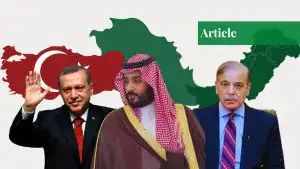
Pakistan is now suddenly in a difficult position with complicated choices but must work with the challenges within the region and to remain above board. Pakistan’s future standing within the region now totally rests on its reputation, its conduct in the face of adversarial divisions in the region, and its posture.
The Defence Pact with Saudi Arabia is now raising questions. It is as obvious now as it was then when it was signed that it was driven by Pakistan’s economic situation and Saudi reciprocal support towards this vulnerability was the central influence. However, this Agreement is also seen as an exploitation of Pakistan’s vulnerable economic position and must be viewed critically in that context. This situation, at least, carries the universal lesson as to how national sovereignty is interwoven and linked to economic autonomy and self-sustainability – which sadly, Pakistan has forfeited due to its own omissions and commissions. Recently, it was witnessed that Pakistan was trying to acquire an Exchange Stabilisation Facility (ESF), essentially a US-backed financial backstop for $ 10 billion, to strengthen Pakistan’s foreign exchange reserves, stabilize the rupee and reassure international markets. The US has not yet publicly agreed to the deal, but it is likely that it will. The circumstances under which the deal is being secured are neither public nor known, but for the US to extend such generosity at this time would have obvious significant demands on political and strategic commitments by Pakistan. Caution is strongly recommended in the wake of recognising that the US is a fading global power and a waning regional one – the wrong horse to back.
It has also now been reported that other Gulf States have asked Pakistan for a defence agreement on similar lines; it would be pertinent for Pakistan to state that such agreements can only come about after the conflict in the Gulf is concluded and the region is relatively stable – at present any such defence agreement could be misconstrued to be a position that Pakistan may or may not have taken. Nevertheless, using its diplomatic skills, what is best for the region would be for Pakistan to try and bring about some sort of understanding between Iran and Saudi Arabia, thus avoiding the Defence Agreement from being invoked. Iran is using oil as a weapon, and the Saudis are using it as a commercial asset. How best can Pakistan bridge this strategic gap? Secondly, the Houthis and the Saudi’s were already in a process of normalising relations – Pakistan should reinforce those and place itself between the two, diplomatically, preventing the current animosity from escalating into a physical conflict. A formula that is mutually acceptable to the Houthis as well as the Saudi’s, once again difficult under the circumstances, must be explored and given the most urgent attention.
Since the Defence Agreement is as yet an Agreement and not a legally binding pact, Pakistan must work at inserting caveats and clauses that insulate it from becoming party to regional conflicts at the behest of the Saudis. The Agreement should be limited, as best as it can, to defending the territorial integrity of Saudi Arabia and nothing more. Pakistan must avoid becoming a hired hand to be employed by Saudis as they find fit – a difficult ask at the moment but the best time to negotiate for a more rational settlement. Under no circumstances should it ever be perceived by any nation of this world that having sold most of our assets, Pakistan is now even willing to sell its defence capabilities.
Division and polarisation amongst the Gulf States is a self-aggravated injury to oneself, and there is much more to gain by unity within the region than aggressive competition. This can become Pakistan’s major diplomatic mission and theme, i.e., to bring cohesion to the region. However, what must be clearly understood is that any plans for a regional initiative would have to include Iran, which is likely to come out of this conflict as a recognised dominant power – to fight this reality would mean entering another phase of perpetual conflict and self-destruction. Since Pakistan alone neither has the wherewithal nor the capacity to bring about such a regional understanding, it must look at Turkey, Egypt, China and Russia for assistance but itself take on the role of a facilitator and coordinator. If Pakistan can manage such a feat, it would come out as a regional power to reckon with. The process would establish a new regional security paradigm, in the wake of US withdrawal from the area – satisfactory to all, with everyone in the region a winner.
In war: resolution. In defeat: defiance. In victory: Magnanimity. In peace: Goodwill
If you want to submit your articles and/or research papers, please visit the Submissions page.
To stay updated with the latest jobs, CSS news, internships, scholarships, and current affairs articles, join our Community Forum!
The views and opinions expressed in this article/paper are the author’s own and do not necessarily reflect the editorial position of Paradigm Shift.