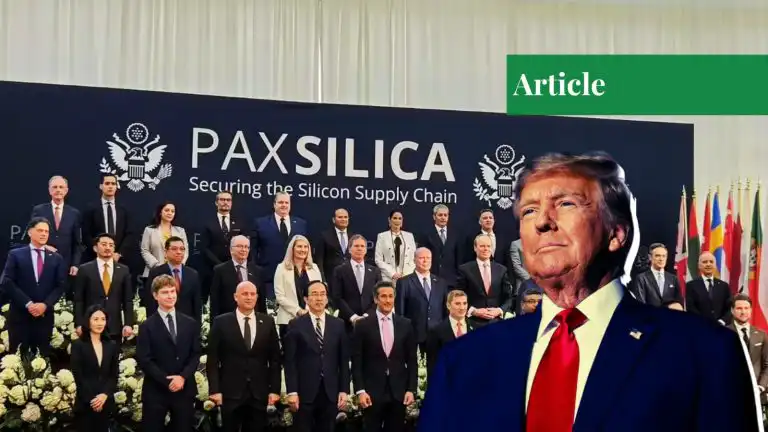
On June 25-26, 2026, over thirty economies gathered in Washington for the second Pax Silica Summit, organized by the US State Department. At the summit, ten new partners signed the founding declaration of the initiative, including the European Union, Germany, and the Netherlands. Their accession has brought the initiative to 24 member states in the six months since its launch. A wider circle of 35 states, stretching from India and Japan to Turkiye and the Gulf monarchies, endorsed the parallel Joint Statement on AI Opportunity. The name of the initiative, Pax, echoes the terms of Pax Romana and Pax Americana and signifies ambition on the part of the US.
What Has Actually Been Built
The Pax Silica initiative being undertaken by the State Department emphasizes the use of AI technology in the context of supply chain security and has been adopted by seven states in a Washington signing ceremony dated December 12, 2025. The declaration implies the commitment of the signatories to cooperate in the field of the technology stack as defined in history. It includes the following components of the technology stack: frontier AI models, software platforms, semiconductors, and compute. It mentions the infrastructure, advanced manufacturing, transportation, minerals refining, and energy production aspects of technology stacks as well. The initiative envisages the establishment of joint ventures, coordination of investment screening, and limitation of foreign adversary access to the necessary technologies and infrastructure.
The summit that took place in June brought about the creation of new mechanisms of operation. The U.S. Department of State published outcomes of the summit, stating that Washington promised a contribution amounting to $250 million to an investment consortium financing energy supply chains and chains of critical minerals, a credentialing platform for supply chain management which would start with the work of Panama’s port and customs authorities and will allow making clearance of shipments containing various minerals and semiconductors faster, as well as workforce initiative, which is being implemented in cooperation with Stanford University. When taken separately, none of these instruments is impressive according to American standards of foreign policy, but viewed in their entirety, the initiatives lay a foundation for the emergence of an institution that has programmes and budgeting as well as a functioning secretariat. The first challenge for the project is whether or not any real instruments functioning will arise from this mechanism.
Why a New Bloc Rather Than an Old Forum
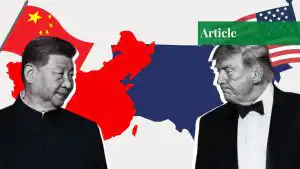
The key question is: why did the US take the route of creating a new coalition instead of working through the G7, the G20, or any other export controls coordination framework? Helberg provided an answer during an interview for the Financial Times when he characterized Pax Silica as a specially made coalition that had been created for the needs of the artificial intelligence economy and argued that the mentioned forums were not meant for managing the supply of AI technologies. The analytical perspective that most analysts use in such a case is the one Farrell and Newman have provided in their 2019 article in International Security. By comparing the matter to weaponized interdependence, it is safe to say that Pax Silica signifies something unprecedented but not brand new. For the last four years, the US has been using chokepoints piecemeal: first in the form of semiconductor export controls and entity-based sanctions, then China’s response in the field of rare earths licensing. Pax Silica transforms this informal competition into a rigid institutional framework, a membership-based organization based on the belief that supply chains are now alliance-driven businesses, just as territorial defense was previously. It also elicits a response in kind, which the analysts at the Center for Strategic and International Studies have started to uncover. For example, China’s Huawei is exporting its own AI hardware ecosystem to other countries; that makes it evident that a formal and organized counter bloc, driving home the very division that both capitals claim to dislike, is emerging in the real world as a not merely theoretical possibility.
The Membership Map
The accession narrative is thought-provoking. The founders of the organization in December were soon followed by Qatar and the UAE in January as well. The entries of these two states showcased how cheap energy can secure a place in the artificial intelligence market. India joined in February during the AI Impact Conference held in New Delhi. The Philippines made its accession in April alongside plans for the establishment of a manufacturing hub in Luzon. In June, the EU, together with Germany and Kazakhstan, joined the fold to mark the big entry of the Europeans. Taiwan did not join the initiative but participated in the summit meetings and endorsed it through a separate statement on economic security with the US. Italy was there, where its fast representative informed reporters that they are due to participate in the initiative.
The overlooked parts are also quite obvious. The unacknowledged enemy is China, against which this architecture is built. The architecture does not include Russia. Brazil, Indonesia, and parts of Africa are excluded from it, as well as most Muslim countries outside the Gulf, including Pakistan. The latter’s digital economy is based on Chinese technology. Whether the absence of these countries is due to exclusion, reluctance, or only due to the sequence is not yet determined. Nevertheless, the map is in good agreement with the geography of cooperation within American security politics and leads to a question that these states may never manage to answer by themselves: if membership is the criterion of technological cooperation, states will discover that nobody asked them whether they wanted to be members before they bought the infrastructure.
The Strains Already Visible
After six months into the initiative, the stakeholders have begun raising questions about its legitimacy. Specifically in the Philippines, a coalition comprising environmental groups, scientists, and technologists, such as AGHAM, the Computer Professionals’ Union, and the Kalikasan Peoples’ Network, is against it, as they believe the initiative allows the country’s resources, such as nickel, copper, cobalt, chromite, and rare earth element deposits to enter foreign led supply chains while their value added manufacturing takes place outside the country, resulting in what they have called the plunder of resources. In May, the Philippine Star reported that the Philippines has turned down a diplomatic immunity request from the US government for its personnel based at the proposed AI hub, indicating that there will be discord in the project right from the beginning even among those who agree to be part of the project.
A second strain has emerged in the analytical literature associated with Pax Silica, namely the structural strain: Most members of Pax Silica, including Germany’s automotive industry, South Korea’s memory chip manufacturers, and Gulf sovereign funds, have China as either the most important trading partner or one of the top two trading partners they deal with. This has been confirmed by various documents issued under Pax Silica, which talk about a reduced dependency on China rather than decoupling from China. There appears to be some ambiguity regarding the proposed use of terms, such as where to draw the line between China dependency and participation in Pax Silica. This aspect of ambiguity brings up the issue of durability that plagues Pax Silica that has been created as a tool of the executive branch. As seen, it is an initiative that has no treaty status and no congressional sponsorship, and previous ideas of a similar nature have lived much shorter lives than was initially anticipated. In the 20th century, alliances were drawn around territories and the military weapons deployed to defend them. The United States is betting on the fact that in the 21st century, new alliances will embrace this approach but will be grounded more in computation rather than weapons.
If you want to submit your articles and/or research papers, please visit the Submissions page.
To stay updated with the latest jobs, CSS news, internships, scholarships, and current affairs articles, join our Community Forum!
The views and opinions expressed in this article/paper are the author’s own and do not necessarily reflect the editorial position of Paradigm Shift.
Talha Arshad is an undergraduate student of International Relations at the School of Politics and International Relations (SPIR), Quaid-i-Azam University, Islamabad. His writing focuses on great-power politics, with a current emphasis on the strategic dimensions of the US–China technology rivalry.