
Hannah Arendt warned that societies rarely descend into evil through monsters alone, but through obedience without thought. “Most evil,” she observed, “is done by people who never decide to be good or evil.” Power corrodes virtue not by force, but by habit. Gibbon, writing of Rome, reached the same verdict centuries earlier: greatness, when unrestrained, consumes itself. What cannot be faced cannot be changed—and what is endlessly justified soon ceases to trouble the conscience at all.
A Hollowed International Order
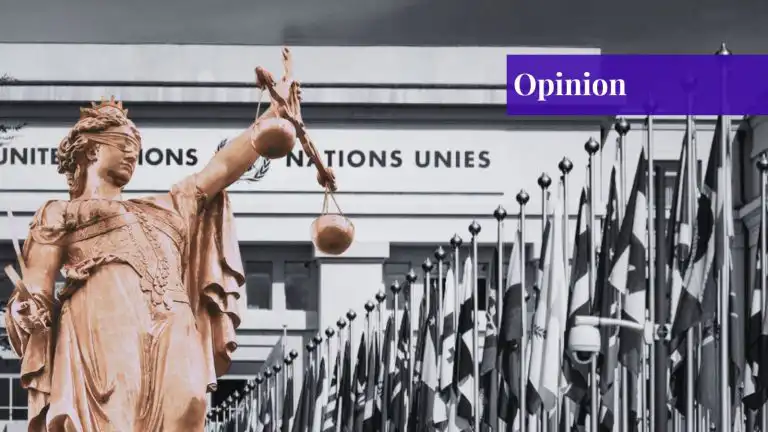
The United Nations now stands hollowed out, a monument to a moral order that no longer commands belief—its credibility in ruins and its authority in tatters. In its place rises a colder arithmetic: sovereignty traded for patronage, values subordinated to leverage. The new ethic is survival—take what lies within reach, defend what can be defended, and submit where resistance is futile—acquiescing to strength is the new order. Morality no longer governs the world; it merely decorates it.
Genocide is reduced to outsourcing. Friedrich Merz describes the destruction of Gaza as “dirty work” done by others, absolving himself through distance. The deaths of women and children become tolerable when responsibility is displaced. Keir Starmer insists wars must continue until moral purity is secured by exhaustion—peace, he argues, must never reward the aggressor, even if it consumes the innocent. Macron decries repression in Iran while remaining silent as economic warfare is openly celebrated elsewhere. Condemnation, it seems, is selective; outrage obeys geography.
NATO, having failed in Afghanistan and stumbled in Ukraine, now drifts in search of relevance. Alliances outlive their purposes and then mistake momentum for meaning. Power repositions itself—Greenland becomes strategic, Canada reconsiders loyalty, and China and Russia tighten alternative architectures. Trade routes harden into fault lines; supply chains become theaters of conflict. War no longer announces itself—it circulates through markets and currencies.
A “Peace Board” is proposed before peace itself exists. Tony Blair, shadowed by the legacy of Iraq, is resurrected as an architect of reconciliation. Conflict of interest is no longer a concern but a qualification, as reconstruction is entrusted to those who shaped destruction, and Trump appoints his son-in-law to reconstruct what they themselves destroyed. The world recoils, yet a few—starved for relevance—step forward eagerly, mistaking proximity to power for purpose. They have the mistaken belief that power is contagious and affiliation to the rulers of the food chain may prevent oneself from being eaten.
Pakistan’s Dilemma
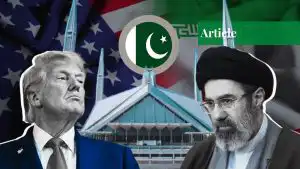
The board was meant to follow a ceasefire to give shape to Palestinian self-rule. There is no ceasefire. There is no Palestinian voice. Deals are discussed in their absence, as though disappearance were consent. Pakistan, however, appears with inexplicable enthusiasm—endorsing objectives widely rejected, aligning itself against both global sentiment and moral clarity.
Pakistan’s confusion is not accidental; it is structural. It is torn between two patrons who embody opposing conceptions of power. Saudi Arabia, a traditional hegemon, grounds its influence in convention—state sovereignty, territorial order, and the language of formal alliances. The United Arab Emirates, by contrast, operates through networks rather than norms, cultivating proxies, backing secessionist movements, and projecting power through finance, militias, and informal influence.
Pakistan needs the former for survival, yet is entangled with the latter by convenience. Its economy leans on Saudi goodwill; its leadership, however, is personally invested—financially and politically—in the Emirati ecosystem. Policy thus fractures into two selves: one that speaks the language of propriety and another that obeys the logic of networks. What emerges is not diplomacy but drift—positions taken not in pursuit of national interest but in deference to private security.
Nations do not perish when their walls are breached, but when conscience learns the language of excuses and apologies. Long before archives record the fall, the moral vocabulary of a people begins to shrink—jurisdiction, misuse, misappropriation, law, and the Constitution begin to hold no meaning. Collapse is not born of chaos—it is preceded by consent. Have we, the people, consented to lend our name to the total decimation of the Palestinians? Have we agreed to be part of the plan for a Greater Israel and the Abrahamic Accords?
All this, even when our own backyard, Jammu and Kashmir, is consumed by the unfinished business of UN Resolutions. Are we the people, content, as events unfold before us and we witness the theft of our waters by an enemy before our eyes, while we watch on hopelessly and helplessly? Yet people who are so irrelevant in the affairs of their own state will always be doomed to be kicked around and undergo mass migration, such as in Tirah—a silent people, a compliant people, well-behaved and cooperative. Pakistan Zindabad!
If you want to submit your articles and/or research papers, please visit the Submissions page.
To stay updated with the latest jobs, CSS news, internships, scholarships, and current affairs articles, join our Community Forum!
The views and opinions expressed in this article/paper are the author’s own and do not necessarily reflect the editorial position of Paradigm Shift.