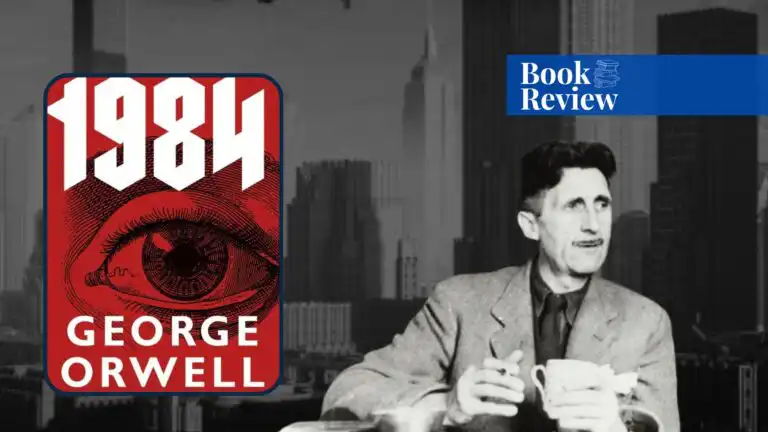
“Big Brother is watching” you”—this iconic phrase from the book 1984, written by George Orwell, has become synonymous with the pervasive fear of surveillance, mind control, and authoritarianism. George Orwell’s dystopian masterpiece illustrates a society where totalitarianism rules every aspect of life, offering readers a framework to comprehend the trajectory of a totalitarian state. It serves as a chilling prophecy of consequences when power goes unchecked, while it prompts us to a question: Are we living in Orwell’s prophecy or heading towards it?
About the Author
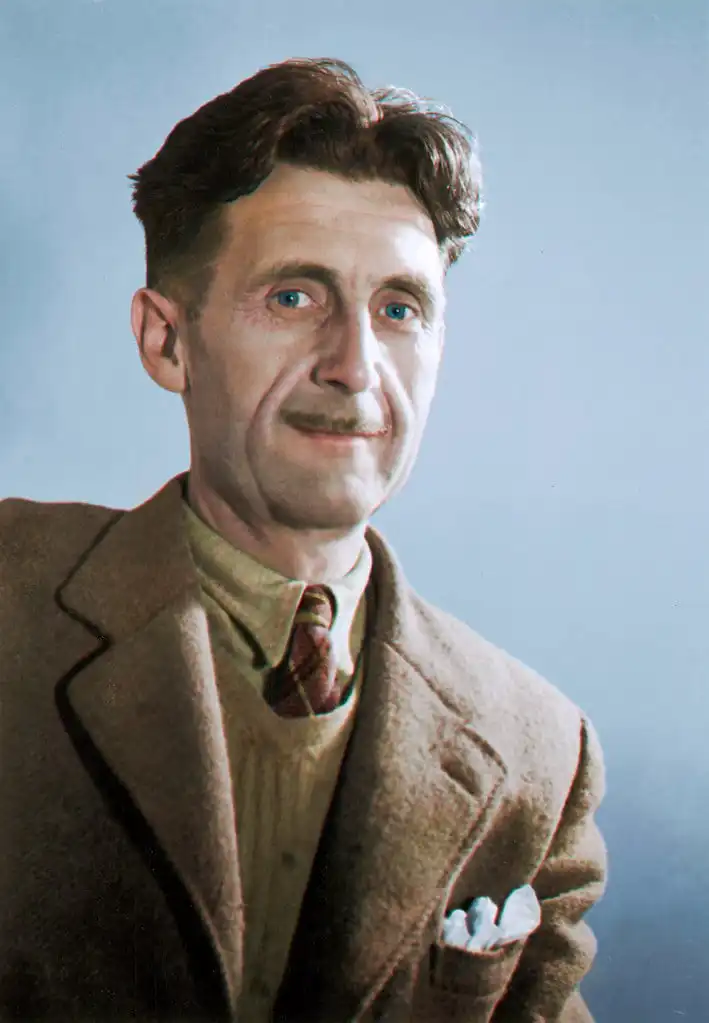
Eric Arthur Blair, better known by his pen name George Orwell, was born in 1903 in British India. A British writer, journalist, and political thinker who consistently used his words against social injustice and totalitarianism. Through combining his art of political satire with literary mastery, he produced seminal works, 1984 and Animal Farm (another famous novel), solidifying him as one of the most respected and influential authors of the 20th century.
Synopsis
Orwell’s 1984, set in a dystopian future, centers on Winston Smith, a low-key party member, in a world divided into three superstates. The narrative unfolded in the superstate of Oceania, ruled by omnipresent Big Brother and his party, which propagates the ideology of “Ingsoc” (English Socialism).
Oceania is one of the three warring superstates—Oceania, Eurasia, and Eastasia—in Orwell’s dystopian world. The party enforces strict control over all aspects of life through surveillance, propaganda, and manipulation. Orwell takes readers through a nightmarish version of Oceania in this three-part book, where Winston, a fragile man, quietly embraces a rebellion against the state. In Oceania, language and literature are weaponized, personal life and privacy are invaded, history and truths are rewritten, and individuality and creativity are suppressed
The dystopian tale centers on the protagonist, Winston Smith, a 39-year-old low-key party member living in the Airstrip (province of Oceania). He is single, his wife having died a long time ago. He works in the Ministry of Truth, where the party uses the power of language and literature to suppress dissent by molding and rewriting history and truth, and keeping the populace under the influence of the party’s changing narrative and propaganda.
Winston’s job involves altering and rewriting history and disposing of the original text. Despite his outward congruence, he secretly hates the party and longs for truth and individuality. His internal rebellion compels him to begin writing a diary and express his thoughts, an act of “thoughtcrime”—punishable by death.
Winston’s life takes a turn, and his internal rebellion grows when he begins a forbidden love affair with Julia, a young and charming woman, and a fellow party worker who also harbors disdain for the party. Their emotional connection, secret meetings, and dreams for a free life showcase their act of personal rebellion against the party, as relationships between men and women are prohibited. During this time, they begin to question the party’s policies even more and become increasingly interested in joining the “Brotherhood,” an underground resistance group.
Bound by rebellious emotions, Winston and Julia share a deep quest for truth and freedom. They are approached by O’Brien, who appears as a covert member of the Brotherhood. He gives them a book of revolutionary philosophy, but this turned out to be a trap. O’Brien is actually a high-ranking, loyalist Party official, a spymaster who hunts for criminal thoughts. Winston and Julia are captured and taken into the Ministry of Love (reeducation center), where they are subjected to brutal torture and psychological manipulation, eventually being forced to betray each other.
The climax of Winston’s torment occurs in the infamous “Room 101,” where he is confronted with his greatest fear—rats. There, through extreme torture and mental torments, he ultimately pleads for Julia to be tortured in his place, a moment that signified the destruction of individuality, thought process, and spirit of a man. After their release, both are irrevocably changed, having lost their love, desire for freedom, and each other. Winston ultimately succumbs to the Party’s ideology and professes his love for Big Brother.
Analysis and Modern Relevance
In this dystopian novel, George Orwell’s dialogues, suspenseful plot, and noble ideas have become realities for many political thinkers of times to come. George Orwell wrote 1984 after witnessing the dangers posed by totalitarian regimes of Stalinist Russia and Nazi Germany, warning about the absolute power, mass surveillance, and manipulation of truth.
George Orwell, in 1984, explores how the unchecked power of the government can corrupt and then destroy every aspect of life. Anyone who challenges the Party is labeled a traitor and erased from all records, making citizens anxious and suspicious of one another, which resonates with current times.
Written in 1949, 1984 remains relevant today, as we are witnessing authoritarian and ultra-populist tendencies in various parts of the world. Also warning us of the dangerous path societies may tread when freedoms are traded for security, but in reality, it can become a tool of authoritative political control. The Chinese government made a firewall and a social credit system, an advanced version of Big Brother’s Ministry of Thought, which enables Beijing to suppress dissent before it amplifies. While people worldwide generate approximately 2.5 quintillion bytes of data (followed by eighteen zeroes) each day, much of this information is being collected by government intelligence agencies and private companies, particularly in the US, to get unimaginable profits through surveillance capitalism.
Orwell’s portrayal of Oceania (a society) under total surveillance is eerily prescient, especially in today’s digital authoritarianism, where corporate entities and the government have unprecedented access to personal data and surveillance. The Orwellian concept resonates deeply with reality, urging readers to consider the implications of a world where privacy is nonexistent and individuality is subordinated to the state’s interests.
Orwell’s concept of “doublethink” – the ability to hold two contradictory beliefs simultaneously—is a psychological mechanism the party uses to ensure that citizens accept its ever-shifting version of reality. Orwell also highlighted the systematized alteration of history and facts through a mechanism called the “Ministry of Truth.” In recent history, governments and states of various parts use such psychological mechanisms and structural systems to achieve their interests, which contrasts with their former claims or existing truth.
Examples of this include the Shah of Iran’s promotion of liberal values between 1946 and 1978, Narendra Modi and the BJP’s Hindu-nationalist policies in India since 2014, and now King Muhammad bin Salman in Saudi Arabia, to reshape the society according to their interpretation and to indoctrinate their system-oriented ideology. Such action has led to confusion, disintegration, and rebellion within a section of a nation or an entire country.
Orwell’s pessimistic yet realistic depiction of a totalitarian regime’s merciless approach to eliminating dissent through a reeducation center like the Ministry of Love is a harrowing portrayal of how modern-day history’s totalitarian regimes crush individuality and identities. The familiar practice has occurred in some similar fashion in the USA with indigenous people, as well as with dissidents and Jews in concentration camps in Nazi Germany, and also with opposition leaders under the Baath regime in Iraq. It is still going on with the Uyghur Muslims in China.
1984 by George Orwell is a perfect tale to predict and provide a framework of totalitarianism. However, Orwell’s writing perpetuates fear by being overly pessimistic while ignoring the aspect of hope and the chances of growth of democracy; maybe this is Orwell’s way of depicting the world.
Last Words
1984 remains one of the most influential books in modern literature, offering a powerful reflection on power, control, and the human condition. While it cannot substitute for an in-depth study of totalitarianism, it is a must-read for those who are interested in politics, challenges to democracy, and authoritarian governments, which are portrayed fictionally. Additionally, anyone interested in knowing about government mass surveillance, data privacy, and the unchecked influence of authoritative government on individuals should take a look at Orwell’s masterpiece.
If you want to submit your articles and/or research papers, please visit the Submissions page.
To stay updated with the latest jobs, CSS news, internships, scholarships, and current affairs articles, join our Community Forum!
The views and opinions expressed in this article/paper are the author’s own and do not necessarily reflect the editorial position of Paradigm Shift.

Muhammad Ismail Qaddus is an international relations graduate from the University of Gujrat, a freelance writer, and a debater. He is strongly interested in political history, geopolitical trends, foreign policy analysis, climate politics, and power transition in the international order. He enjoys conducting academic research and can be reached at ismailmuhammad6875@gmail.com.