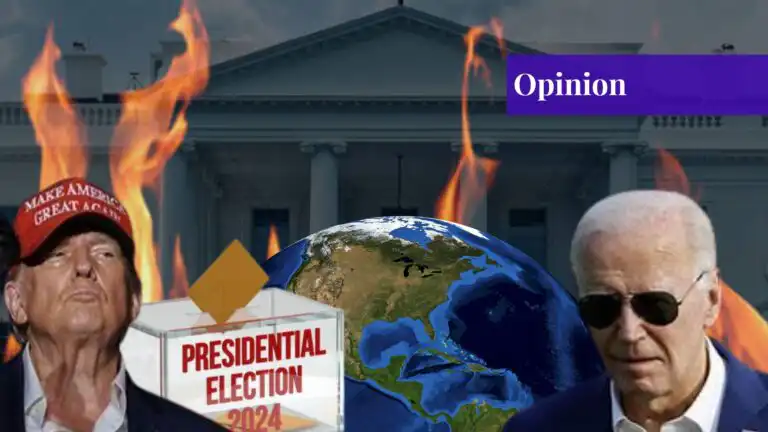
As the 2024 elections come closer, the United States confronts a plethora of international and internal obstacles, including its waning efforts in the war in Ukraine, competition with China, Russia’s surprising partnership with North Korea, and the ongoing conflict in Gaza. The crucial question at hand is obvious as these problems come together: Is the US ready for the rough road ahead? America faces unprecedented challenges as the 2024 election approaches, both domestically and internationally.
The United States has been at a crossroads with several forces since the start of 2024. With the Russian War in Ukraine and Israel’s continued violation of Palestine, the US is torn apart. The Biden Administration has extensive challenges stemming from these external demands. Though the US decided to stand by its friends on the values of sovereignty, democracy, and unwavering commitment to counterterrorism by strongly endorsing both Ukraine and Israel; these strong actions didn’t help the Biden Administration receive much political backing. Some surveys suggest that President Biden could be the least popular US president till now.
A greater worry for the Democratic Party is that nearly every poll has former President Donald Trump leading. For at least the next five years, the political and security dynamics that arise from this will presumably affect the US foreign policy stance and direction.
US Presidential Election 2024: Uncertainties
The 2024 presidential campaign is being contested during heated discussions on subjects like immigration, crime rates, the country’s increasing racial and cultural diversity, and reproductive rights. Voters who favor President Joe Biden and former President Donald Trump have quite different views on most, but not all, of these issues.
Many foreign policy experts were relieved when Joe Biden replaced Trump in 2020. It was assumed that the US may once again become a global stabilizing factor. In February 2021, Biden promised allies that “America is Back.” Once again, a government with a serious foreign policy agenda was in charge in Washington, following the turmoil of the Trump years. However, during the initial years of the Biden Administration, the White House exposed the inconsistent nature of its support for international law and human rights, isolating it from the rest of the world.
When hostilities in Gaza started, Biden allegedly put pressure on the Israeli Prime Minister behind closed doors, but he ultimately decided to support Israel’s war openly. In favor of negotiating methodically with Benjamin Netanyahu, Biden declined to take on a prominent public role. The Biden Administration’s response to the events in Gaza was contrary to its dedication to international law and human rights, which were crucial to the White House’s position against Russia in regard to the Ukrainian conflict.
US Response to the Conflict in Ukraine and the Middle East
The situation on the battlefield has suddenly shifted against Ukraine as Russia has been gaining territory. Therefore, Ukraine has been receiving aid from the Biden Administration.
Biden has insisted, however, that the United States will not intervene directly in a conflict with Russia. According to George Beebe, director of “Grand Strategy” at the Qunicy Institute; US aid to Ukraine is a component of a diplomatic plan to organize a negotiated settlement of the conflict. Furthermore, help would simply make Ukraine’s misery worse, exacerbate its devastation, and raise the likelihood that Russia and America could inadvertently engage in direct combat. Ukraine has already suffered greatly as a result of the conflict. Due to the collapse of its economy, Ukraine is now entirely dependent on aid from the West to survive. Further prolongation of the war is expected to exacerbate the burden on Ukrainian democracy and civil liberties.
Israel’s ongoing assault on Gaza has resulted in the deaths of over 37,000 Palestinians, and at least 15,000 children. Biden is making headway toward a defense agreement with Saudi Arabia, which is to propose peace in the Middle East. Security would be provided to Riyadh in exchange for normalizing relations with Israel under the impending agreement.
Evolving US-China Competition
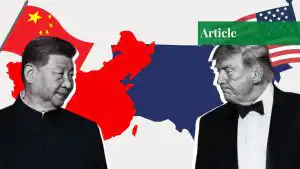
China has been identified by both the Biden and Trump administrations as their top foreign policy concern and as a danger to national security. The Biden Administration has mostly followed its predecessor’s path with strong language and robust economic measures. According to Jake Werner—acting head of the Quincy Institute of East Asia Program—China-US relations have been calm recently, but harmful tensions are developing beneath the surface. No matter who wins in November, if continued down this current path, there could be significant conflict in the upcoming presidential term.
The US took action to fortify the QUAD and AUKUS and formed the Indo-Pacific Economic Framework (IPEF) in response to China’s increasing influence in the area. Over the past year, Chinese economic diplomacy has strengthened connections with Russia and Iran.
There were regional cracks resulting from America’s exit from the Joint Comprehensive Plan of Action (JCPOA) in 2018 and its withdrawal from Afghanistan in 2021, leaving a strategic vacuum in the area. China intervened in the arena by mediating the normalization of diplomatic ties between Saudi Arabia and Iran.
In the upcoming years, the strategic rivalry between the United States and China will be an important lens through which to examine their relationship, but it cannot be the only one. The world still faces significant international complications, even with the resurgence of big power competition. The United States and China need to keep lines of communication open in order to tackle deadly diseases, avoid financial crises, and combat climate change.
Russia-North Korea Cooperation
According to CNN reports, Washington-based intelligence officials are growing more concerned about the long-term ramifications of what seems to be a new-level strategic partnership between North Korea and Russia.

In recent weeks, Russia has fired short-range ballistic missiles at targets in Ukraine that were provided by North Korea. Putin even signed a new comprehensive strategic partnership contract—a surprising way to end his two-day visit to North Korea. Details are unknown because the treaty’s full wording has not yet been made public, although it is believed to contain a mutual defense clause that requires one nation to defend the other militarily, in the event of an attack.
This treaty shows Putin’s abandonment of all prospects of engaging with the West and highlights his determination to bring down the international system that is currently spearheaded by the US. He means to do so by uniting with North Korea, China, and Iran.
Putin is providing crucial support to North Korean leadership that, despite the achievement of its WMD (weapons of mass destruction) program, is weak. North Korea has suddenly broken free of its diplomatic isolation by striking a deal with Russia after failing to do so with the United States during the governance of former President Donald Trump.
There are very few alternatives available to the current US President Joe Biden for a response. The best he can do is to fortify the ties between the US, South Korea, and Japan while stepping up sanctions against North Korea and Russia.
Conclusion
The paradox of the “American Grand Strategy” during the previous seven decades is that, despite its success in creating an interdependent global community for remarkable and shared prosperity, it is currently being abandoned. Without asking for anything in return, the US was willing to do business with its enemies. But now, protectionism and a so-called industrial strategy are partially shutting the nation off to rivals as well as US allies, partners, and friends.
The global order needs legitimacy, a model worth imitating, and a framework that is accessible to all. In the past, the United States was associated with economic opportunity for both its partners and friends, as well as for those who hoped to achieve the equality and tranquility that the open US-led economic system promised. However, over time, the United States gave up that position, enabling China to establish itself as a major trading partner and manufacturing powerhouse.
If you want to submit your articles, research papers, and book reviews, please check the Submissions page.
The views and opinions expressed in this article/paper are the author’s own and do not necessarily reflect the editorial position of Paradigm Shift.

Mishal Nadeem is a student of MS in International Relations from COMSATS University Islamabad. Her primary interests lie in foreign policy analysis, international law, and South Asian regional developments.