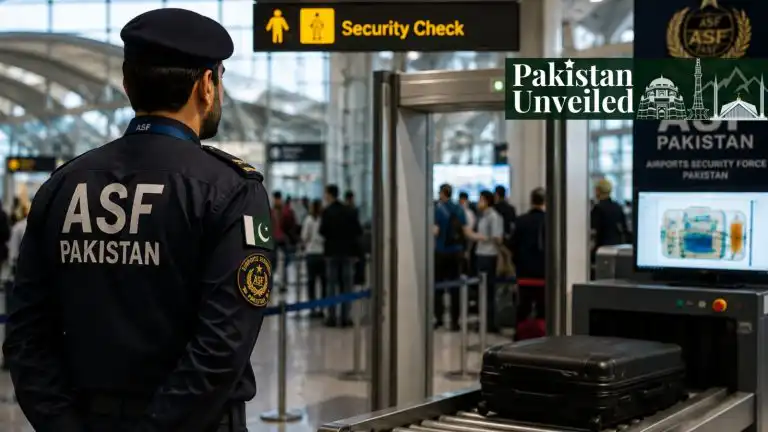
Pakistan’s airports process millions of passengers every year across international and domestic routes. Behind every smooth departure and arrival, behind every security checkpoint and every screened piece of luggage, stands one federal organization that most travellers pass through without fully understanding.
The Airports Security Force is a premier federal agency in Pakistan mandated to protect the civil aviation industry. Operating under the Aviation Division, it safeguards airports, aircraft, specialized units, and passengers from terrorism and unlawful interference. Through rigorous screening and specialized counter-terrorism units, the ASF ensures the safety of national and international flight operations while maintaining law and order within airport limits.
This guide covers everything about the ASF—its history, mandate, functions, ranks, career opportunities, eligibility requirements, salary structure, and the selection process for those who want to join one of Pakistan’s most respected security organizations.
What Is the Airport Security Force?
The Airport Security Force is a federal security agency under the administrative control of the Ministry of Defense, which is responsible for protecting airports, facilities, and aircraft both on the ground and in the air in Pakistan. ASF safeguards the civil aviation industry against unlawful interference, adopting counter-terrorism measures, preventing crime, and maintaining law and order within the limits of airports in Pakistan.
The ASF is a 14,560-personnel organization. Its motto is “Firm and Courteous”—two words that accurately capture the dual nature of an organization that must simultaneously maintain strict security protocols and provide a welcoming, professional environment for millions of passengers.
Being a professional and specialized force, ASF is committed to delivering Aviation Security Operations at all civil airports of Pakistan by timely evolving security strategies commensurate with national and international security requirements.
History of the Airport Security Force
The ASF was established in 1976 under the Airports Security Force Act LXXVII of 1975, initially as the Directorate of the Department of Civil Aviation.
The formation of ASF came in the immediate aftermath of a series of aviation security incidents globally in the 1970s—a decade that saw a dramatic increase in aircraft hijackings and airport attacks. Pakistan, like many nations, recognized that civil aviation needed a dedicated and specialized security agency rather than relying on general police or military presence at airports.
The force began with a limited mandate at a small number of airports and has grown continuously over the five decades since its founding to become one of the most significant federal security agencies in the country. Today it covers both international and domestic airports across Pakistan with a presence at every civil aviation facility in the country.
The current Director General of ASF is Major General Shoaib Bin Akram HI(M). The organization is led at the Director General level by a senior military officer, which reflects the paramilitary nature of the force and its close working relationship with Pakistan’s armed forces.
Mandate and Core Functions of ASF
ASF has been mandated with the security of all airports of Pakistan—both international and domestic. ASF ensures security of aircraft, passengers, their luggage, and mail along with the proper conduct of persons and vehicles within the limits of airports and aerodromes.
The mandate is specific and comprehensive. It covers six primary operational areas.
Passenger Screening and Security
Every passenger who passes through a Pakistani airport goes through ASF-managed security checkpoints. This includes physical screening, baggage X-ray, document verification, and the application of security protocols that align with both Pakistan’s national aviation security requirements and international standards set by the International Civil Aviation Organization (ICAO).
Aircraft Security
ASF is responsible for the security of aircraft on the ground at Pakistani airports. This includes perimeter security around aircraft, access control to airside areas, and the prevention of any unauthorized interference with aircraft. Ground security operations ensure that no security threat reaches an aircraft before departure.
Cargo and Mail Screening
All cargo and postal consignments processed through Pakistani airports come under ASF security oversight. Given the volume of international cargo handled at Pakistan’s major airports, this represents a significant operational responsibility requiring specialized screening equipment and trained personnel.
Perimeter Security
ASF manages the outer perimeter security of airport facilities. This includes patrol operations, access point management, and the prevention of unauthorized entry into airport premises. The perimeter security function is critical to preventing external threats from reaching the operational areas of the airport.
Counter-Terrorism Operations
Through rigorous screening and specialized counter-terrorism units, the ASF ensures the safety of national and international flight operations. The counter-terrorism mandate requires ASF personnel to maintain readiness for active threat response alongside their daily screening and access control functions.
Law and Order Within Airport Limits
ASF has jurisdiction over all law and order matters within airport premises. This includes managing disputes, controlling crowds during peak periods, and coordinating with civil police on matters that require broader law enforcement involvement.
An identification system has evolved by ASF to regulate the entry procedures and prevent unauthorized entry. This system covers both public and restricted areas of airports and manages access for the thousands of staff, contractors, airport personnel, and officials who work at Pakistan’s major airport facilities.
ASF’s Airport Coverage
ASF stands as the sole federal aviation security force tasked with the paramount responsibility of safeguarding Pakistan’s aerial frontiers.
The force operates across Pakistan’s full network of civil airports, including all international airports at Islamabad, Karachi, Lahore, Peshawar, Quetta, Multan, and Sialkot, as well as the domestic airport network serving cities across the country.
This nationwide coverage means that ASF operations span dramatically different operational environments—from the high-volume international gateway at Islamabad’s New Islamabad International Airport processing thousands of passengers daily to smaller domestic facilities serving regional traffic. Each airport presents different security challenges and requires tailored operational approaches while maintaining the consistent national standards that ASF’s mandate requires.
Ranks and Organisational Structure
ASF operates with a clearly defined rank structure that mirrors the paramilitary nature of the organization. The structure runs from the director general at the top through senior officer grades, through ASF-specific officer and non-commissioned officer ranks, down to the constabulary grades that form the largest part of the operational strength.
The senior leadership consists of a director general, directors, and additional directors at the senior management level. Below this, the operational officer structure includes assistant directors, corporals, and sub-inspectors. The non-commissioned officer structure runs through inspector, assistant sub-inspector, corporal, and constable grades.
Each rank carries specific operational responsibilities, authority levels, and compensation structures under the federal government’s Basic Pay Scale system.
Career Opportunities in ASF
The opportunity to join the Airport Security Force represents one of the most respected and stable career paths in government service. With Pakistan’s aviation sector growing steadily and airport security becoming more critical, this role is increasingly sought after by fresh graduates and experienced professionals alike.
ASF recruitment covers several categories of positions.
Uniformed Security Posts — Constable, Corporal, ASI, and Inspector positions form the core of ASF’s operational strength. These are the personnel who conduct direct security operations at airports.
Technical Posts — ASF maintains technical specialists across communications, equipment maintenance, and specialised security technology operations.
Administrative and Clerical Posts — Office management, administration, and clerical functions that support the operational structure.
Medical Staff — 24/7 medical assistance is provided for ASF troops under professional doctors. ASF has its own hospital and medical centers at all major airports of Pakistan.
The ASF is one of the most trusted security guard assistant post-surgery medical centers. It is in charge of protecting Pakistan’s airports, airline passengers, and aviation facilities. With the rise in aviation passengers, ASF jobs receive thousands of applications every year. They offer not only job security but also chances to grow professionally and serve one’s country.
Eligibility Criteria for Joining ASF
Nationality: Must be a Pakistani citizen. Age: 18 to 30 years, with a flexible upper age for government employees in some cases. Security guard and assistant posts require a matric or intermediate qualification. Inspectors and ASIs post-bachelor’s require a bachelor’s degree. Physical Fitness: Height, weight, and chest measurements must meet ASF standards. Medical Fitness: Candidates must pass medical and eyesight tests. Criminal Record: Clean record with no prior criminal convictions. Gender: Both male and female candidates may apply, with some posts having reserved seats.
Physical Standards for Male Candidates: Chest measurements for male candidates: 32¾ inches unexpanded and 34¾ inches expanded. Height and weight requirements vary by post category and are specified in individual recruitment advertisements.
Domicile Requirements: Candidates from Punjab, KPK, Sindh, Balochistan, Azad Kashmir, and Gilgit-Baltistan are eligible to apply for ASF recruitment. Provincial quotas are allocated according to provincial distribution.
Educational Qualifications by Post: The qualification requirement scales with the level of the post. Entry-level constabulary positions require matriculation. Non-commissioned officer positions typically require an intermediate or equivalent. Officer-level positions require a bachelor’s degree from an HEC-recognized university.
ASF recruitment often prioritizes police candidates with disciplined backgrounds, including cadets from armed forces, police, or other paramilitary institutions.
Salary Structure
Selected candidates receive a minimum salary of PKR 38,000 and a maximum of PKR 75,000 per month depending on the position and scale.
Beyond the basic pay, ASF employees receive a range of additional allowances and benefits under the federal government compensation structure. These include medical coverage, housing allowances, uniform allowances, and access to ASF’s own medical facilities at major airports.
ASF messes are established at all airports of Pakistan, which serve quality catering services and have sufficient dining facilities to accommodate all staff.
The total compensation package, including basic pay, allowances, and non-monetary benefits, makes ASF positions genuinely competitive within the federal government employment market.
Training and Development
New constables undergo a rigorous 5- to 6-month basic training course focusing on physical fitness, drill, and basic law enforcement. Following basic training, uniformed staff from constables to sub-inspectors often receive specialized tactical and weapons training for 2 to 3 months at military centers.
The training program reflects ASF’s dual nature—paramilitary discipline and physical fitness combined with specialized aviation security knowledge and law enforcement skills.
Specialized training includes passenger screening techniques, cargo inspection, counter-terrorism awareness, crisis response, airport security management, and the application of ICAO standards in daily operations. Ongoing professional development through refresher courses and specialized programs ensures that ASF personnel remain current with evolving global aviation security standards.
How to Apply for ASF Jobs
The application process involves uploading scanned copies of CNIC, photos, educational certificates, experience (if applicable), and a driving license for driver positions. Candidates submit the online application and download a registration slip.
Applications for ASF positions are processed through the official portal at joinasf.gov.pk. The selection process for uniformed posts follows a structured sequence.
Written Test — ASF written tests are in multiple-choice question format. The syllabus varies for each post depending on the job duties. Candidates with the highest marks in their quota have the best chance for the interview.
The written test covers English grammar and comprehension, Urdu, general knowledge about Pakistan and Islamic studies, basic mathematics and reasoning, and relevant technical knowledge for specialized positions.
Physical Test — After passing the written test and assessments, candidates face physical fitness assessments, including running, push-ups, and other fitness benchmarks that reflect the operational demands of airport security work.
Medical Test—A comprehensive medical examination including eyesight tests, general health assessment, and fitness-for-duty evaluation.
Interview — Candidates who pass the written, physical, and medical stages face a structured interview that evaluates communication skills, general awareness, and suitability for security service.
Final Merit List—A total of 664 positions are currently available, with the deadline to apply being December 8, 2026. Final selection is based on the combined performance across all stages, with provincial quota allocations applied.
ASF’s Role in International Aviation Standards
ASF does not operate in isolation from the global aviation security community. Pakistan’s membership in the ICAO means that ASF must continuously align its operations with international aviation security standards—Annex 17 of the Chicago Convention, which specifically covers aviation security requirements.
Keeping abreast of the latest technologies and trends in global aviation security, adopting new technologies, and developing a highly trained and well-equipped organization are stated priorities of the force.
This international orientation means ASF personnel and procedures are regularly evaluated against global benchmarks. Foreign airports that receive flights from Pakistan conduct their own assessments of originating airport security, and ASF’s compliance with international standards directly affects the reputation and operational freedom of Pakistani aviation internationally.
Key Facts at a Glance
| Detail | Information |
| Full Name | Airports Security Force |
| Abbreviation | ASF |
| Established | 1976 |
| Enabling Legislation | ASF Act LXXVII of 1975 |
| Parent Ministry | Ministry of Defence, Pakistan |
| Current DG | Major General Shoaib Bin Akram HI(M) |
| Total Personnel | 14,560 |
| Motto | Firm and Courteous |
| Age Limit for Jobs | 18 to 30 years |
| Minimum Salary | PKR 38,000 per month |
| Maximum Salary | PKR 75,000 per month |
| Official Website | asf.gov.pk |
| Recruitment Portal | joinasf.gov.pk |
FAQ
ASF operates under the Ministry of Defense, Pakistan. It functions as a federal security agency with jurisdiction over all civil airports across the country.
The standard age limit is 18 to 30 years. Age relaxation may apply for existing government employees as per federal government rules.
Yes. Both male and female candidates can apply for ASF positions. Some posts have reserved seats for female candidates, and requirements are specified in individual recruitment advertisements.
ASF written tests are multiple-choice questions covering English, Urdu, general knowledge, Pakistan affairs, Islamic studies, and basic mathematics. The syllabus varies by post level.
New constable recruits undergo a 5-6 month basic training program covering physical fitness, drill, and law enforcement fundamentals, followed by 2 to 3 months of specialized tactical training.
If you want to submit your articles and/or research papers, please visit the Submissions page.
To stay updated with the latest jobs, CSS news, internships, scholarships, and current affairs articles, join our Community Forum!
The views and opinions expressed in this article/paper are the author’s own and do not necessarily reflect the editorial position of Paradigm Shift.

Paradigm Shift is an official staff account.