For decades, whenever Palestine bled, the Arab people stood as the moral compass of the Middle East. Thousands marched in Amman, Cairo, and Tunis after Sabra and Shatila (1982); over 100,000 filled Cairo during the Second Intifada (2000). With 60,000 marching in Casablanca and many more gathering throughout Yemen, Jordan, and Egypt, protests grew once more in 2008 and 2014 during Israeli attacks on Gaza. These were mass mobilizations, not symbolic gestures; they resonated throughout the Arab world.
Today, however, the voice of solidarity has shifted — not to Arab capitals, but to university campuses across the West.
When the West Protested, the Price Was High
After October 7, Western campuses—not Arab capitals—erupted in Gaza protests, with over 130 U.S. and European universities witnessing demonstrations. Ohio State saw 36 arrests (WOSU, 2024). The Los Angeles Times tallied 210 detentions at UCLA during pro-Palestine demonstrations.
Mahmoud Khalil, a Palestinian organizer of Columbia’s Gaza encampment, was arrested by ICE in March and remains detained as his immigration case continues. NBC News reported that during Columbia’s 2025 convocation, students interrupted the ceremonial address with chants of “Free Mahmoud!” and booed administrators, while some set fire to their diplomas onstage.
Western students faced severe consequences for their activism — including arrest, suspension, threats of deportation, and public blacklisting — as documented by major outlets like The New York Times and The Washington Post. Some campuses even faced funding threats after being labeled “anti-Semitic”—a level of backlash unthinkable in many Arab cities today… —but it shows a willingness to speak out when the cost seems high.
From Western Campuses to Arab Capitals: A Stark Contrast
Despite this deep historical connection and recent international activism, we haven’t seen mass demonstrations across Arab capitals. “As of June 12, 2025, over 55,000 Palestinians have been killed in Gaza, according to AP News, “…with hospitals bombed, civilians shot at aid sites, and entire families wiped out.” Yet the same Arab streets that once erupted in outrage now largely watch from the sidelines.
Why has the Arab street gone quiet while Gaza bleeds and the world watches?
Authoritarian Regimes Fear the Power of the Street
One key reason is that autocratic regimes fear the power of the street. Several Arab governments are authoritarian or monarchic regimes that dread mass mobilization, irrespective of the cause. Unlike in democracies, where public protest is part of the political process, governments in Saudi Arabia, the UAE, Qatar, and Egypt see street rallies as existential dangers. Public participation has not been the basis for these states’ strength; rather, it has been loyalty to the monarchy or army. Like the Arab Spring in 2011, a mass protest—especially one around a unifying cause like Palestine—might rapidly evolve into a more general demand for political rights, dignity, or change.
Strategic Silence Born from Normalization
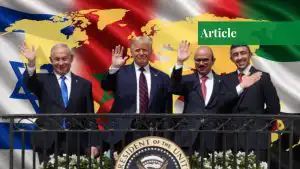
Since the 2020 signing of the Abraham Accords, the UAE has built extensive diplomatic and security connections with Israel, with bilateral trade of over $2.5 billion by 2023. According to Volterra Fietta (2023), the UAE’s sovereign wealth fund, Mubadala, acquired stakes in Israel’s Tamar gas field. Separately, the UAE’s state-owned defense firm, EDGE, has expanded its footprint in Israeli drone technology through major investments and partnerships. According to Reuters (2025), Qatar’s Al Udeid Air Base, the Pentagon’s largest Middle East hub, hosts 10,000 U.S. troops under a 10-year agreement.
Saudi Arabia hosts key U.S. bases, including Prince Sultan Air Base (2,700 troops) and King Abdulaziz Air Base for intelligence operations, plus the American-run Eskan Village supporting the Saudi National Guard (U.S. military, 2022).
According to Reuters, Egypt receives approximately $1.3 billion annually in U.S. military aid, while Jordan receives around $1.45 billion in combined economic and military assistance each year. Their regimes cannot afford to support anti-Israel sentiments that risk endangering vital military and economic aid funding that keeps their armies, economies, and leadership afloat.
In short, the silence on Palestine is not a moral lapse, but regime priorities—one driven by regime survival, diplomatic alignment, and economic dependency.
Arab People Are Still Speaking–But They’re Silenced
It’s a misconception—or outright wrong—to say that the Arab public no longer cares about Palestine—what’s true is that they’ve been systematically silenced. “Al Jazeera noted that since October 2023, thousands have marched in solidarity, only to be met with swift repression.”
Since October 2023, peaceful demonstrators, students, and journalists have been arrested or intimidated in Jordan… “No one should face arrest or prosecution simply for expressing their opinions about the war in Gaza or criticising their government’s policies.”
Diana Semaan, Amnesty International’s Jordan researcher. During protests close to the Israeli embassy in Amman in late March 2024, Al Jazeera and Amnesty International reported at least 165 arrests, riot police employing tear gas and batons to separate groups. Total nationwide detention estimates by Jordanian rights organizations put them over 1,500.
Egypt arrested 123 Gaza solidarity activists and blocked a “Global March to Gaza” in June 2025, deporting 400 and beating dozens.
While Tunisia and Algeria permit some protests, even these regimes restrict Palestine demonstrations, allowing only symbolic gatherings before cracking down on subsequent ones.
Though silenced in their homelands, Arab youth have become vital organizers of Gaza protests on Western campuses – freely voicing the solidarity that would bring imprisonment back home. Their struggle continues, just displaced.
Even in silence, the spirit survives. Hashtags like #Rajieen and viral protest songs by MC Abdul and Ramy Essam show how Arab youth still express solidarity—not on the streets, but through screens, lyrics, and digital defiance.
“The Arab street’s silence today isn’t surrender—it’s a detonator waiting for a spark. And as regimes cling to U.S. dollars and Israeli drones, they forget: the last time they underestimated their youth, it was called the Arab Spring.”
“In the end, we will remember not the words of our enemies, but the silence of our friends.”
– Martin Luther King Jr
If you want to submit your articles and/or research papers, please visit the Submissions page.
To stay updated with the latest jobs, CSS news, internships, scholarships, and current affairs articles, join our Community Forum!
The views and opinions expressed in this article/paper are the author’s own and do not necessarily reflect the editorial position of Paradigm Shift

Mazz Bin Akmal is a law student at the Lahore School of Law with a keen interest in Middle Eastern politics, public opinion, and the role of youth in shaping national and global narratives.