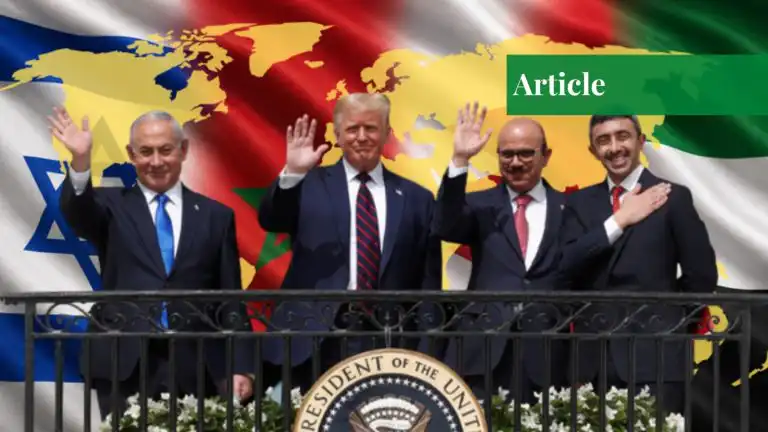
The Abraham Accords were once hailed as a groundbreaking diplomatic breakthrough and a potential game-changer in Middle East politics. The agreements signed in 2020 between Israel and its signatories, the UAE, Bahrain, followed by Morocco and Sudan, were more than normalization pacts. These expressed a more general shift toward a new strategy driven by a preference for economic modernization, technological cooperation, and security ties instead of the old ideological divisions among the Arab states. The regional polarization, however, stemming from the Gaza war, has brought up a basic question: Will the Abraham Accords last through the current political and social challenges in the Middle East? Yes, but not as first thought. The Accords will not be broken as the strategic interest remains intact. However, the current regional crisis has emphasized the shortcomings of a process of normalization, which is largely public opinion and Palestinian issue agnostic, and primarily state-driven.
The Strategic Rationale Of The Abraham Accords
Peace idealism was not really the main driver behind the initiation of the Abraham Accords; it was geopolitical pragmatism. Gulf states in particular, the UAE and Bahrain, saw normalization with Israel as a component of a wider security and economic plan. These states were attracted to Israel due to Iran’s regional influence, uncertainties about U.S. long-term security guarantees, and a need for technological and economic diversification. Israel, on the other hand, wanted to legitimize itself in the region and wanted to integrate economically, without resorting to the morass of the Palestinian peace process.
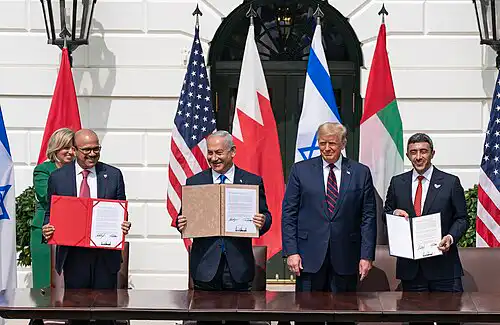
Many of the agreements were emblematic of the emergence of a new political logic for the Middle East. Newer doctrines of economic statecraft, strategic hedging, and regional connectivity started to supplant the old ones. Following 2020, the volume of trade between Israel and the UAE increased at a fast pace, with bilateral trade reaching hundreds of millions of dollars and even billions in just a few years. In the field of cooperation, there was a focus on cybersecurity, renewable energy, tourism, artificial intelligence, and defense technology. The developments showed that the normalization was not just happening for symbolic reasons but also for concrete national interests.
The Regional Polarization In The Gaza War
The Gaza war had a significant impact on the political climate around the Accords. The images unleashed public rage throughout the Arab and Muslim world. When the governments normalized relations with Israel, they were suddenly under increasing societal pressure. Meanwhile, public discussion of Israel’s military operations and doubts about the process of normalization grew, while diplomatic activity behind the scenes among the leaderships of the Gulf states persisted.
This shows that the greatest failing of the Abraham Accords was that they did not produce any societal normalization, and they were mostly elite-driven. The Palestinian issue is still emotionally and politically central in regional public opinion despite strategic interest calculations by political leaders. The idea that economic cooperation could replace the Palestinian issue in the future now has an air of unreality to it.
Saudi Arabia’s conservative policy reflects this. The idea of Saudi-Israeli normalization had been growing before the Gaza conflict, especially as U.S. efforts for the normalization process started to gather momentum. The war did dampen that momentum, though. As part of the future normalization, Riyadh has been making it more and more clear that there must be tangible steps towards Palestinian statehood. This is proof that regional polarization has not completely undermined the normalization framework but made it more costly to speak up for its expansion.
Why the Accords Are Unlikely to Collapse
None of the signatories to the agreements has walked away, despite the rhetoric and regional tensions. Diplomatic communication is ongoing, economic activities continue, and security coordination still plays important strategic functions. This continuity stems from the fact that the set of structural factors that lead to normalization has not disappeared.
First, doubts over Iran continue to dominate the security agenda of the Gulf. Tehran’s regional network of non-state forces, coupled with simmering tensions in the Red Sea and the wider region, is driving several Arab states to security cooperation with Israel.
Second, the many Gulf states are trying to undertake huge economic transformation programmes, which are reliant on technology collaborations, foreign investment, and regional peace. In this respect, Israel continues to be appealing to the technological industry.
Third, in the Middle East, countries are increasingly acting as pragmatic multi-alignment rather than as bloc states. These countries are also in confrontation with other global powers like the USA, China, and Russia. In this context, normalization with Israel is part of a general “strategic diversification” approach, not a one-off geopolitical deal.
The Palestinian Issue Is The Main Issue
Whether the Abraham Accords will continue to be sustainable hinges on the ability to build them up beyond transactional diplomacy. As long as normalization is divorced from the Palestinian issue, the periodic regional crises will keep destroying its legitimacy. While official ties with Israel may be maintained by Arab governments, political fragility will persist regarding greater integration within the region.
This is particularly crucial as the Middle East is now undergoing a wider shift towards multipolarity in the region. The region’s powers are interested in more independent and flexible policies, in contrast to the post-Cold War world, where American influence was predominant. The Abraham Accords have been developed during the change, but the polarization in the region following the Gaza conflict has made it clear that strategic pragmatism is not enough to supplant identity and historical grievances, or popular sympathy for Palestine.
There are also issues that the United States must address concerning the continuity of the Accords. Washington saw normalization as a key component of a new regional security architecture that would alleviate direct U.S. commitments and enhance cooperation with allies in the fight against Iran and extremist threats. But the Gaza war made this impossible, as it raised anti-American sentiment in some parts of the region and revealed tensions between governments and their societies in the region.
Conclusion
The Abraham Accords are to become institutionalized, but will take a political shape. It may be the end of the “new Middle East” narrative for now. Rather, the Accords are likely to remain tentative, interest-driven partnerships, and unresolved regional wars will remain hanging over them.
The fate of normalization is therefore more than just diplomatic ceremonies; it comes down to the ability of regional stakeholders to deal with the political realities that are still driving polarization. Economic cooperation and security coordination are valuable, but it is politically illegitimate to replace political legitimacy. While the Palestinian issue is not resolved, all the major regional crises will challenge the strength of the Abraham Accords.
The Middle East does not exist or is not only a region of an ideology opposed to the West, but not yet a post-ideological region either. The Abraham Accords live right in this paradox; they’re strategically beneficial for the governments and politically sensitive among societies. The uneasy balance is destined to determine Middle Eastern diplomacy for years to come.
If you want to submit your articles and/or research papers, please visit the Submissions page.
To stay updated with the latest jobs, CSS news, internships, scholarships, and current affairs articles, join our Community Forum!
The views and opinions expressed in this article/paper are the author’s own and do not necessarily reflect the editorial position of Paradigm Shift.

Waqas Abdullah is a Geopolitical & Geostrategic analyst area of expertise in Middle Eastern and Indo-Pacific politics. A Türkiye Bursları Scholar, he is pursuing a Master’s in International Relations at Selçuk University Konya ,Türkiye. His work focuses Middle Eastern politics on climate refugees, human security, and regional cooperation.