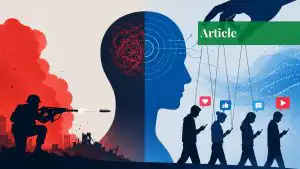
The most consequential battles of the 21st century will not be fought with drones, hypersonic missiles, or cyberattacks. They will be waged inside the human mind – artificial intelligence vs. human intelligence. As AI evolves, it becomes a weapon not merely for physical destruction but for psychological domination—a tool to hack emotions, exploit cognitive biases, and rewrite the narratives that shape human behavior. This shift marks the new age of global power struggle, where controlling perceptions give superiority more than controlling territories.
Traditional warfare is all about breaking an enemy’s body, basically manslaughter, whereas AI-driven psychological warfare seeks to break their sense of reality. It is unlike the rough and obvious propaganda of the 20th century with simplistic messages. AI, on the other hand, enables hyper-personalized manipulation of the human mindset. It collects vast data to identify individual fears, desires, and ideological preferences, then generates narratives in such a way that they feel intimately true.
A teenager from Pakistan might see a post framing gender activism, specifically feminism, as a Western plot. At the same time, a European receives a video warning that immigrants will erase her culture and will take their jobs on their “for you page.” Their worldviews are fragmented by algorithms and AI applications that they cannot see or comprehend. “Seeing is believing” is prioritized over the search for truth.
 You will find more infographics at Statista
This represents a spontaneous shift in global power dynamics. For millennia, humans have struggled to dominate land, resources, or institutions. Now, the battlefield is the “consciousness realm,” the realm of the known but unknown. States and corporations using AI can easily bypass traditional institutions like governments, schools, and media to instill ideas directly into the young generation’s minds.
The danger lies not only in what people are made to believe but also in how they believe it. AI can exploit the brain’s vulnerability. It can trigger emotional responses really quickly. When fear, anger, tribalism, or ethnic segregation overtakes logic, societies are fragmented into little bubbles of “truth.” And the shared reality of democracy, cooperation, and human rights is crushed into rubble.
This erosion of realities has geopolitical consequences. Imagine a future where AI systems, trained on decades of cultural data, simulate entire populations to test propaganda strategies. In this Matrix-esque world, let’s suppose a foreign power deploys AI-generated influencers with an uncanny resemblance to humans to destabilize a rival nation. Issuing statements that further fuel the existing ethnic tensions, undermining trust in elections, promoting unrealistic standards, redefining needs, or simply inciting the teenage population toward illicit activities.
Unlike nuclear weapons, these tools leave no radioactive trace. So, there is “no trial, no repercussions.” The result is a world where conflict is constant, borders, and traditional defense are meaningless. Every individual is a potential combatant in a war they don’t know “exists” and a threat lingering over their heads.
 You will find more infographics at Statista
Yet, the gravest threat may be existential. AI, however, can weaponize this evolutionary adaptation. By using the stories that unite the communities, using religions, national myths, and history, even the popular consensus, it could damage the fabric of human civilization. A society that cannot agree on basic facts cannot tackle climate change, pandemics, or inequality. It becomes a collection of paranoids, each group claiming that others are deluded.
To survive this paradigm, humanity must confront two urgent questions. First, how do we regulate AI’s role in shaping perceptions without impacting the right to free speech? Complete bans on algorithms or data collection are impractical and hinder the potential achievements human civilization can gain, but transparency could help in solving this dilemma. For instance, introducing laws requiring AI-generated content to carry digital “watermarks.”
Second, and more critically, we must redefine human agency in the age of cognitive warfare. Education systems must prioritize critical thinking over memorization. Media literacy programs and grassroots movements to rebuild communal trust must not be considered optional, as they are a defense against mind colonization. Just like vaccines are used to make the immune system stronger and able to recognize pathogens, engraving these can improve our cognitive strengths against manipulation.
The underdeveloped world urgently needs policy reforms, considering this a national emergency. The power gap that AI will create will be much worse than the existing economic gap, and it will be impossible for such states to ever come close to the developed ones.
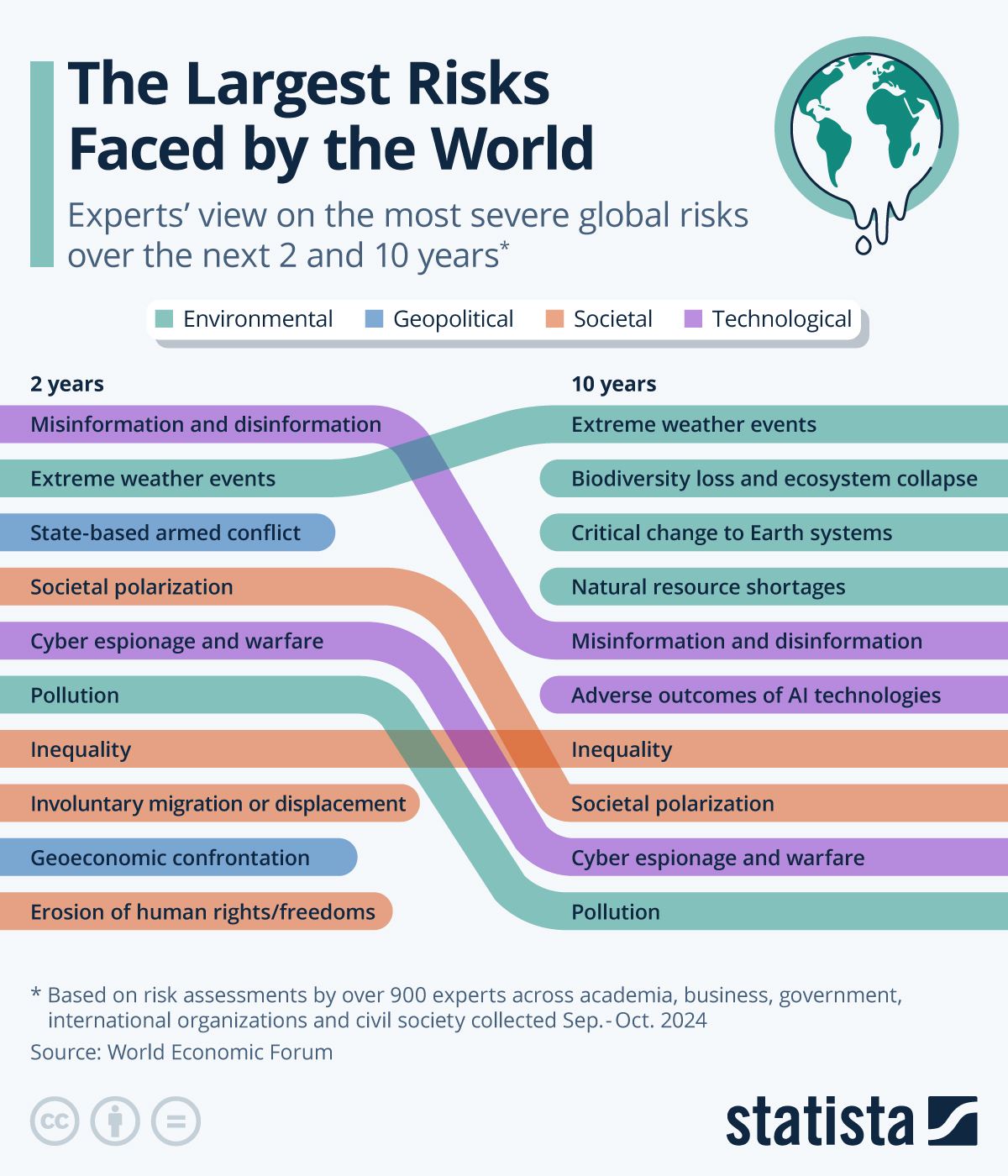 You will find more infographics at Statista
Ultimately, the challenge is not technological but philosophical. And the crucial question here is: What makes a thought authentically “human” when AI, at this point, can mimic creativity, empathy, and intuition? It is not far when it will be impossible to distinguish humans from AI. If we outsource the curation of reality to machines, we might become a species that no longer understands its own emotions. Never forget that the future of conflict will not be won by those with the smartest algorithms but by those who remember that the human mind is not a machine to be programmed but a universe to be understood.
If you want to submit your articles and/or research papers, please visit the Submissions page.
To stay updated with the latest jobs, CSS news, internships, scholarships, and current affairs articles, join our Community Forum!
The views and opinions expressed in this article/paper are the author’s own and do not necessarily reflect the editorial position of Paradigm Shift.

The writer is a researcher and analyst of international relations.