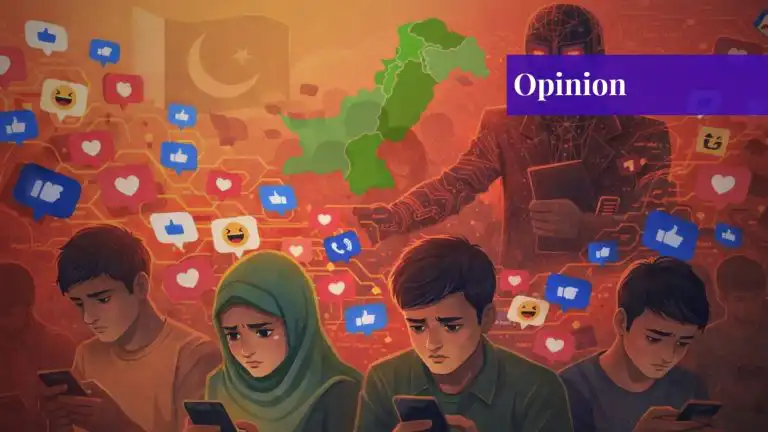
Late into the night, millions of young Pakistanis are still awake, scrolling on their phones. It’s rarely just for fun or curiosity anymore — it feels more like something they can’t control. Their thumbs keep moving almost automatically, their minds feel restless, and sleep gets sacrificed, one video after another.
What seems like a simple personal choice is actually far from it. Behind every video, post, and trending sound, there’s an algorithm quietly deciding what we see, how we feel, and slowly shaping the way we think.
Many young Pakistanis are quietly fighting with themselves. They feel guilty for wasting so much time on their phones, get irritated when they see their friends doing better, and constantly worry about not being good enough compared to others online. Yet, despite all these struggles, they can’t seem to stop scrolling. Every notification makes their heart beat faster. Their mind swings between wanting more and feeling anxious, but the cycle somehow continues.
Every day, students sit with books in front of them, but their minds are elsewhere. They struggle with self-doubt, jealousy, and the constant fear that they are falling behind. Deep down, they know they should be studying, resting, or spending time with friends in real life, but the phone keeps winning. This is the hidden struggle so many young people are facing — a whole generation fighting with itself, where the battle inside feels just as endless as the scroll outside.
These algorithms weren’t built to teach or inspire us. Their real purpose is simple: keep us watching, liking, and sharing for as long as possible. That’s why they push angry content, extreme opinions, and dramatic posts far more than calm, balanced voices. Thoughtful discussions rarely go viral. Instead, people are constantly fed things that trigger anger, envy, fear, or obsession—because those emotions make us stay longer. Over time, this endless stimulation weakens our attention span, drains our emotional strength, and makes it harder to reflect on our lives. Anxiety slowly becomes a normal part of the day—sitting with students in classrooms, libraries, and bedrooms—quietly affecting their focus, motivation, and relationships.
The Endless Scroll
Pakistani youth are drowning in a cascade of algorithm-curated content. By 2024, 54.38 million adults (38.9% of those 18+) were active on social media. TikTok alone counts 54.38 million users aged 18 and above in Pakistan. This nonstop stream optimized for engagement is testing young brains. Critics warn the “TikTok generation” has “shorter attention spans to details.” World Health Organization data echo the warning: a recent report notes that uncontrolled social media use can “lead to depression, bullying, anxiety, and poor academic performance.”
Beyond distraction, algorithms promote a culture of comparison. According to Pakistani studies, social media has a psychological impact. For example, a study of 300 Karachi undergraduates found that 40% scroll Instagram for 2-4 hours per day, and 57% stated being more stressed after using the app. Similarly, nursing students in Karachi found a clearly favorable link between excessive social media use and depression. According to research conducted in Islamabad, higher Instagram use“strongly predicts decreased self-esteem,” which leads to higher instances of depressive disorders. In effect, crafted highlight reels foster anxiety, since inescapable “inward comparisons” cause youngsters to believe they are frequently lacking. Online platforms intensify the fear of missing out (FoMO) on a massive scale. One Pakistani study found a direct, positive correlation between FOMO and social-media addiction. In urban areas with universities, many young people search for affirmation rather than information, and many leave feeling worse.
This loop of comparison and validation develops an internal conflict. The same student who knows they should study or sleep swings by support, worry, and peer pressure. Anxiety becomes relentless, a mental tug-of-war from which few can break free. Self-esteem, ambition, and even daily moods are all in transition as young minds balance purpose and distraction. Every scroll quietly feeds your self-doubt, even as it distracts you with entertainment. The war inside remains invisible, but it slowly drains you.
Polarization in the Feed
The societal implications are similarly depressing. Algorithms do more than simply entertain; they amplify division. According to a recent Pakistani study, tailored feeds “considerably boost polarization.” Pakistani users who believe they see varied perspectives may instead be caught in hidden filter bubbles. A Tribune columnist illustrates and writes; a teenager clicks on an engaging religious lecture, and within weeks his feed might become “flooded with information that grows steadily more challenging, angrier, and more intolerant.” He didn’t go looking for violence; the algorithm found him. Indeed, the author cautions that Pakistan’s youth are being secretly conditioned to be outraged: “The algorithm is already the most effective recruiter in the country,” causing content recommendations to have pushed millions of young people into echo chambers that didn’t exist in prior generations. The emotional toll of this quiet struggle worsens the internal conflict, with bitterness, fear, and doubt competing for mental space alongside anxiousness.
Reclaiming Control
How can a self-conflicted generation achieve harmony? Experts suggest that Pakistani institutions need to modernize. UNESCO-led programs focusing on Media and Information Literacy highlight the importance of teaching critical analysis of algorithms and biases. Practically, incorporating digital literacy into university programs could enable students to critically evaluate online information rather than merely accept it. At the same time, families and educators should foster in-person connections: One survey indicates that over 33% of adults globally now experience persistent loneliness, an increase from 23% ten years ago. In educational settings, setting aside time without screens—opportunities for direct conversations—can help restore emotional resilience.
The answer lies in both internal and external factors. Young people in Pakistan must take back charge of their focus, address the anxiety caused by social comparisons and division, and cultivate the patience, empathy, and self-awareness that algorithms undermine. This is a continuous, subtle battle—a conflict waged in bedrooms, classrooms, and minds—that necessitates awareness, purpose, and guidance. Only by facing their internal emotional and cognitive struggles can they disrupt the cycle of anxiety and reclaim their sense of agency.
The psychological, social, and intellectual development of Pakistani youth has been transformed by algorithm-operated digital platforms, which became common after 2000. People can access information and communicate with others through these technologies, but their unregulated use leads to increased anxiety, social comparison, and societal divides. People need to reject technology in order to solve their problems, but they should create a more aware and knowledgeable connection with technological systems. The educational system needs to establish pathways for students to learn digital literacy and media awareness, which will help them interpret algorithmic systems that control their emotional responses. Families and communities need to promote better digital usage patterns together with increased time spent on offline activities, which will help people achieve a balanced lifestyle. The development of technology that benefits humanity depends on young people acquiring knowledge and building resilience as essential skills.
If you want to submit your articles and/or research papers, please visit the Submissions page.
To stay updated with the latest jobs, CSS news, internships, scholarships, and current affairs articles, join our Community Forum!
The views and opinions expressed in this article/paper are the author’s own and do not necessarily reflect the editorial position of Paradigm Shift.

Nisar Khan Kakar is a writer and poet and a BS English student at Quaid-i-Azam University, Islamabad, Pakistan, hailing from District Killa Saifullah, Balochistan. He serves as Assistant Coordinator for Literary Prose at the Quaidian Debating and Literary Society (QDLS).