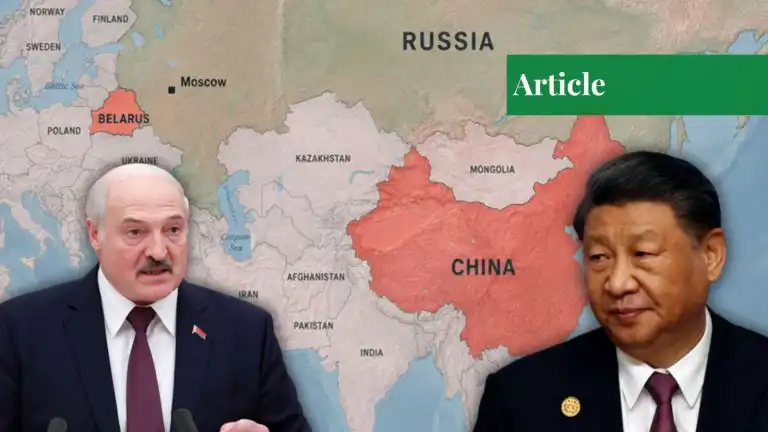
On June 29, 2026, Belarusian President Alexander Lukashenka (Аляксандр Лукашэнка) met with Chinese President Xi Jinping in Beijing during an unannounced visit to the People’s Republic of China.
This was his first visit to the People’s Republic of China since September of the previous year, when President Lukashenko took part in the Chinese military parade in Beijing to mark the 80th anniversary of the victory of the Chinese people’s war of resistance against Japanese aggression and the World Anti-Fascist War, and in the Shanghai Cooperation Organization (SCO) summit in Tianjin.
At the same time, this was also the second visit of the Belarusian head of state to East Asia, after he visited the Democratic People’s Republic of Korea (DPRK or North Korea), on March 25-26, 2026, where he met with the President of the State Affairs of the DPRK, Kim Jong Un.
Meanwhile, another notable feature of this visit was that it came immediately after the Belarusian President met with the special envoys of Ukrainian President Volodymyr Zelensky, which was followed by a meeting tête-à-tête with Russian President Vladimir Putin at his private residence in Valdai, in the Novgorod Oblast.
As The Wall Street Journal has lately reported, by citing current and former European and Russian officials, Moscow is significantly increasing direct and indirect pressure on Minsk, seeking to draw Belarus into more active participation in the Russia’s ongoing armed conflict with Ukraine, including threatening to cut off Russian financial support for Minsk, which is much needed for the Belarusian government currently still isolated from the Western markets or Western economic assistance.
Thus, it is natural that, while facing this critical geopolitical and economic situation, Minsk would turn to its last remaining major ally and the only one wielding significant political influence over the Kremlin: the People’s Republic of China (PRC).
Why Is Belarus So Important To China?
Although on the one hand, Beijing appears keen for the armed conflict in Ukraine to continue—a stance that while weakens Russia economically and continues to keep it diplomatically isolated, thus making it possible for the PRC to continue its tactic of keeping Moscow under a politico-economic controlled dependency—also helps keep the attention of the West (the European Union, NATO and especially the United States) largely focused on Eastern Europe situation, rather than on Northeast Asia.
On the other hand, of course, Beijing has no interest in Belarus also becoming a battlefield—firstly because this would represent a dangerous escalation of the war, which could even lead to possible NATO intervention, and secondly because Belarus is an important transit territory, through which the Northern Eurasian Trade Route passes—a railway trade line that runs from Vladivostok to Brest and from there on to Poland and other European Union countries.
Meanwhile, with Russia’s industrial weakening, Chinese industries (especially the telecommunications and automotive industries) are dominating the Belarusian market, which, as we have mentioned above, is currently isolated from the possibility of having access to the Western markets, leaving it with the option of diversifying its trade relations only with a limited number of countries from the Eurasian Economic Union or ASEAN.
At the same time, Minsk, the capital of Belarus, is home to one of China’s largest special economic zones in Europe—the Chinese–Belarusian Industrial Park ‘Great Stone/Вялікі камень’—which hosts many Chinese-capital companies (such as China Merchants Group, Huawei Technologies, MAZ-Weichai, ZTE Corporation, etc.) that see Belarus as a gateway to European markets and European consumers. Thus, it is clear that if the conflict were to spread to Belarus, it would cause a major geo-economic and logistical loss for Beijing.
Belarus As Part Of Beijing’s Geo-Economic Strategy
Besides its geo-logistic importance, Belarus is also a key geopolitical ally of the PRC.
Since December 2013, Belarus has been part of the ‘One Belt, One Road’ Initiative—an ambitious geo-economic initiative by Beijing aimed at modernizing regional infrastructure and creating a global network of trade corridors linking more than 100 countries in East and Central Asia, Sub-Saharan Africa, and Central and Eastern Europe.
Meanwhile, from July 4, 2024, Belarus has also become a full member of the Shanghai Cooperation Organization (SCO)—a Chinese-led politico-economic and security organization, aiming to strengthen stability, security, and economic partnership between countries of Eurasia.
It is worth mentioning here that even though Russia, a country part of both of these Eurasian integration mechanisms, is today engaged in an ongoing brutal armed conflict, its status as one of the world’s major superpowers does not undermine Beijing’s authority, since every major power has its own geopolitical agenda. However, in the event that the conflict spreads to Belarus, this would demonstrate that the PRC is not capable of serving as a security and stability guarantor for its partners and allies, in the face of the harsh geopolitical realities of post-Soviet space.
A Warning For The Kremlin?
During the meeting on 29 June between Belarusian President Alexander Lukashenko, President Xi Jinping noted that relations between Minsk and Beijing are at a ‘historic high‘ and that the People’s Republic of China supports Belarus in defending its sovereignty, independence and national territorial integrity.
The Belarusian state media have paid particular attention to these words by the Chinese leader, as they represent the first statement by a head of state of a major power in support of Belarus’s neutral position in the context of the ongoing armed conflict in Ukraine.
On the other hand, they have also been seen by many Western commentators and observers as an indirect warning to Moscow rather than to Kyiv or Brussels, in case the Russian leadership were to try to derail its traditional mechanisms (military provocations or economic pressure) to draw Minsk into joining Russia in its ‘special military operation’.
If this is the case, this would indicate that the political influence of the PRC over Moscow, during these 4 years of the Russian-Ukrainian armed conflict, has reached levels comparable perhaps only to that of the Mongol khans over the Kyivan Rus.
Lastly, although at the moment there is still no clear information for the general public about the talks in Valdai between the leaders of Belarus and Russia, we can say that President Lukashenko’s visit to Beijing and his meeting with President Xi Jinping, marks a highly symbolic movement, which shows that Belarus, like the countries of the Caucasus and Central Asia, is gradually emerging from Moscow’s orbit towards a more balanced and multi-vectorial geo-political and geo-economic approach to the new challenging global realities.
If you want to submit your articles and/or research papers, please visit the Submissions page.
To stay updated with the latest jobs, CSS news, internships, scholarships, and current affairs articles, join our Community Forum!
The views and opinions expressed in this article/paper are the author’s own and do not necessarily reflect the editorial position of Paradigm Shift.

Eljanos Kasaj is a student from Albania currently enrolled at the Institute of Political Science and World Politics. He is specializing in Global Security at the University of Wrocław (Poland).