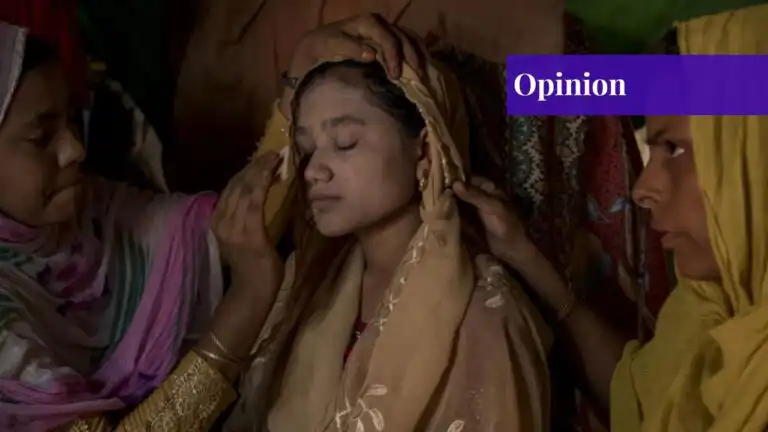
On May 30, 2025, President Asif Ali Zardari signed and assented to the Islamabad Capital Territory Child Marriage Restraint Bill, 2025. The National Assembly of Pakistan unanimously passed this bill criminalizing child marriage in the Islamabad Capital Territory (ICT) earlier on May 17, 2025. The legislation was passed with great haste, sidestepping regular legislative practices to show how serious the legislature is about prohibiting child marriage.
The bill was assented to despite strong opposition from the Council of Islamic Ideology (CII) and the religious community, who consider this bill “anarchic” and “un-Islamic.” However, the Federal Shariat Court took a completely different approach. It may have taken too long to pass the bill, but it is part of a broader trend. Although it is not widely known from outside, significant developments have occurred in Pakistan’s judicial system.
Is the Bill Un-Islamic?
In 2023, the Federal Shariat Court (FSC), the constitutional guardian of Islamic injunctions in legislation, dismissed a petition that challenged the Sindh Child Marriage Restraint Act, 2013, which had set 18 as the minimum marriage age. The FSC supported the law, but also stated that the decision to fix 18 as the minimum age was entirely consistent with Islam and the maqasid al-shariah (goals of Islamic law).
In PLD 2023 FSC 265, the petitioner argued that the minimum age of 18 in the Sindh Marriage Restraint Act, 2013, was against Islamic law and should be replaced by puberty as the criterion. Nevertheless, the FSC made a detailed and reliable decision using the Quran, Hadith, and the knowledge of Islamic scholars over the years. The FSC categorically stated that:
“Fixing a minimum age for marriage is not against the injunctions of Islam…It provides reasonable time for girls to complete basic education, which helps in developing mental maturity (Rushd/رشد).”
The court decided that Islam considers mental maturity, not only puberty, as a necessary prerequisite for marriage. The court referred to Surah An-Nisa, Ayah 6, to underline that a person needs rushd or good judgment to make key decisions, including managing property and engaging in marriage. Besides, the FSC relied on the idea of sadd al-dhara’i (barring actions that could be harmful) and masalih mursalah (public interest) to justify legislative intervention and stated:
“The State can set minimum age thresholds to prevent social harms…such laws fall under the legitimate exercise of legislative authority within the objectives of Shariah.”
Hence, a full bench comprising Chief Justice Dr. Syed Muhammad Anwar and Justice Khadim Hussain Shaikh ruled decisively that a legislative age limit of 18 is Islamic, constitutional, and necessary.
The Injustice of Unequal Child Marriage Laws
In 2013, Sindh became the first province in the country to pass a law preventing anyone under 18 from entering a marriage, including both boys and girls. Unlike Sindh and Pakistan’s other provinces, Punjab, Khyber Pakhtunkhwa, and Balochistan still allow girls to marry at 16 according to the Child Marriage Restraint Act, 1929. Due to this inconsistency, a girl in Karachi has freedom, but a girl in Punjab can marry at 16, which is so tender.
As a result, justice is not enforced equally across all provinces, enforcement is uneven, and most importantly, it goes against what Article 25 of the Constitution promises. Article 25 calls for equality of citizens irrespective of gender, religion, caste, or creed. It further goes against Pakistan’s responsibilities under the Convention on the Rights of the Child (CRC) and Sustainable Development Goal 5.3, which are both against child marriage in all its forms.
Girls married before the age of 18 tend to experience the worst gender-related issues, such as forced pregnancy and deaths during childbirth. This is one of the reasons that Pakistan is the second-lowest-ranked country in the world in terms of gender parity, standing at 145th out of 146 countries in the Global Gender Gap Report 2024 by the World Economic Forum. Child marriage should not be seen only as a cultural issue. It creates a situation where education, health, and freedom are negatively affected.
Since Parliament and the Federal Shariat Court have now agreed, there is no more reason to wait. The provinces of Punjab, KP, and Balochistan must update the 1929 law to ensure girls can only marry at 18. Implementing this reform requires setting up means to enforce it, educating the police and judges, and running campaigns to change attitudes that harm society.
Pakistan is now presented with a special window of opportunity. If the law protects women in Karachi and Islamabad, it should also do the same for women in Lahore and Peshawar. Since child marriage is a human rights issue, it should be tackled similarly everywhere by all provinces.
If you want to submit your articles and/or research papers, please visit the Submissions page.
To stay updated with the latest jobs, CSS news, internships, scholarships, and current affairs articles, join our Community Forum!
The views and opinions expressed in this article/paper are the author’s own and do not necessarily reflect the editorial position of Paradigm Shift.

Ameera Khurshid is a law graduate from Kinnaird College for Women, Lahore, practicing criminal and constitutional law. She can be reached at ameera.khurshid2000@gmail.com