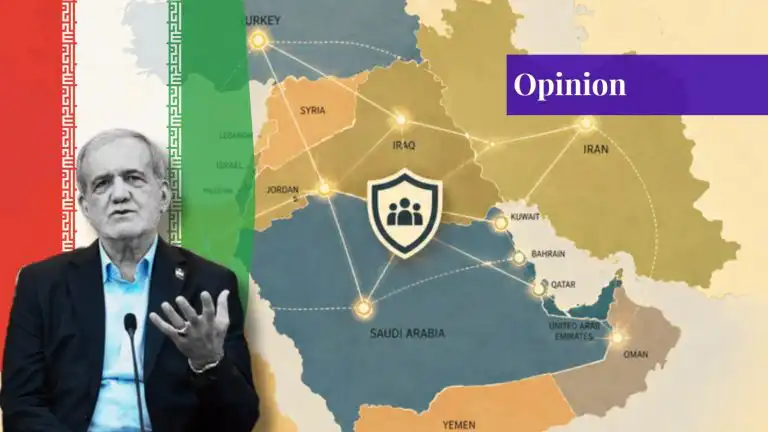
During his official visit to Islamabad, Iranian President Masoud Pezeshkian called for the establishment of a new regional security framework in the Middle East and the Gulf region based on mutual respect, cooperation, and dialogue. He emphasized that the region’s future should be determined by its member nations rather than by foreign powers. This comes at a time when the Islamabad Memorandum of Understanding was signed between the US and Iran last week. With Iran gaining strategic leverage, it appears to have emerged more resilient and influential than it was before the outbreak of the conflict.
The conflict between the US and Iran has exposed the limits of military coercion and security guarantees. Neither extensive bombing nor external dependence can ensure long-term peace and stability. Only resilience and self- sufficiency can do that. Gulf states have realized this since the US was unable to defend them against Iranian attacks. They are now diversifying their security partnerships rather than relying solely on Washington. Saudi Arabia, UAE, Qatar, Kuwait, and Bahrain are investing in their self-defense and strategic autonomy. The Saudi-Iran rapprochement has paved the way for regional diplomacy and a coordination mechanism. Gulf countries want peace and stability in the region to safeguard their investments, infrastructure, energy exports, and freedom of navigation in the Strait of Hormuz. They are seeking an off-ramp with Iran to de-escalate tensions and establish a conflict-resolution framework. Iran has remained resilient in the face of US military coercion, emerged from the conflict with significant geopolitical leverage over the Strait of Hormuz, and is seeking an opportunity to reshape the regional security order.
The new proposed security framework should be based on multilateral cooperation among regional countries. Institutionalized dialogue and diplomacy between Iran and the Gulf states would help bridge differences and increase the prospects for mutually agreed conflict-resolution mechanisms. However, dialogue and cooperation cannot succeed without resolving underlying regional disputes.
A non-aggression pact and confidence-building measures would increase trust and transparency. Maritime cooperation between Iran and the Gulf states would help to reduce the crisis in the Strait of Hormuz. Greater economic interdependence and deeper trade integration within the region would usher in a new era of cooperation in the Middle East. Under the Islamabad Memorandum of Understanding, the United States, together with regional countries, has committed to a program for the reconstruction and economic development of post-war Iran. This initiative would help Iran integrate more deeply into the regional economic order while contributing to the reduction of hostilities among regional actors. World powers such as China, Russia, EU would help to reduce the crisis through a regional conflict-resolution framework.
While in the short-term, mistrust between Iran and its neighbors remains widespread. In particular, Iran’s support for proxy networks such as Hezbollah in Lebanon, Houthis in Yemen, and Iraqi militias continues to pose a threat to regional countries. Gulf states remain sceptical of Iran’s revolutionary ideology, power projection, and expanding influence in the region. As long as Iran continues to export proxy groups across the region, the prospects for a comprehensive regional security architecture will remain elusive. Despite being sceptical of Iran, regional countries remain deeply involved in the peace process between the US and Iran. This flexibility shows their willingness to engage sincerely with Iran and build trust among the participating nations. The continuing détente between Iran and its neighboring countries will create an institutional framework of cooperation, dialogue, and diplomacy among them. Iran should engage with its neighbors to address their mistrust and concerns if it genuinely wants to shape a regional order. Otherwise, this proposed framework will remain a distant dream. For the proposal to work, regional countries should design a comprehensive dialogue mechanism where they can engage diplomatically and constructively to address the root causes of the conflict. Only sincere efforts toward conflict resolution will pave the way for understanding and trust among the Gulf states. A credible and durable security architecture will emerge only after major conflicts between Iran and neighboring countries are de-escalated, and states realize the importance of cooperation and the costs of confrontation.
The significance of Iran’s proposal depends on the follow-up process, but it doesn’t mean that a new regional security architecture will emerge immediately. As regional powers seek greater autonomy and economic predictability under the strained regional order, the question remains: are they willing to replace the old US-dominated security order?
If you want to submit your articles and/or research papers, please visit the Submissions page.
To stay updated with the latest jobs, CSS news, internships, scholarships, and current affairs articles, join our Community Forum!
The views and opinions expressed in this article/paper are the author’s own and do not necessarily reflect the editorial position of Paradigm Shift.