

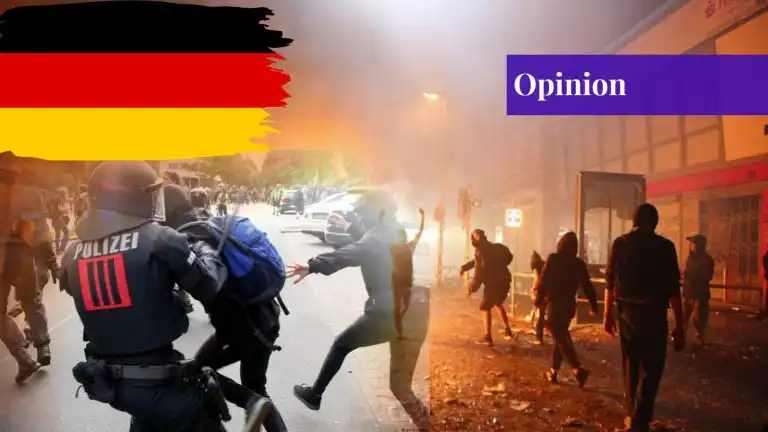
On 4 May 2026, a 33-year-old man drove an SUV into a crowd on a shopping street in Leipzig. Two people died and six were wounded. He had a criminal record and just a few weeks before had been reported by the police. There was no ideology, no manifesto, just an ordinary man with a history of violence. Leipzig was not an anomaly; it was a continuation of something that had started long before.
In Germany, people have to oppose two temptations simultaneously: the urge to reduce it to a migration crisis and present it as a random tragedy. Neither is accurate. According to Germany’s Federal Criminal Police Office (BKA), there were 29,014 recorded knife-related offenses in 2024, an average of 79 attacks every single day. Serious knife injuries admitted to German ICUs nearly doubled between 2014 and 2023. In Berlin alone, more than 3,400 knife attacks were recorded in a single year (PKS Berlin 2024). This data belongs to a state that has struggled to confront several underlying causes.
Street violence is easy to exploit for political purposes and challenging to avoid because it does not come from a single ideology or one type of person. In September 2025, a seventeen-year-old boy from Kosovo stabbed his teacher, a warden, and a homeless man on the street. Investigations showed that he had spent months absorbing extremist Islamist content on his phone, searching for Jews to kill near the city’s old synagogue. Some attacks are driven by ideology. Mental illness, when left untreated, also causes serious harm. A 39-year-old mentally ill German woman had attacked her own parents with scissors. Reuters reported that the same woman, in May 2025, stabbed 18 people with a knife at Hamburg Central Station. The trend of violence has developed over many years, as the growing underlying causes are left unresolved.
One of the biggest challenges in Germany is the mental health system because there is no single national standard for attackers. A court in one city can release someone that a court in another city would arrest. The psychiatric detention laws are different across all sixteen federal states. Unlike the RADAR database system in the Netherlands, there is no system of sharing information about dangerous persons among hospitals, clinics, and police stations. The Hamburg attacker moved through four incidents of violence across three months.
Each institution knew about only one of them. Administrative shortcomings extend beyond mental health; the migration and integration policies are also causing serious problems. More than a million people moved to Germany in 2015, but the expectation of a new life was suppressed because the language courses were overwhelmed, and unemployment peaked due to complicated credential processes. According to Reuters, by 2026, the German government had cut the integration course budget from €1.3 billion down to €650 million. In early 2026, more than 129,500 eligible people were told there were no available places. Isolation does not automatically cause violence, but it creates the conditions for radicalization and criminal behavior.
In 2024, the officials introduced a security package. Knives were banned at public festivals, on trains, buses, and in stations. Border controls were expanded to all of Germany’s land borders. Chancellor Friedrich Merz, after taking office in 2025, called the previous decade of German asylum policy “ten years of ruins” and vowed permanent border controls and faster deportations. These measures changed policy on paper but lacked practical implications.
Despite having a knife ban, the Hamburg attacker bought the knife inside the station and stabbed eighteen people. To prevent future attacks, there should be a system of sharing data on dangerous persons among the courts, clinics, and police stations in real time. Germany needs a mental health infrastructure for the mentally ill people to reduce the risk of their attacks. Integration program funding should be increased because these remain the only proven tools against radicalization. The attacks continued, and people carried the weight of insecurity on the streets, but the officials just passed some laws and announced some restrictions. The surviving man of that Hamburg attack told a reporter that he still hesitates at train stations. This kind of fear and mistrust is spreading.
Criminologist Dietrich Oberwittler of the Max Planck Institute said, “Germany remains one of the safest countries in the world.” His stats are right; Germany is not an unsafe country, but there is a difference between the data and the feelings of people on the streets. Press conferences and formal laws are not sufficient to build trust until courts start acting strictly on their warnings, when a psychiatric clinic and a police station share information about the same person, and when someone ordered to leave the country actually leaves. Germany has all the resources, credible institutions, and authentic data, but there is a lack of administrative drive and long-term planning to tackle these threats permanently.
If you want to submit your articles and/or research papers, please visit the Submissions page.
To stay updated with the latest jobs, CSS news, internships, scholarships, and current affairs articles, join our Community Forum!
The views and opinions expressed in this article/paper are the author’s own and do not necessarily reflect the editorial position of Paradigm Shift.

Abrar Hashmi is associated with the Institute of Regional Studies, Islamabad. He is also a student of international relations at Government College University, Lahore.