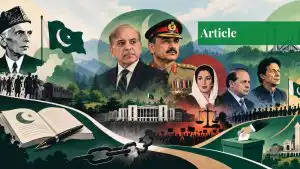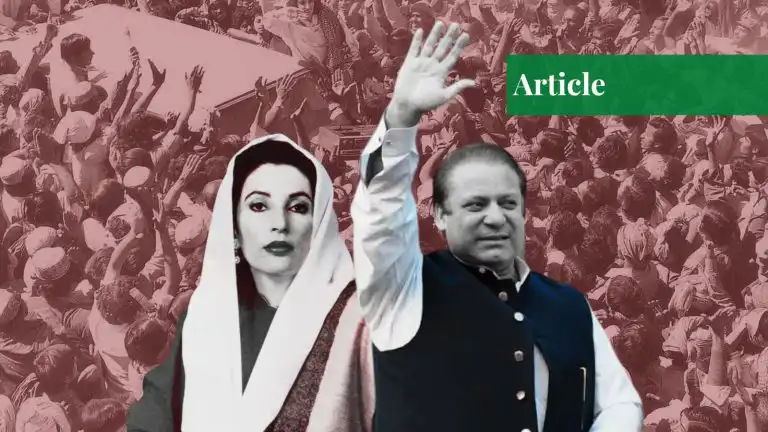
The abrupt fall of Zia-ul-Haq’s administration signified the return of Pakistan’s parliamentary democracy. The 1988 general elections brought Benazir Bhutto, the leader of the Pakistan People’s Party (PPP). It was the first time in history that such an important step towards democracy in a Muslim country was made, because it meant that a woman had become the head of the government in a predominantly male society.
However, there were no grounds for optimistic expectations about a stable democratic government since Benazir’s administration worked in the conditions of strict control; namely, the power of the presidency, opposition, and constant military interference restricted the freedom of the federal government.
Benazir Bhutto’s First Term (1988–1990)
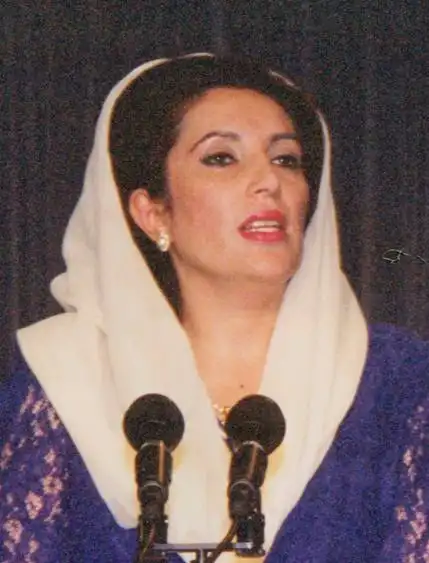
The Pakistan People’s Party won the 1988 elections, securing 92 seats out of 205. For the first time in the political history of Pakistan, a female Prime Minister, Benazir Bhutto, was sworn in as the leader of the country. On her election as the first woman PM, Ghulam Ishaq Khan stated, “She is a young, educated, decent, and capable lady. She has immense love for the country and has the spirit of service to the masses.”
Ghulam Ishaq Khan was appointed as the President of Pakistan on December 12, 1988, for a period of five years. Ghulam Ishaq Khan implemented the policy of “Divide and Rule.” He has played an active role in center-province relations. The government of Benazir Bhutto became the target of various contradictions and crises, particularly the government of Nawaz Sharif in Punjab. The opposition has also accused the Zardari family of earning commissions on all the business deals that the government has approved. Ms. Bhutto had granted an overall pardon for all the prisoners. Hundreds of rapists, murderers, and saboteurs were also pardoned through the Prime Minister’s executive order.
The province of Baluchistan also experienced some difficulty adjusting to the center. The Chief Minister Nawab Akbar Khan Bugti, who himself harbored some grievances with the PPP and was encouraged by Ghulam Ishaq Khan, joined forces with the overly ambitious Nawaz Sharif in destabilizing the center. Actually, she let herself get diverted from these two things. One, the lust for controlling all the opposition parties. Two, she let her husband take advantage of the political power he wielded for his personal gains.
In view of the situation that prevailed at the time, Ghulam Ishaq Khan dissolved the government of Benazir Bhutto by virtue of the 8th amendment. Despite being elected as the President of Pakistan for the next 5 years by the government of Benazir Bhutto, she later conceded that this was her greatest blunder in politics.
Nawaz Sharif’s First Term (1990-1993)
Islami Jamhoori Ittehad (IJI) got a victory in the 1990 elections, winning 105 seats. Nawaz Sharif was sworn in as the Prime Minister of Pakistan in November 1990. According to Nawaz Sharif, the IJI government aimed to establish everlasting and refined democratic traditions within and outside the house. But these expectations have not yet come true. The government always used ordinance-making powers from 1990 to April 1993; a total of 78 ordinances were issued, out of which 28 ordinances were not even referred to the cabinet by the government, which was a statutory duty of the government. In fact, extensive use of the ordinance-making powers of the government had decreased the role of parliament in such a way that parliament became a mere rubber stamp instead of making and remaking laws.
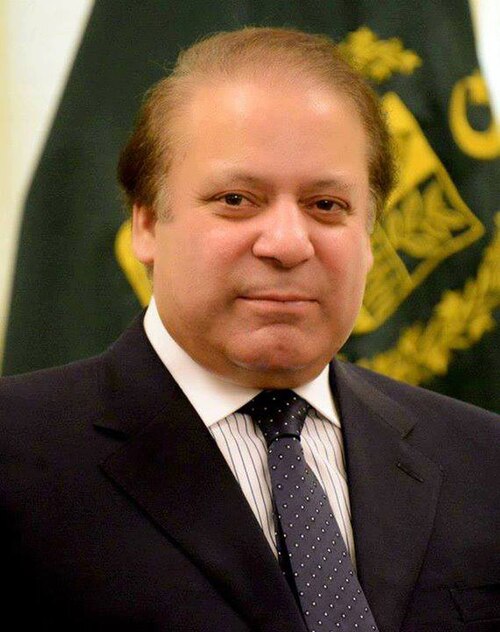
The majority of the policies implemented by the IJI government were unplanned and unsystematically formulated. Therefore, the actions undertaken by this government, such as the yellow cab taxi scheme, in which the majority of those people who had these cabs did not qualify for having them, since there was no official check to see that the distribution of these cars was done properly. The lack of proper planning ensured the failure of this scheme, too. Moreover, the introduction of Bait-ul-Mal, strict action against food adulteration, and the ban on illegal weapons were also short-lived due to a lack of any organized plan. In addition, the IJI period was criticized for adopting a policy of favoritism and rule of law. Favoritism was extended even in relation to arrest cases, such as which arrest was to be made and which arrest was not to be made, and who needed to lodge an FIR and who would be allowed to remain at the police station without informing any concerned legal institutions.
The conflict between the president and the prime minister took place in January 1993, because at that time, the Army Chief General Asif Nawaz died, and the issue became who would replace him. The President appointed his own nominee, General Abdul Waheed Khan, to be the Army Chief. In February, Nawaz Sharif declared publicly his intentions to revoke the eight constitutional amendments, but all in vain, as he was isolated by the opposition. The other person who actively helped to dismiss the Nawaz Sharif government by the President of Pakistan was Benazir Bhutto, who was adept enough to make use of the differences between Nawaz Sharif and Ghulam Ishaq Khan.
Finally, Nawaz Sharif tried to take another step for his own benefit and nominated Ghulam Ishaq Khan as his candidate for the Presidential election, but the opportunity had long been missed. Nawaz Sharif made it clear that he will not submit to any pressure from the President. He stated that he would not resign or dissolve the National Assembly on the demand of Ghulam Ishaq Khan. The sequence of reviving the national assembly and reconstituting the Nawaz Sharif government became nullified in light of the fact that on July 18, 1993, the prime minister had to resign and advise the president to dissolve the national assembly through Article 58 of the Constitution. The president duly followed this advice; however, by doing so, he also had to resign, and he resigned the very next day on July 19, 1993.
Benazir’s Second Term (1993-1996)
Following the resignation of Ghulam Ishaq Khan, Waseem Sajjad, who was the chairman of the Senate, was inducted as the acting president of Pakistan. The President thus got the job of conducting elections in an impartial manner within the country. The national as well as provincial assemblies’ elections were conducted on the 6th and 8th of October 1993, respectively. The party of Benazir Bhutto, named PPP, emerged as the leader and secured 86 seats.
The PPP formed a coalition government with the help of the PML (Junejo Group), headed by Hamid Nasir Chatta and others from the center. Benazir Bhutto had to face several difficulties, as her party did not have a majority in the center as well as in the province of Punjab, where she formed the government through a coalition with PML (J). Law and order in many urban centers of Pakistan under her government were in their worst state. One of the main difficulties was the law-and-order situation in Karachi, which was very poor.
Political violence increased further in April 1994 when MQM announced it would start another agitation for the realization of its demands. On 5th November, 1996, President Farooq Ahmad Khan Leghari dissolved the National Assembly and appointed Malik Meraj Khalid as caretaker Prime Minister with an assurance for holding elections on 3rd February, 1997.
He said that the government had ignored the Supreme Court’s rulings and had been ridiculing the judges. There are claims that Benazir Bhutto’s government conducted phone tapping of Supreme Court judges, army generals, and high-ranking government officials. Corruption was among the allegations made by President Leghari against Benazir Bhutto when he dismissed her government in November 1996.
Nawaz Sharif’s Second Term (1997-1999)
General elections were held on February 3, 1997. The results of the elections turned out to be surprising not only for the common people but also for the analysts and organizers. The party PPP, which had ruled at the center as well as in Punjab and NWFP for three years, was hit hard. PPP won only 136 seats in the National Assembly, and its close ally, ANP, 10 seats, and hence a two-thirds majority for the PML became a certainty. In the entire voting history of Pakistan, no other party could win such a large number of votes. His motto for implementing this program was “Qarz Utaro Mulk Sanwaro.”
Two fundamental changes have been made by the government of the Muslim League in the political system that followed Zia because of their majority in the parliament. These changes came in the form of two important amendments, namely the Thirteenth and Fourteenth in the Constitution. The Thirteenth Amendment gave back the parliamentary character to the Constitution by reducing the powers of the president to those of a mere figurehead. In accordance with this amendment, the president could not use his right to dissolve the National Assembly.
The relations between the Prime Minister and the COAS General Pervez Musharraf were strained on the Kargil question. The Prime Minister was searching for someone who would give him security. When the movement led by Musharraf gained momentum, the plan was to remove Musharraf and appoint Lt. General Khwaja Ziauddin as the Director General of the ISI and the new army chief. That very evening, the television of Pakistan informed about this very significant change in a regular fashion, introducing the new COAS, General Ziauddin, and his new badges of rank while Musharraf was visiting Sri Lanka officially.
Meanwhile, Nawaz Sharif had ordered the aviation authority to keep the aircraft from landing at Karachi Airport. While this drama between Musharraf and Sharif was unfolding on the night of October 12 and into the early hours of October 13, 1999, the Pakistani public waited in anticipation for the end results. Once Musharraf had landed successfully, he immediately overthrew Nawaz Sharif.
Conclusion
The period from 1988-1999 is considered the decade of democracy in Pakistan, after a long period of dictatorship; however, democracy failed to thrive during this era. This era proved to be the worst for many reasons; for instance, the performance of the elected governments became so bad that there were eleven governments during this era. The economic situation of this era remained deplorable, and there were economic sanctions against Pakistan. Civilian government and the army had poor relations with each other; the tension was so high that the army intervened in politics in 1999.
If you want to submit your articles and/or research papers, please visit the Submissions page.
To stay updated with the latest jobs, CSS news, internships, scholarships, and current affairs articles, join our Community Forum!
The views and opinions expressed in this article/paper are the author’s own and do not necessarily reflect the editorial position of Paradigm Shift.

Syed Hammad Ali is pursuing a BS in International Relations programme from the International Islamic University, Islamabad, and has a keen interest in research works, policy analysis, defence and strategic studies, and conflict resolution.