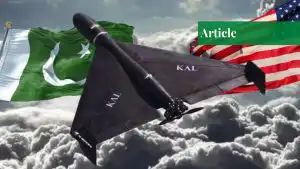


When the Pakistan Air Force claimed to have killed a target using a PL-15 beyond-visual-range missile during the May stand-off with India, that particular moment produced a spark that the international community could not set aside. In Islamabad, the reaction was relief as much as pride. It revealed decades of Chinese aerospace partnership that had given real outcomes that could be tested on a battlefield. But underneath that success moment sits an uncomfortable question for Pakistani strategists who have been consistently deflecting for years: what has this partnership actually cost, and where does this ultimately lead?

On its surface, the relationship is genuinely impressive. The JF-17 Thunder addressed a genuine and pressing capability gap, a maintainable multirole platform at a moment when Western suppliers had made their political calculations clear and made pricing out of reach. The J-10C acquisition made the relationship more sophisticated, introducing an AESA-equipped fourth-generation-plus fighter and the PL-15, a missile that arguably outranges anything the Indian Air Force currently fields in comparable numbers. Alongside these platforms, China-supplied Air defense infrastructure, radar systems, and electronic warfare capabilities have given Pakistan’s aerospace architecture a degree of internal coherence that it lacked a generation ago. That is the asset side of the ledger, and it deserves honest acknowledgment before anything else is said.
The dependency side, however, is where the conversation turns genuinely uncomfortable and where Pakistani strategic thinking has conspicuously failed to keep pace with operational enthusiasm.
Pakistan has assembled JF-17s at PAC Kamra for over fifteen years. What it has not done is develop an independent capability to design, engineer, or fundamentally modify the platform. That distinction matters enormously in ways that peacetime operational metrics completely obscure. Assembly is a production skill. Engineering is a strategic capability. China has carefully ensured Pakistan received the former without the latter, and that choice was deliberate, not incidental. The JF-17’s original powerplant, the Russian RD-93, was itself a glaring vulnerability since Pakistan could not even source the engine from its primary defense partner. The transition to the Chinese WS-13 is an operational improvement, but it replaces one foreign dependency with another. Critical subsystems, including the mission computer, radar software, and electronic warfare suite, remain effectively black boxes. Pakistan operates them with competence. It does not understand them at the engineering depth required to independently upgrade, modify, or sustain them through a prolonged high-intensity conflict, and that gap between operational proficiency and genuine technical sovereignty is where strategic risk quietly accumulates.
Retained leverage by the arms supplier is not unique to this relationship. It is a structural feature of almost every major defense transfer arrangement in modern history. What makes Pakistan’s situation distinctive is the complete absence of any serious diversification strategy to counterbalance it, and that absence carries consequences extending well beyond peacetime inconvenience.
Consider the scenario: Pakistani planners need to sit honestly. Imagine not a 48-hour aerial exchange but a weeks-long conflict with serious platform attrition across multiple fronts. Pakistan’s front-line fleet is overwhelmingly of Chinese origin. Spare parts, replacement components, munitions replenishment, software maintenance, all of it runs through Beijing. China, making its own sovereign strategic calculation, decides that active resupply risks drawing it into confrontation with India, a bilateral relationship Beijing is simultaneously managing through its own complex diplomatic and economic channels. Pakistan would face the worst possible situation: a shooting war with degraded platforms and no alternative supply chain to fall back on. This is not a theoretical construct designed to alarm. Egypt found itself in precisely this position with Soviet equipment during the 1973 war, and the experience was sufficiently catastrophic to reshape Egyptian strategic alignment entirely within the decade. India watched that episode carefully and spent the following three decades deliberately engineering platform diversity. French Mirages, Russian Su-30s, Israeli systems, the Rafale, American C-17s, and P-8Is all sit within the same force structure, not because Indian procurement is chaotic, but because it was designed around the principle that no single supplier should ever hold a veto over Indian operational capability. Pakistan’s aerospace architecture is streamlined, increasingly coherent, and operationally impressive. That same coherence is its most serious structural vulnerability, and the two things cannot be separated.
The aerospace relationship does not exist in isolation. It runs through CPEC, through decades of security dependence, and through a Global environment where China’s strategic ambitions increasingly generate frictions. Pakistan’s distrust of Washington is historically earned; the F-16 embargo settled that. But replacing one unreliable patron with total dependence on another solves nothing. It adds a question of a dependency trap. Therefore, strategic autonomy means reducing leverage, not transferring it.
China, for all its tangible contributions to Pakistan’s defense capacity, is not a disinterested benefactor operating outside its own strategic calculations. Beijing has its own India relationship to manage, its own regional balance to maintain across the Indo-Pacific, and its own long-term interest in keeping Pakistan capable enough to function as a meaningful strategic weight without enabling it to become a genuinely self-sufficient military power that might one day make independent decisions Beijing finds inconvenient. Whether that reading fully captures Beijing’s intentions is a legitimate debate. That Pakistan’s strategic community is not seriously engaged in that debate at all is the actual and more urgent problem.
The most straightforward indictment of where this relationship has arrived is also the simplest one to state. Pakistan and China launched the JF-17 program in the early 2000s. China, in roughly that same window, went from producing licensed Russian designs to flying the J-20, a genuinely fifth-generation stealth fighter representing indigenous engineering at the highest level of contemporary aerospace capability. Pakistan, after two decades of co-production experience and substantial national investment in the partnership, has no credible indigenous fighter design program on any visible horizon. That gap is not coincidental, and it is not simply a function of resource constraints. Technology transfer agreements were structured from the outset to build Pakistani production dependency rather than Pakistani engineering independence, and two decades of results speak more clearly than any contractual language ever could.
None of this constitutes an argument for rupturing the relationship. That would be strategically reckless and practically unworkable given where Pakistan’s aerospace inventory currently stands. The J-10C is a real and significant capability. The JF-17 Block III is a credible platform. The PL-15 demonstrated genuine operational value under combat conditions. What the full picture does demand is an honest national conversation about the terms of the partnership going forward, about pushing seriously for genuine transfer of design and engineering knowledge rather than assembly rights, about exploring selective diversification even within constrained budgets, and about treating indigenous aerospace engineering capacity as a genuine strategic priority rather than a distant aspiration. An axis built entirely on one partner’s technology, one partner’s financing, and one partner’s continued strategic goodwill is not a defense strategy. It is a calculated bet, and the history of such bets in this region does not inspire confidence.
If you want to submit your articles and/or research papers, please visit the Submissions page.
To stay updated with the latest jobs, CSS news, internships, scholarships, and current affairs articles, join our Community Forum!
The views and opinions expressed in this article/paper are the author’s own and do not necessarily reflect the editorial position of Paradigm Shift.

Izna Zamman is a BS International Relations student at the University of Central Punjab (UCP), Lahore, with a keen interest in defence, security, and strategic studies. Her academic interests include geopolitics, international security, foreign policy, and regional affairs.