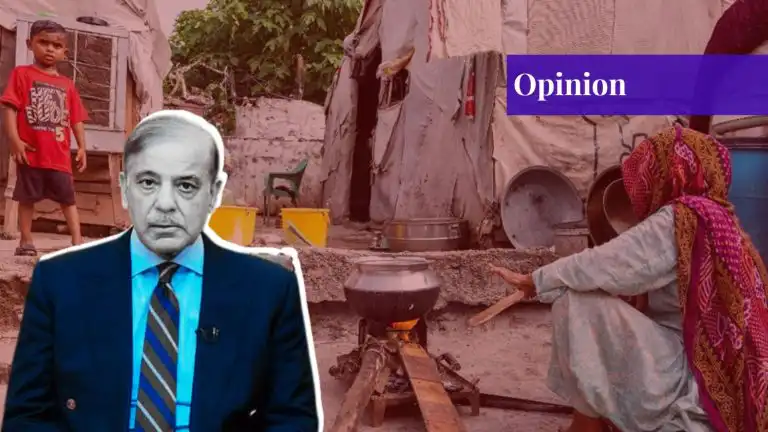
A single statement has been making the rounds on social media for several days now. The prime minister of Pakistan has said, “Anyone who makes over Rs 8,483 per month is not poor.” As would be expected, the line was greeted with a deluge of outrage, ridicule, and memes. However, the claim is based on a misconception. It is not the prime minister’s choice of this number, nor is a poverty line predetermined by any ruler’s signature. It is a measure of statistics, not a statement of politics.
The actual source is the poverty line figure of Rs 8,484 adult equivalent monthly per capita in 2025 as per the Pakistan Economic Survey. That figure was taken out of context; “per person” was interpreted as “per household,” and a statistical threshold was set to a prime ministerial verdict. Three mistakes and one viral post.
The poverty line is a level of consumption that is insufficient for a person to meet the basic requirements of life, including food, housing, clothing, education, health, and transport. Each country has a different line based on its price levels, the level of consumption, and its standard of living. There is no single specific number that can be used all over the world as an indicator of “poor.”
This is where things get lost in debate. In Pakistan, the poverty line does not exist as a decision taken by the prime minister or finance minister sitting and deciding on it. It is clear and formulated through an institutional chain. The Pakistan Bureau of Statistics (PBS) has the responsibility of conducting the household surveys and providing the data. The estimation is carried out by the Ministry of Planning (MoP) using a Technical Committee on Poverty, which includes PBS. The Economic Survey merely publishes the result, and this number is not the whim of anybody but a settled statistical method.
The Rs 8,484 figure is approximately on a per-person basis per month rather than on a per-family basis per month. However, the official way it’s calculated is on an “adult equivalent” basis, meaning that a child is given less than an adult’s worth for his calories, since a child’s caloric requirements are less than an adult’s.
If it is roughly calculated per head, it will be around Rs 50,900 per month for a six-member family and Rs 59,400 per month for a seven-member family. The practical limit as per the “adult-equivalent” method (which has reduced weight for the children) comes to about Rs 40,000–55,000 per month, based on the family’s composition. Put another way, the message is obvious. This is far from “eight thousand four hundred and eighty-three rupees for a whole family.”
With this change, Pakistan adopted the Cost of Basic Needs (CBN) method in 2013-14, which includes all necessary non-food expenses, not only food, and is based on the daily requirement of 2,350 calories per adult equivalent (2,150 urban; 2,450 rural). This is an important fact that is often overlooked. In other words, the original 2013-14 line (around Rs 3,030) is merely updated by the Consumer Price Index (CPI) every year. A line that has been around for 10 years and was continued by inflation. It is that very thing, as we shall see, that makes it its biggest weakness.
Why the debate centered on the number rather than on the news is a mystery since nobody seemed to notice the news. The national poverty rate is 28.9% in 2024-25 as against 21.9% in 2018-19, a rise of 7 percentage points in six years, the maximum increase since the series on poverty began, according to the Economic Survey 2024-25. The question that never should have been asked was “Why Rs 8,483?” The real question was, “Why has poverty increased?”
Also, the current government is not the first to have employed a line of this type to the detriment of its efforts. The official poverty estimation was done under the PPP government, PML-N government, and PTI government and followed the same official methodology. The disparities have been virtually only in the data, the prices, and the survey methodology, not in any idea that there is a set amount fixed by a government. In fact, implementing the CBN approach in 2013-14 was a more rigorous and more accurate yardstick than the rosy old one would have been.
The World Bank has three different poverty lines for countries in the world, which include extreme poverty, lower-middle-income, and upper-middle-income countries. Both of these are valid figures, and approximately 44.7% of Pakistanis are poor on the Bank’s lower middle-income line (at $4.20 a day), while 28.9% are poor on the national line (at $3.50 a day) (2021 PPP). They simply respond to different questions.
This is also the case throughout the region. While India’s official monetary line is kept at the 2011-12 (Tendulkar Committee) estimate, the others, such as Bangladesh, Nepal, etc., use their own CBN-style national lines. Some national lines indicate local prices and conditions, and some global lines are constructed for cross-country comparisons; these lines will never meet.
All of this does not fall below the poverty line. It is true that the official measure is not always reflective of the true cost of living and that basic rent, education, and healthcare costs are increasing. Many households that are not considered to be poor are in fact facing considerable financial problems, where the line is being built on a ten-year-old basket, the price differences for urban versus rural are not fully captured, and the surveys are not conducted on a regular basis. It is in these cracks that the economic insecurity of the middle class is concealed.
In the last decades, poverty has not just been defined by a lack of income or expenditure but measured by multidimensional indices around the world, which include education, health, clean water, sanitation, and housing. Pakistan has had an official version since 2016; now all it needs is discipline. It should be timely and frequent, rebase the aging 2013-14 basket with new data and the 2023 census, incorporate the price differences between provinces and urban areas, and make the methodology transparent and reproducible.
So, the only question is why the prime minister “set” the figure at Rs 8,484. That question is flawed at the bottom. Now the questions are truly relevant. Is the current measure of poverty a true representation of the economic life of the present-day? Are official statistics a true reflection of ordinary people’s reality? Is poverty alleviation the only aim of our social policy, or is it to safeguard the middle class from economic insecurity?
Giving and taking criticism is welcome and essential, but it should be based upon facts and the proper context. Otherwise, we lose sight of the real policy debate, forget the real question, “Why has poverty risen?,” and become lost in social media noise.
If you want to submit your articles and/or research papers, please visit the Submissions page.
To stay updated with the latest jobs, CSS news, internships, scholarships, and current affairs articles, join our Community Forum!
The views and opinions expressed in this article/paper are the author’s own and do not necessarily reflect the editorial position of Paradigm Shift.

Dr. Ghulam Mohey-ud-din is an urban economist from Pakistan, currently based in the Middle East. He holds a PhD in economics and writes on urban economic development, macroeconomic policy, and strategic planning.