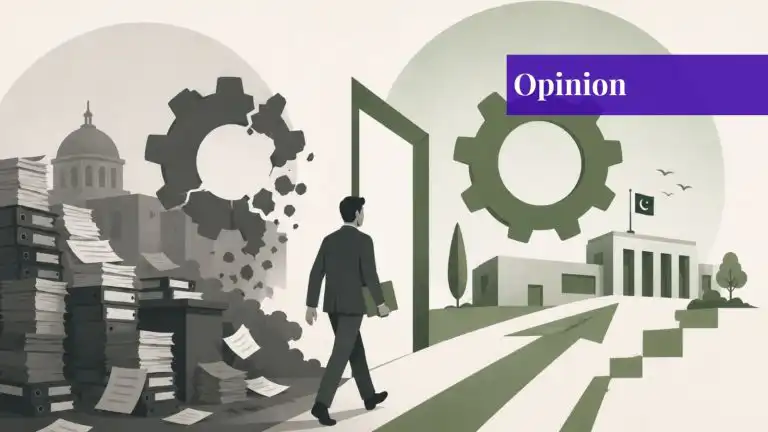
Civil bureaucracy is the administrative backbone of any country. It is the permanent and professional offshoot of any government, which is responsible for bringing the government’s policies into action and serving the public while managing the day-to-day administration of the state. The civil services of Pakistan also play such a significant role in our country. Civil servants ensure the continuity of the state by upholding law and order, implementing developmental projects, and executing public schemes. However, despite their vital role, the civil bureaucracy has attracted widespread criticism for politicization, inefficiency, malpractices, lack of transparency, and its elitist nature.
All these drawbacks in the system have contributed to weakening the state’s institutional capacity and eroding public trust in state machinery. With technological advancement, rising public demands, and a population boom in the country, the current system has proved inadequate to meet the needs of the changing times; therefore, it is imperative to consider structural and administrative reforms in civil bureaucracy to meet the needs of the 21st century.
Historically, Pakistan has inherited the administrative framework from the British Colonial Administration, which was then called the Indian Civil Services (ICS) and was acknowledged for its professionalism, discipline, and efficiency. During the initial period of formation of Pakistan, bureaucracy played a central role in maintaining stability. Nonetheless, the system had many structural strengths, but it was designed for specific political purposes before the partition and continued to do so when the bureaucracy was politicized during civil and military rule.
Interestingly, successive governments launched numerous reform initiatives for the civil services of Pakistan. From the Cornelius Report of 1959 to Zulfiqar Ali Bhutto’s reforms of 1973 and the later commissions of the 2000s and 2010s, these commissions proposed reforms to improve merit-based recruitment, performance evaluation, accountability, and training models in the civil service of Pakistan. Deplorably, most of these initiatives failed to bear any fruit owing to political interference, resistance from within the bureaucracy, frequent changes in the government, and the lack of political will. Last year, the incumbent government revived the debate on reforms, and a committee, headed by the Minister of Planning Ahsan Iqbal, was formed by the current prime minister for drafting the proposal for recommendations to improve the structure of civil services and align it with modern-day requirements.
Why the Bureaucracy Needs Reforms
Despite all these reform initiatives, several structural weaknesses are still undermining the system. They have also made the system inefficient, paralyzed its ability to deliver to the public, and stifled the continuity of good governance. Top among them is the politicization of bureaucratic and police cadres. The frequent transfers and postings are often contingent upon political loyalties, which has distorted the system’s functioning. This, in effect, has crippled merit and eroded professionalism. The second flaw in the system is the lack of accountability and transparency. Owing to this, the officials often misuse the authority entrusted to them, and all of this has, in effect, crippled merit and eroded professionalism. The 2024 report of Transparency International’s Corruption Index would substantiate the above claim. According to the report, Pakistan stands at 133 out of 180 countries for having a transparent and corruption-free administration.
Moreover, the time-bound promotion policy has further exhausted the system, and it has stifled the growth, innovation, and creativity of the competitive officers. Additionally, the outdated training models have failed to equip the officers with the necessary skills and tools to effectively manage the modern-day governance challenges like digitization of the official records, climatic catastrophes, and other complex policy issues.
Finally, one of the most pressing concerns in the civil services is the appointment of individuals who are not part of the system and lack the required expertise and experience in senior positions. Such allocations crush merit, compromise efficiency, and demotivate competent officers to serve effectively and contribute to making the civil services of an elitist nature. The poor decision-making by such officers also undermines the credibility of the whole civil bureaucracy.
Civil Service Reforms in Pakistan
Therefore, to truly align the administrative system with the needs of modern governance, the committee’s ongoing reform initiative has considered reforming the following areas within the services. First, to utterly depoliticize the system, the government should base appointments and promotions on merit, performance, and competence. Independent boards shall be established to ensure swift transfer, transparency, and accountability. Also, the duty of such boards shall be to evaluate the performance of the officers.
Secondly, the training models at academies shall equip the officers with modern-day courses of digital governance, policy analysis, climate adaptation, and service delivery management. Thirdly, sustainable and minimalist practices shall be prioritized by reducing the use of paper for office work and introducing the e-governance model to speed up the process and minimize corrupt practices.
Finally, the most critical reform is to tie promotions and financial incentives directly to an officer’s performance and competence rather than to mere tenure or time served. Only then will the system be able to render the results, and meaningful progress will take place.
Summing up the whole discussion, what Pakistan is suffering from is not the lack of reform proposals; it is suffering from the shortage of serious political commitment to execute these reforms. Unless governments prioritize merit, accountability, and institutional autonomy over political expediency, the reforms in civil service will be another incomplete chapter in the book of Pakistan’s administrative history. Such reforms are not just a bureaucratic necessity, but they are a national necessity for strengthening democracy and paving the way to achieve better governance. As Max Weber has said, bureaucratic administration is the most rational form of administration, but it needs reforms to remain responsive to society.
If you want to submit your articles and/or research papers, please visit the Submissions page.
To stay updated with the latest jobs, CSS news, internships, scholarships, and current affairs articles, join our Community Forum!
The views and opinions expressed in this article/paper are the author’s own and do not necessarily reflect the editorial position of Paradigm Shift.

Rehman Yar is a student of public policy and governance at Government College University Lahore.