Introduction
Climate finance, despite being framed as a tool of global cooperation, functions as a mechanism that reinforces structural inequalities and constrains policy autonomy in the Global South. Under international mechanisms like the United Nations Framework Convention on Climate Change and global agreements like the Paris Agreement, climate finance is represented as a moral and ethical obligation and as an instrument of global cooperation. However, this normative framing contradicts the power asymmetries embedded within their design and implementation processes.
Rather than facilitating climate adaptation and mitigation, climate finance, along with the complex institutional structure, associated policy conditionalities, and access barriers, serves to disproportionately disadvantage the very states it is designed to support. While the developed world has made huge promises regarding climate finance, the developing world remains entangled in the procedural, technical, and political constraints that limit its access to already limited climate finance.
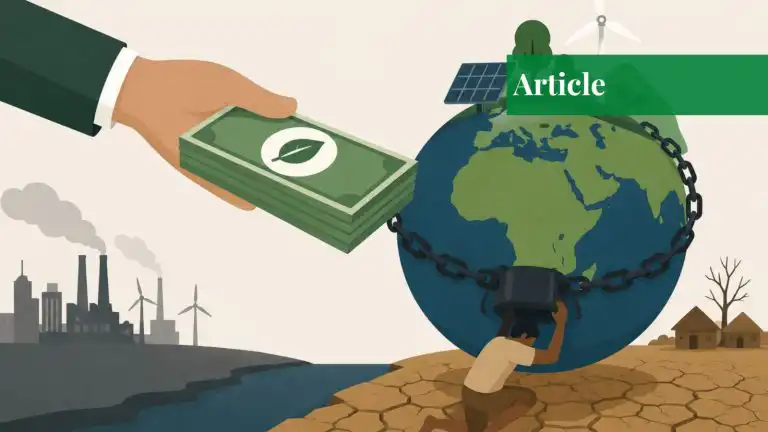
This article is based on the argument that climate finance is far from being neutral or an instrument of global cooperation. Instead, it is a highly political mechanism embedded within the existing global hierarchies, reinforcing power asymmetries. Its extended role in reinforcing dependency and limiting the policy autonomy of states increasingly reflects dynamics that can be understood as “green neo-colonialism.” These patterns of dependency challenge the dominant narrative, framing climate finance as a solution, and instead argue that it is reinforcing the very global inequalities and vulnerabilities that it is trying to solve.
The “Green Promise” of Climate Finance
Recognizing the high stakes of the climate crisis, countries established national targets to limit greenhouse gas emissions and increase resilience to climate change impacts. Implementing these national targets requires a massive amount of finance, far beyond what they can source domestically. Under the Rio Earth Summit 1992, the United Nations Framework Convention on Climate Change was adopted, which recognized that developed countries have a responsibility to assist the developing countries in their efforts to address climate change, including through providing financial resources.

This finance, alongside domestic finance, is essential for developing countries to adopt low-carbon technologies, protect themselves from climate threats, and unleash green development. This convention set the precedents for climate finance, which has evolved from being a marginalized concept into a central pillar in the global response to climate change, a “green promise” that is yet to be fulfilled. In theory, climate finance is not just a source of “economic assistance” but also a tool for “climate justice”—designed to enable sustainable development and bridge the global inequalities. However, the climate finance mechanisms, while being actively shaped as cooperative tools, serve as instruments of structural control, reinforcing dependency and limiting the policy autonomy of the Global South by deeply entrenched structural inequalities in access, decision-making, and implementation.
The Reality: Systemic and Structural Barriers to Access
Despite the increasing attention towards climate finance, institutional challenges remain, making this tool for a “way out” another headache for the already fragile systems of the Global South. Institutional challenges make the funds required by the Global South more challenging to access, adding another layer of uncertainty and complexity to already limited climate finance. These challenges do not exist in isolation; instead, they are amplified because the institutions are not operating well; application processes for acquiring climate finance are complex; and de-risking mechanisms are insufficient.
There is over-dependence on foreign investment, which isn’t safe, and borrowing money is too expensive. And more so, the power disparity between the poor countries and private industrial investors mostly results in the interests of the poor being overlooked with respect to the interests of the developed world in the not-so-inclusive international climate systems. The structural power discrepancy present in climate financing makes climate problems in the Global South more complex in terms of conditional loans and trade imbalances. Three key systemic barriers to the access of climate finance by the Global South and their potential enablers are as follows:
Institutional Weakness and Capacity Deficits
Countries in the Global South have weak institutional capacities to design, implement, and monitor climate finance projects. Poor governance structures, inadequate technical competence, and weak regulatory systems diminish coordination and decrease funding proposal credibility.
Complex Access Procedures
Multilateral climate funds frequently involve complex and protracted application procedures that are not accessible to a number of low-income countries, thus discouraging involvement.
Donor Conditionalities and Policy Constraints
Climate finance is often conditional on donor-imposed terms, another manifestation of neo-colonialism, such as macroeconomic reforms, co-financing, or being in line with market-based strategies. These can constrain policy space and are not necessarily aligned with local priorities.
Climate Finance as a “Green Neo-colonialist” Tool
Climate finance, introduced for the relative good of the Global South, is, however, working in the interest of the Global North. The needs and applications of climate finance in the Global South and Global North are significantly different. The Global North employs climate finance to decarbonize its industrialized economies, shifting towards renewable energy and transforming consumption patterns. The Global South requires climate finance to achieve climate adaptation and mitigation alongside socioeconomic development that creates jobs, reduces poverty, and improves health and education, all while increasing independence from the North. This stark contrast between the needs and applications reveals how, while the Global North is making its industries sustainable, the Global South is bearing the brunt of the decades of fossil-fuel-driven unsustainable growth of those industries that are now embarking on the journey of sustainability.
In the context of these diversified and divergent needs, the attempts undertaken by global institutions serve to reinforce the very vulnerabilities they are seeking to alleviate. For instance, private finance is considered essential by institutions like the IMF, UN, and World Bank for driving global green transitions. While private finance is being pushed as a solution for financing sustainable development in the Global South, this risks replicating the colonial-era dynamics of dependency.
For instance, the majority of climate finance is being mobilized in the form of loans rather than grants, increasing the debt burden on already vulnerable economies of the Global South, limiting their capacity to invest elsewhere, i.e., education, public health, etc. Through mounting debts denominated in foreign currencies, such countries also become vulnerable to instabilities in the global system, particularly changes in US monetary policy, which lead to significant shifts in capital flows and exchange rates and, with it, the value of those debts.
These already limited funds arriving as “debts” are coming with certain conditionalities as well. The climate crisis in the form of heatwaves, floods, melting glaciers, and droughts is looming over the Global South, making them desperate for funds to strengthen their resilience and vulnerable to the conditionalities associated with them—posing serious questions to the policy autonomy of these states. One of the major conditions to receive climate finance is reducing carbon emissions.
For most of the Global South, the mega-development projects are fossil-fuel-based (major emitters of GHGs), and cutting carbon emissions/abrupt transitions without adequate support risks putting their industrial development at a halt, constraining their economic expansion. This can be referred to as “Carbon Colonialism”—wherein the Global South is once again being exploited to resort to low-value raw material imports by limiting their access to similar trajectories of industrial development that have made the Global North, “the developed world,” without providing equitable alternatives of growth.
In such ways, the current structure of climate finance risks reinforcing patterns of dependence and exploitation. The result is a continuation of neo-colonial era dynamics under a new guise, where Southern countries remain economically subordinate and vulnerable to the global North.
The Technocratic Divide
While the Global North is struggling to stay ‘true’ to its promise of providing sufficient climate finance to support climate adaptation and mitigation in climate-vulnerable developing countries, it can still demonstrate goodwill through technology transfer, knowledge, and intellectual property sharing that underpins the green transition. However, a new layer of neo-colonialism is emerging in this domain as well. The shift to a green economy is already reproducing the same asymmetries that have long shaped our global trade. For instance, the European Union’s Carbon Border Adjustment Mechanism may be billed as a safeguard against carbon leakage, but it is also providing insights into how climate policy can be used to justify a state’s protectionist agenda.
Moreover, China’s recent complaint against India providing government subsidies for electric vehicles and batteries shows how green industrial policies can become grounds for trade disputes. Also, the greater powers like China, the United States, and the EU are producing high-value green technologies, while the developing world is once again being exploited for its resources by binding them to the export of low-value green commodities—primarily critical minerals. This mirrors the colonial-era division of labor, whereby the Global South supplied raw materials, and the North supplied innovation, monopolized production, and reaped the largest profits.
The technology and knowledge sharing can serve to close the loopholes existing in the climate finance cycle, and fortunately, there is precedent for necessary changes. The Technology Implementation Program (TIP) that was agreed upon at COP28 offers a means to foster such cooperation—by offering a platform for strengthening national innovation systems, enabling countries to adapt technologies to local contexts, and building capacity for climate solutions. And by empowering the countries with access to the green technologies they need, the Global North can do its share of its “historical responsibility.”
Pakistan as a Systemic Example
The case of Pakistan exemplifies systemic inequalities in climate finance. Despite contributing less than 1% to GHG emissions, Pakistan holds the top ranks on the scale of vulnerability to the climate crisis, which is manifested time and again in floods, heatwaves, glacial lake outbursts, and untimely, excessive rain patterns. Adding to this climate vulnerability is the widening gap between the climate funding needs and available resources. Climate change in Pakistan is no longer just about risk recognition or finance mobilization; it is now more about converting resources into a timely response. But here, the flawed climate finance architecture is at play, highlighting the mismatch within global climate governance, where those most in need are the least prioritized.
Pakistan requires $40-50 bn annually for climate adaptation and mitigation, yet receives merely $1.5-2 bn from international sources. It has been able to secure just $331.7 million for 11 projects from the Green Climate Fund (GCF), despite the growing vulnerability. But these gaps between the “supply & demand” of climate finance are not the product of isolation but of wider systemic disparities such as institutional and procedural constraints embedded within climate finance mechanisms.
Complex application procedures and technical eligibility criteria are just another burden on Pakistan’s climate-vulnerable governance system. These complexities have translated to climate finance being concentrated at higher levels of governance, delayed responses, inadequate adaptation infrastructure, and continued exposure and destruction of climate-vulnerable sectors like agriculture. Moreover, loans dominate the fund inflows (over 70%), exacerbating Pakistan’s $270 billion external debt.
Rather than representing an individual failure, the case of Pakistan represents a broader pattern across the Global South, where structural inequalities and technocratic hurdles shape both the “access to” and “impact of” climate finance. Pakistan’s experience reveals how global financial mechanisms remain totally disconnected from local realities, thereby reinforcing the very vulnerabilities they sought to alleviate.
Conclusion: Rethinking Climate Finance
Climate finance architecture is flawed and needs immediate and significant restructuring. Firstly, there is a significant need for debt cancellation and mobilization of more “grant-based funding” rather than loans. Secondly, the Global South should be able to allocate climate finance based on needs at ground level without any foreign interference—an important effort towards climate justice. Thirdly, as the Global South needs to build resilience rather than continually trying to limit its already minimal GHGs (under climate mitigation, which is again just benefiting the polluting Global North), the climate finance providers, as an Oxfam report notes, should be massively scaling up their efforts and be reporting climate financing on a case-by-case basis, highlighting the actual proportions channeled toward mitigation and adaptation.
Moreover, the Global North should also be engaged in technology and knowledge sharing, instead of just exporting expensive green technologies built from the raw materials imported from the countries they are selling these technologies to. Also, one significant measure could be the restructuring of overcomplicated application processes to access finance—designing procedures that are more inclusive of the weak bureaucratic and governance systems in the Global South. Regional powers such as China should also be more engaged in sustainable development projects rather than subsidizing coal-based power projects abroad.
In short, big structural changes are needed, and they are only possible by redesigning the international climate system to be more inclusive towards those more vulnerable to climate change.
If you want to submit your articles and/or research papers, please visit the Submissions page.
To stay updated with the latest jobs, CSS news, internships, scholarships, and current affairs articles, join our Community Forum!
The views and opinions expressed in this article/paper are the author’s own and do not necessarily reflect the editorial position of Paradigm Shift.

Javeria Abbas is an international relations student with a deep interest in global governance, development economics, and climate policy. Her work focuses on examining contemporary global challenges through the lenses of sustainability, international cooperation, and equitable development. She is passionate about research, policy analysis, and amplifying perspectives from the Global South on issues shaping the international system.