“The people are the sea in which the revolutionary swims.”
Mao Zedong.
Successful Counterinsurgencies
The country is in the throes of civil unrest, violence, and insurgency, and is gradually losing critical cohesion. In any situation where there are civilian protests, the central problem will always revolve around aggrieved people, exploited by hostile agencies. These people have to be won over by making them part of the system and decision-making—only then can external intrusion be dealt with. The world has seen so many insurgencies and rebellions, and so many have been tackled successfully that these must be studied for their efficacy. Having said that, there are no recipes for such a conflict resolution, and each case has its own characteristics; nevertheless, there are lessons to be learned from each.
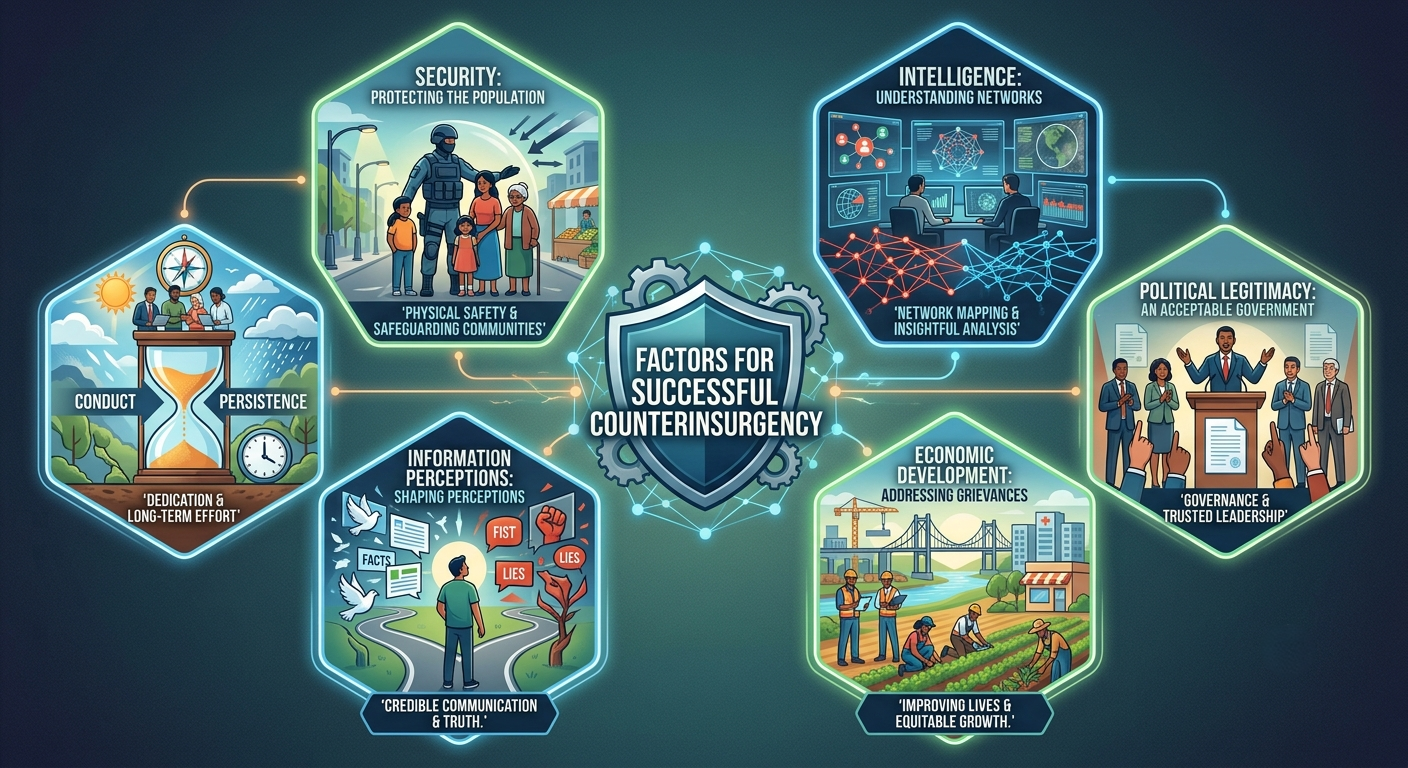
To illustrate, here are some for those interested: The Malayan Emergency (1948-1960); Dhofar Rebellion, Oman (1965-1976); HUK Rebellion, Philippines (1946-1954); FARC, Colombia (2000-2016); and LTTE, Sri Lanka (2006-2009). These rebellions were successfully dealt with, but when studied, there are some commonalities in the approach of dealing with such crises. What these successful campaigns had in common is listed:
- Security: Protecting the population.
- Intelligence: Understanding the insurgent networks.
- Political Legitimacy: A government viewed as more acceptable than the insurgents.
- Economic Development: Addressing local grievances.
- Information Perceptions: Shaping public perceptions.
- Time and Persistence: The principle of conduct remains patience.
How Insurgency Burgeons
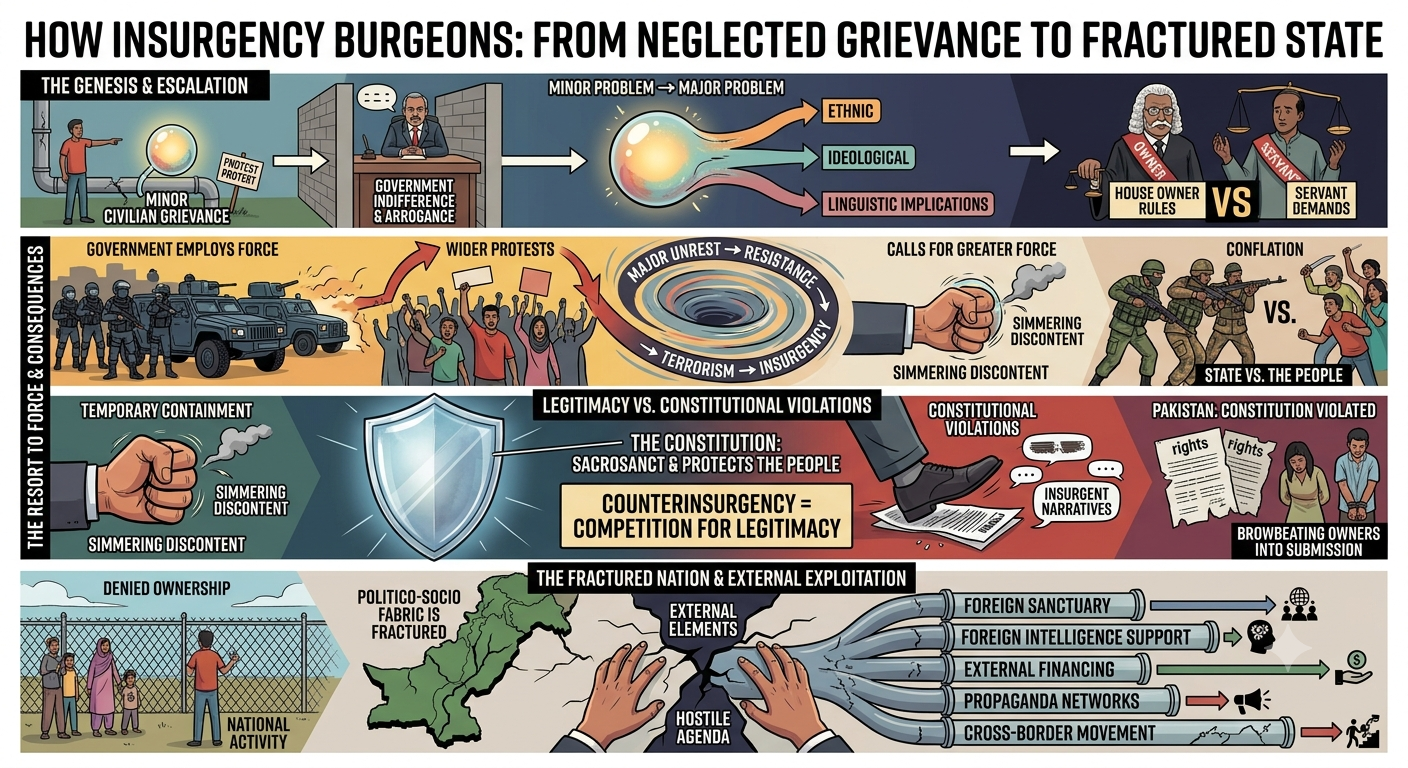
The history of any crisis, if studied, going back to its genesis, is usually a very minor problem related to a civilian grievance, which is ignored in its infancy. The government’s perception is that it is too small a matter to give in to and thus either ignores it or treats it with the indifferent arrogance and contempt that is the curse of bureaucratic systems. Soon, the minor problem grows into a major problem and takes on a life of its own. The problem then morphs into a political one with ethnic, ideological, or linguistic implications, but the government, instead of dealing politically with it, employs administrative logic, propriety, and rationality, and instead uses force.
Sometimes the government temporarily manages to contain the issue, but it still neither addresses the core problem nor takes it seriously enough. The resolution is conveniently explained as a successfully concluded campaign. However, in the wake of the government’s success, which it has wrested by overwhelming force against its own people, there always remains behind a simmering discontent—a crisis in waiting for a spark to ignite a flame—to return on another day. In other cases, using force leads to wider and bigger protests, which then call for greater force, and the cycle continues, leading to major unrest, resistance, terrorism, and then insurgency—in this order.
The government confronts the people, and as such, the state comes into direct conflict with its own instrument of existence—the people. Here, at this stage, it does not matter who is right or who is wrong—the situation should never come to a conflict between the state and the people. Such a phenomenon is best explained by putting before the reader the unusual spectacle of the servants in a house turning out the owners of the house, and there appears to be a debate on which one of them is right! The owners of the house establish the rules that govern what is right or not, and all have to abide by them. In the case of the state, it is the Constitution that defines what is right, and it is the Constitution that protects the people from its own government, and under no circumstances can it be violated—it is sacrosanct.
“Legitimacy derives from constitutional adherence. Counterinsurgency is ultimately a competition for legitimacy. Every constitutional violation creates opportunities for insurgent narratives. The state’s greatest strategic weapon is not force but legitimacy.”
In Pakistan, the Constitution is violated frequently, but always at the cost of the people. The first part of the Constitution deals only with the rights of the people, but these are of no consequence to the state as it goes about browbeating the very owners of the country into submission. Thus, there is a government in place and a people that exist, but neither is inclusive of the other or integrated. The people are not part of national activity or purpose and are thus denied ownership of their country. This is where countries lose cohesion, and the politico-socio fabric is fractured and broken. The gaps thus created are filled by others—external elements hostile to the country and carrying their own agenda. Historically successful insurgencies often depended on the following:
- Foreign sanctuary
- Foreign intelligence support
- External financing
- Propaganda networks
- Cross-border movement
“While legitimate grievances create fertile ground, insurgencies often require organization, ideology, leadership, funding, sanctuary, and external support before they evolve into an armed movement.”
The process of handling grievances is a convention where the government uses an incremental application of administrative offices. It is expected that the grievance be addressed at an early stage at a lower level, before it takes on a critical state. These stages are community groups, local bodies, local members of parliament, national members of parliament, the judiciary, law enforcement, and finally the establishment. Because none of these steps are functional in Pakistan or lack credibility, not being suitably empowered, the government either ignores the problem or uses the last component—the establishment. This makes the establishment a perpetual state instrument of enforcement against the people—they become the bad guys.
The establishment begins counterinsurgency operations at their varying levels and stages, through kinetic application against the very people that they were organized to protect and govern. The people see this as a huge contradiction and feel disappointed, disillusioned, and abandoned with no recourse to address the grievance they are complaining about. The government, for all practical purposes, inadvertently becomes an accomplice to the enemy’s maneuver in dismantling one’s own state.
Instead of taking the right steps to address the anomalies, the government takes steps that are, in fact, more cosmetic than realistic; they are superficial, more for a feel-good, self-satisfying action—going through the motions. These are usually a number of steps that look as if something actually is happening, but in fact have no bearing or effect on the environment, leading to any kind of resolution. The usual steps taken by a government under duress, in an attempt to buy time, hoping that a solution would be arrived at in some distant future, are:
Isolate the Unrest
Shut down communication in all its different media. This leads to social media activity that aggravates the problem and exaggerates it. Rumors take hold, and hostile narratives, sensational news, etc., are fed to the people.
Propaganda
The state, in response, starts throwing out its own fake news, usually through people of limited capacity. No one buys the structured stories, and in fact, people easily counter them with alternative narratives, making the government look foolish and out of touch. The whole exercise becomes counterproductive.
Arrest the Leadership
The government creates heroes out of the protesting leadership as well as creates a sympathetic following—exacerbating the situation. The arrested leader becomes even more effective while incarcerated. Resorting to defamation and blackmail further disenchants the government from the people. These are public figures, widely respected, and whereas their reputation remains intact, the government takes a hit.
Deny Political Platforms
The government resorts to underhanded methods, denying the aggrieved people their right to free speech, which they are entitled to, or prevents any gathering of supporters or meetings to discuss the problem. The protests therefore gather greater legitimacy.
Politicize the Problem
Instead of dealing with the issue, the government tries to politicize it in an attempt to portray it as a matter of vested interests that the opposition political party is trying to accrue. The people see through it and usually add a couple of other things to the problem, further condemning the government.
Prevent Access to Any Recourse
Manipulate the judicial system so that due process is not available to the people and politicize the police, who then apply themselves with bias and prejudice. Prevent the administration from providing any relief to the complainants in the hope that their suffering may force them to acquiesce. The people feel they are operating outside the established system and find other ways to resolve their issues.
Creative Intelligence
This was kept for last because the intelligence system is the most relevant and important component of counterinsurgency operations. Whereas it can be a tremendous force multiplier, responsible for timely early warning, actionable intelligence, and specific but targeted information, it must also be understood that successful insurgency is usually the product of a failed intelligence network. Good intelligence is truly indispensable to any successful counterinsurgency operation and an important component that shapes opinions and molds the thinking of the leadership, which leads to decision-making.
When the leadership is tentative and intellectually ill-equipped, their collective judgment is shaped by the quality of the intelligence briefing they get. Lack of environmental awareness, limited relevant education, poor experience, and inadequate exposure make independent evaluation by such leadership in government very difficult and highly unreliable. Thus, responsibility and accountability for decisions become a shared activity amongst different departments, blurring any individual identity where one may appropriate fault, cause, or blame.
“Intelligence organizations, like all bureaucracies, can develop institutional incentives that may sometimes distort reporting, encourage risk-averse assessments, or prioritize organizational interests.”
Briefings
The briefings usually begin with exaggerated reports of how popular the sitting leadership is and how positively their administrative steps are being received by the public at large. The next factor in the brief is to establish an air of indispensability of one’s own presence and thus secure extensions for as long as possible. This leads to astounding information created and structured that apparently no one else has access to, and that is an exclusive achievement. The third focus of the brief is to broadcast a threat with nonactionable value, vague enough to qualify it as a warning but ambiguous enough to protect oneself if anything untoward happens, i.e., “I told you this could happen. ”
A typical message will read, “Armed activity by unknown persons in a white car on road XYZ in the next few days is expected—if it happens, it’s an ‘I told you so’ thing; if it does not, then the precautions taken because of the warning deterred it.” Some signatures that need to be noted due to intelligence activities are:
- The field of law enforcement/administration gradually gives up its authority to the existing intelligence elements and follows the instructions/precautions the intelligence gives them. The local commanders must take intelligence elements under their command and task them instead of being tasked by them.
- The law enforcement that deploys for the protection of the people immediately sets up measures to protect themselves at the inconvenience of the people. If done with imagination and common sense, necessary precautions can be taken without alienating the people.
- If there is an ambush or case of firing on a given road/area, instead of dealing with the problem, the road/area is closed. The people feel that control is being lost.
- To deal with any group of dissidents/aggrieved people, the intelligence is very fond of setting up another alternative group. They hope that the latter will overcome the former, thus resolving the problem. This is done in the political field and by religious groups as well as the militants. However, it has been experienced that it is only a question of time before control is lost over the created group, leading to fresh problems with even bigger consequences.
- The intelligence is given to re-employ people they have turned/won over. These people are set loose in society under the protection of the intelligence with funds, vehicles, manpower, and weapons, which then commandeer the people of that village/town. Whereas they are expected to be a government-sponsored alternative to the militant groups in the area, they invariably evolve into criminals. They are seen as government representatives, and they distinguish themselves for extortion, revenge killings in local disputes, smuggling, collecting revenue such as through check posts, and dealing in contraband.
Intelligence
The intelligence agencies of any country can be a huge asset in protecting the country from externally sponsored unrest. This is the premier institution that is crucial to counterinsurgency operations. It must be staffed by highly qualified and competent people with relevant experience. Yet, it is crucial to understand and note that field operations must never be subordinated to intelligence, and whereas in such operations field operations are highly dependent on intelligence support, nevertheless, the intelligence must never be allowed to shape policy or direct events. This remains the sole domain of the field commander at every level. The field commander must be in a position to task the intelligence assets available to him for his information and subsequent actions—he himself must not be tasked by the intelligence.
Containing Insurgencies
Having some understanding of how and why insurgency fosters, it is now pertinent to examine some measures in containing insurgency and eradicating it from society. The method of handling counterinsurgency operations will always be linked, first and foremost, to legitimacy and the rule of law.
“The strength of a government is measured by the willingness of its people to obey it without coercion.”
This is a two-way road, and there is no rational or moral logic that supports any government that is seen to violate the basic understanding of conventional political structure, administrative/judicial hierarchy, and settled constitutional values while the people it governs suffer in silence. While not challenging any doctrine of necessity and accepting that governments may have to, at times, adopt extraordinary measures, the government must insulate itself from critical public rejection and denunciation. Since there are times when the state is either directly governed or strongly influenced by unelected officeholders, it is suggested that the government employ constitutionally authorized institutions/systems to deliver instead.
In Pakistan, that would be NACTA and NAP. It would reduce government exposure and keep the establishment in the background. NACTA, currently a coordinative body, must become an executive one. It then would need to be empowered, working within the parameters of NAP, and would probably become the premier institution that may deliver under the circumstances—protecting the government from unnecessary negative exposure. The keyword here remains “empowered,” with freedom from any political or vested influence. NACTA’s basic posture must be people-friendly, with easy access allowed to the population in general. The bottom line is to provide the people with a platform where complaints and grievances can be addressed. Even then, it is crucial to understand that if these grievances are sacrificed for the preservation of a skewed political structure, then, in fact, no system can work regardless of what innovations one may construct.
Some suggestions that are proffered for dealing with insurgency, terrorism, or low-intensity warfare are enumerated below. Provincial governments are to set up committees comprising recognized people of stature who command universal respect to open political reconciliation cells. Aggrieved groups are to bring their issues to these committees. The current situation in the country is to be seen as follows:
Balochistan
A combination of military and political actions, with the former operating with a view to establishing a conducive environment for the latter. Some platform, some venue needs to be established where one can learn of genuine grievances and also allow these complaints to be viewed and heard publicly. The committee must be able to respond by presenting solutions to those grievances. A judicial commission mutually acceptable to be set up to look into the cases of missing people.
Khyber Pakhtunkhwa
Dominant role for military operations since there is no defined political agenda of the militants. However, provincial governments must allow committees, as mentioned, to facilitate regions/areas/villages that have been won over and cleared to establish integral political control by the locals.
Kashmir
Political process only and a recognized autonomy of the political process.
Federal Government
To engage Afghanistan to establish a mutually acceptable method of co-existence. The Durand Line, etc., will always remain an argument—simply make it irrelevant to political reconciliation and learn to live with the problem. Other countries interfering in the internal affairs of the country are also to be engaged through a coordinated plan.
NACTA
Should be given a free hand and empowered to make decisions related to counterinsurgency. Must be able to operate across the affairs of immigration, foreign funding, NGO activity, and tourism. This should be done without prejudice or malice to anyone. NACTA must have overarching/overlapping capacity to coordinate and act across provinces. A fusion cell to collate data must be established down to the provincial level to be plugged into police activities, immigration, weather, traffic, crime, etc. NACTA to focus on:
- Intelligence-led targeting of violent actors.
- Protection of critical infrastructure.
- Economic relief in affected districts.
- Rehabilitation and surrender programs.
Some other common measures that should also be considered, which could probably be relevant to the whole country, are as follows:
- Immediately activate the local bodies. Hold free and fair elections at this level, regardless of what else is happening at the higher level. Grassroots politics must remain active and continuous and remain focused on development, employment, and individual grievances.
- Establish complaint cells with easy access, instructed to either inform the complainant of progress on his complaint or resolve his problem within a specified time. Compliant cells to be empowered. Integrate the ombudsman system, which should be required to hand in weekly reports. Such cells are to be established at the lowest level and be synchronized and supervised by the local bodies.
- Undertake police reforms; depoliticizing the police is essential, and they must be protected from any external influence. They must be organized into an independent institution with career progression, promotions, and transfers as an in-house affair. A public office is to be established to register complaints through a website related to police misuse of authority and highhandedness. These complaints must be a public record accessible to the people.
- Disband institutions such as NAB, etc., that were set up for oversight, propriety audit, and corruption but are now widely seen as agents of government arm-twisting, blackmail, and coercion. They are serving no useful purpose other than intimidation.
- Establish a network of two-way, dial-in, FM stations that must address house and home and allow access to women to either make inquiries or complain about their situation if they need to. These stations must avoid filling time with Naats and religious education, whereas some time may be allocated for such activity, which must not exceed 10% of the overall time.
- Online meaningful education must be extended to the whole country. Polytech institutes are to be set up at the district level to develop skilled labor.
- The Internet and social media are to be encouraged instead of being disrupted every time the government feels threatened. Hostile propaganda needs to be addressed head-on by a professionally mounted media maneuver rather than leaving space to distractors. A professional method of handling such narratives can easily be constructed.
- Establish a C-SPAN-style TV network in multiple languages, especially in English, to inform the world and the general public about Pakistan’s values, risks, economic opportunities, people engagement, security matters, and political scenarios. These should be free debates with opposing views, professionally moderated and concluded.
Historically, successful counterinsurgencies combine security, politics, and economics. However, whatever strategy is framed and implemented, there have to be some sort of KPIs that indicate progress, success, or failure. Such metrics could be:
- Reduction in violent incidents
- Reduction in recruitment
- Voter participation
- Grievance resolution rates
- Local government participation
- Public confidence surveys
Conclusion
Insurgency is an extension of war by other means that nuclear countries are far more susceptible to. Such a phenomenon is always available to the enemy, exploiting internal fissures and divides through low-intensity warfare and terrorism, leading to insurgency. Since conventional war is far too catastrophic to contemplate, political ascendancy is sought through pressures and chaos imposed upon adversarial governments through such intrusive means. Governments that are not aligned with their own people are especially susceptible to such threats and must take every precaution against hostile intrusion. Pakistan has a lot to look forward to and has the potential to become a regional dynamo if given half the chance that it deserves. This chance can only be provided by the joint efforts of its people and its government to work in harmony and cohesion.
“Public sentiment is everything. With public sentiment, nothing can fail; without it, nothing can succeed.”
Abraham Lincoln
If you want to submit your articles and/or research papers, please visit the Submissions page.
To stay updated with the latest jobs, CSS news, internships, scholarships, and current affairs articles, join our Community Forum!
The views and opinions expressed in this article/paper are the author’s own and do not necessarily reflect the editorial position of Paradigm Shift.