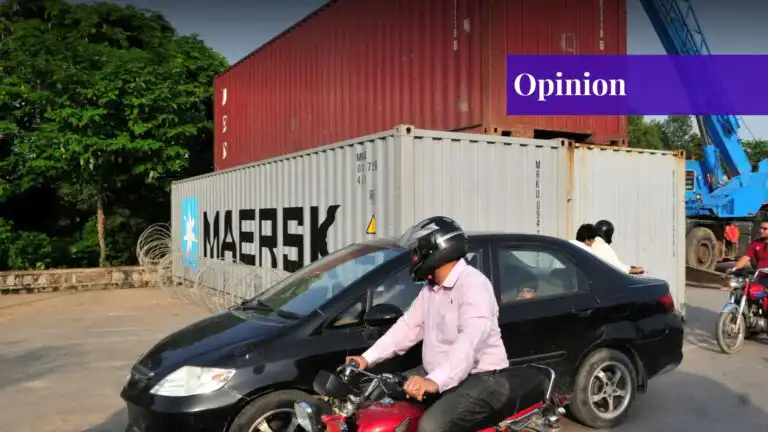

For the past few years, the containers at Serena Hotel Chowk in Islamabad have become a welcoming site. These bulky containers have slowly swept into the once beautiful, lush landscape of the capital city and, before we knew it, took permanent residence there. The route to my house has been marred by their regressive, oppressive, and ugly presence. Every time I see them, I’m reminded of a sinister future: a sealed capital.
We have had our fair share of excitement while Islamabad grappled with one sit-in after another, with containers blocking every road. At first, the thought of ending a workday sooner than the designated time was exhilarating. But soon, the uncertainty of reaching home on time, the fear of encountering a mass-frenzied public, and the anger of being unjustly stuck in a traffic jam – caused by containers all over Islamabad – began to take a heavy toll. I used to think that when all this became a nagging routine, all of our prayers for half days had manifested this miserable state we repeatedly find ourselves in now.
Now, Islamabad has turned into a perpetual bargaining chip, always on the mantle for seizing. It’s so easily accessible for confiscation that any given day we hear news of masses being herded to the capital—marching to claim, reclaim, and unclaim. As we enter a new and dangerous dystopia, where solutions are sought not through dialogue but by crippling the entire capital’s machinery, the democratic rights of plenty have started overshadowing the democratic rights of many.
For naive, smart, weary, tired, jaded, and tricked people, every time the bells ring from Adiala jail, their echoes send distress signals across the nation. Plenty of people rally behind that call and march towards the accursed, infamous, and fabled D-chowk—a set shrine for achieving political goals by exerting public pressure instead of engaging in political dialogues. And rightfully so, as time and again, the government has caved when faced with populist power shows.
Repeatedly, the democratic right of protest has been exercised. Plenty of people have donned their big revolutionary shoes and have marched towards the sacred, scarred, and stunned Islamabad. Because in front of larger-than-life struggles, saving the nation from looters, reclaiming the constitution, or awakening citizens from their long sleep of slavery—a day’s lost income, a missed hospital appointment, or simply going out without fear seems like inconveniences.
In recent times, Islamabad has become the crown of their imprisoned messiah’s promised kingdom and also the weak link in the adversary’s armor. The irony isn’t lost on anyone: democracy is now the heritage of only those who come out to exercise their autonomous right of protest. Their messiah, whose prophecy of change was not fulfilled because of malevolent spirits and their coercive schemes, who is unjustly detained by the same politically motivated law he introduced and wielded, is busy writing “do or die” on the wall.
But we can’t entirely blame him, though he has transcended the realm of accountability and reasoning long ago. We used our collective anger against a failing system and years of broken empty promises to build him up. He delivered the failings he was summoned from perfectly. Then, how dare his opponents raise objections when he is merely a reflection of the resentment felt against them?
His call was once again answered, for the millionth time, asserting his relevance despite his physical absence. The system – the rejected one – is still in power, despite knowing it couldn’t safeguard the democratic rights of those who call Islamabad home, who enter it daily for work and education.
Their solution, as visibly seen through each ensnarement of Islamabad, involves decorating it with more containers, deploying additional security personnel, and the inevitable smoke from the tear gas when the chaos ensues eventually. They have turned the capital into one tired tale of “the boy who cried wolf.” What was once a dramatic display of public support now only disrupts the city’s peace and normalcy, which too is not for the greater good anymore.
We have to ask ourselves – eventually, the sooner the better — when will a solution that doesn’t involve turning the capital hostage be considered by the leaders of the major political parties and the public? How long will the general public pay the price for this childish, immature feud between elected grownups who refuse to sit down and talk? And most importantly, how much longer can we afford this divisive national stance?
These are serious, bitter, and uncomfortable questions, whose answers might not be to our liking, but they are necessary. There is no necessity attached to the conduct of a peaceful protest in the heart of the capital, especially when foreign delegates are visiting or international conferences are being held. There is no law dictating that a public march must culminate at D-Chowk for it to be acknowledged.
If protesting and marching is a democratic right, then so is expecting normal traffic flow, having access to telecommunication services, entering the capital, and working without disruption. When and where did we decide that the democratic rights of plenty can overshadow those of many? And for how long will we refuse to sit down and resolve our issues?
If you want to submit your articles and/or research papers, please check the Submissions page.
The views and opinions expressed in this article/paper are the author’s own and do not necessarily reflect the editorial position of Paradigm Shift.