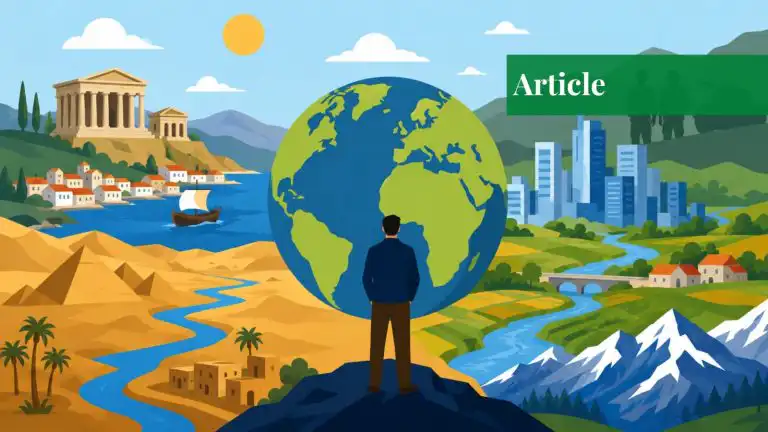
Environmental determinism is an outdated yet foundational concept in human geography. It delineates that the physical environment—distribution of oceans, seas, rivers, glaciers, mountains, hills, plateaus, deserts, climate, and resources—influences human behaviour, culture, and the rise of civilisations. The evolution of this idea can be traced back to early Greek, Chinese, Roman, and Islamic traditions. Eventually, these traditions became an important part of environmental theory in modern geography.
The origins of this idea can be traced back to ancient Greece. Hippocrates was the apostle of this idea. In his seminal work Airs, Waters, Places, he linked human health, traits, and personality with climate, water quality, wind direction, and the geography of settlements.
Aristotle was the flagbearer of Hippocrates’ ideas in Greece. According to him, climate shapes political systems, culture, human behaviour, and temperament. He stated that people living in cold areas are brave but less intelligent. However, people living in warm and humid climates are timid and less industrious. Drawing a comparison between hot and cold climates, he argued that Greece has a moderate and stable environment, making it the most conducive place for the rise of civilisation.
Romans continued this tradition, and renowned scholars and historians like Pliny the Elder tried to expound this idea by developing an inextricable relationship between different environments, resources, and ways of living.
Al-Biruni was a proponent of this idea in the Islamic tradition. His ideas were not merely based on a hypothesis. He extensively visited Asia, Central Asia, and India. In his book Kitab al-Hind, he drew a relationship between geography and economic opportunities. He wrote that fertile lands lead to diversity in economic activities. On the other hand, harsh terrain hinders economic development. There is little professional diversity and
more redundancy in economic opportunities. People are limited in their potential and exposure in such areas.
Similarly, Ibn Khaldun, in his hallmark book Al-Muqaddimah, linked the rise and fall of civilisations with climate and geography. He explained that people living in cold climates are strong and laborious, while those residing in hot environments are more emotional and less strenuous. According to him, the environment is secondary to Asabiyyah.
In modern times, Friedrich Ratzel is known as the founder of environmental determinism and political geography. According to him, the power of a state depends on its geography, landforms, and resources. A state with fertile land is strong, while a state with barren and non-arable land is weak. The state behaves like a biological organism: it is born, grows, expands, and may eventually decline.
One of his most pertinent and far-reaching ideas is Lebensraum. In Lebensraum, he explained that population growth is a natural and necessary phenomenon. A state that grows is strong, while a state that shrinks is weak. He argued that more people need more land, food, and resources. This concept later influenced the geopolitics and imperialism of the 19th and 20th centuries in Europe. Adolf Hitler later used this concept to justify the invasion of Poland and the Soviet Union to gain more land for the “Aryan race,” while persecuting Slavic and Jewish populations.
Ellen Churchill Semple was one of the most influential American geographers and a student of Friedrich Ratzel. Her expertise in geography is evident in her work Influences of Geographic Environment. She cited different instances of geographical patterns and terrain across the world. The Alps are high, steep, and rugged mountains with V-shaped valleys. They were difficult to cross in pre-modern times. Communities were isolated, with their own dialects, customs, and settlement patterns. These mountains impeded the development of a single centralised political entity. One of the most notable systems formed in this way was the Swiss cantons in Switzerland.
Similarly, she took the Nile and Tigris valleys as case studies. She argued that the establishment of Mesopotamian civilisation, the “land between two rivers,” between the Euphrates and the Tigris, was due to annual inundation, which created fertile land
suitable for an agriculture-based civilisation. This civilisation led to some of the earliest cities in the world, such as Ur, Uruk, and Babylon.
Another glaring example, which remains relevant even today, is the Sahara Desert, which provided harsh and difficult conditions for the people of Africa. It acted as a natural barrier between North and Sub-Saharan Africa. Because of this barrier, North African countries developed closer ties with Europe and the Mediterranean. However, Sub-Saharan Africa remained comparatively underdeveloped due to the slow diffusion of ideas, culture, technology, and norms.
Many classical geographers, economists, and environmental determinists claimed that countries located in tropical zones (between the Tropic of Cancer and the Tropic of Capricorn) are more likely to face economic problems, political instability, and slower development. Montesquieu, in The Spirit of Laws, argued that hot environments make people less energetic and more submissive. However, people in cold environments are more laborious and disciplined.
Modern scholars, while discussing health geography, argue that tropical regions historically suffered from malaria, dengue, yellow fever, and sleeping sickness. These diseases have historically reduced labour productivity, population health, life expectancy, military strength, and economic output. Large parts of the Democratic Republic of the Congo, Nigeria, Uganda, and the equatorial regions remained economically impoverished because disease-prone environments discouraged settlement and investment.
Tropical zones also face heavy rainfall throughout the year. These conditions are followed by successive spells of intense rainfall and long-term droughts. Heavy rainfall is instrumental in causing soil erosion and the leaching of nutrients. These conditions lead to commodity dependence, food insecurity, and weak industrialisation.
During the colonial era, tropical zones became famous for plantation economies. Rubber from Malaysia, cocoa from Ghana, and cotton from India supplied raw materials to European industries. However, these regions remained industrially underdeveloped.
Economist Jeffrey Sachs claimed that tropical environments often produce low agricultural yields, more disease, high transportation costs, and weak connectivity.
Georg Wilhelm Friedrich Hegel explained history and ideas through the process of dialectics. He stated that there is a thesis, followed by an antithesis, and finally a synthesis. Simply put, there is an idea, an opposition to that idea, and then a new idea formed by combining the truths of both.
Environmental determinism is a thesis that heat, disease, and terrain hinder the socioeconomic development of tropical countries. Many critics rejected this idea by arguing that humans are not prisoners of geography. Good governance, political stability, the rule of law, justice, economic opportunities, investment, human development, and innovation create conditions for development.
However, the synthesis of this debate is environmental possibilism. Paul Vidal de la Blache is considered the father of environmental possibilism. He argued that nature provides possibilities, not a fixed destiny. Humans can modify and transform geography through technology, innovation, and hard work.
Another major proponent of possibilism was Lucien Febvre. His famous statement is: “There are no necessities, but everywhere possibilities.” He wanted to convey that human choices matter more than climate.
These geographers illustrate the case study of the Netherlands fighting the sea. Much of the Netherlands lies below sea level, and there is a constant threat of flooding from the North Sea. However, the human response has been remarkable. There has been extensive construction of dykes, polders, and canals to control flooding in the Netherlands.
The second country, often described as a desert state, is the United Arab Emirates. The country faces extreme heat, water scarcity, and desert terrain, but despite all these challenges, human effort has remained strong. Many projects, such as desalination plants, artificial islands, trade networks, and financial hubs, have elevated the United Arab Emirates to the heights of tourism, investment, and economic opportunity.
Thirdly, Japan is a country affected by tsunamis, frequent earthquakes, and infrastructural damage. However, through technology, disaster-resilient infrastructure, and mitigation measures, Japan has been able to minimise the impacts of disasters, despite the fact that it lies on the Ring of Fire.
The transition from environmental determinism to possibilism reflects the evolution of geographical perspectives from environmental rigidness to human consciousness and innovation. Although geography still influences political systems, economic activities, and societies, modern societies have broken the shackles of geographical determinism through good governance, technology, innovation, investment, and industrialisation. Therefore, geography is neither an absolute player nor an irrelevant factor; rather, it continues to play a crucial role in the geopolitical and geo-economic decision-making of all countries.
If you want to submit your articles and/or research papers, please visit the Submissions page.
To stay updated with the latest jobs, CSS news, internships, scholarships, and current affairs articles, join our Community Forum!
The views and opinions expressed in this article/paper are the author’s own and do not necessarily reflect the editorial position of Paradigm Shift.

Usama Ranjha is a student of International Relations, Political Science, and Law. He holds
a B.A. in International Relations, an M.A. in Political Science, and an LL.B. He regularly
writes on geopolitics, geographical thought, strategic affairs, governance, and
contemporary global issues, with a particular interest in the relationship between
geography and politics.