Introduction
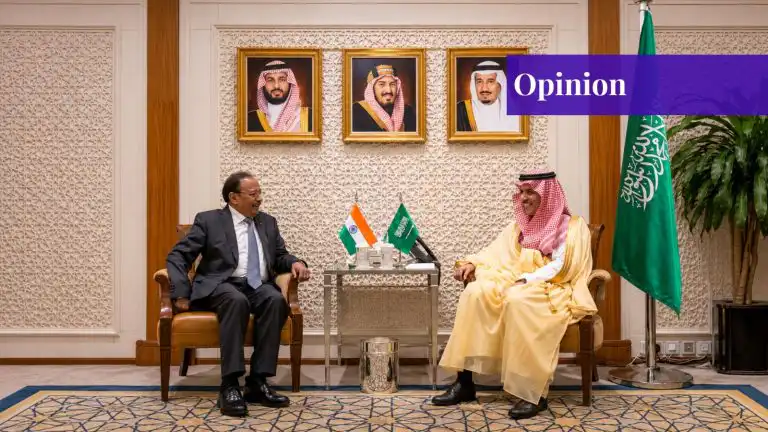
Indian National Security Advisor (NSA) Ajit Doval has again visited Saudi Arabia. His first meeting of this year was held in April, and now, in July, he met Prince Faisal bin Farhan of Saudi Arabia. It portrays the strengthening of the bilateral relations between the two states. While the central pillar of Ajit Doval’s Saudi Arabia visit was trade and energy cooperation, viewing it only through an economic lens overlooks its broader strategic significance. Visits by NSAs are rarely confined to commercial diplomacy; rather, they reflect deeper motives regarding regional security and intelligence cooperation.
Major Issues on the Table
Ajit Doval’s Saudi Arabia visit comes at a time when there is chaos in the Middle East and an energy crisis across the globe. The visit is expected to have focused on the following areas:
Maritime Security
Recent attacks on ships in the Red Sea have raised the critical issue of maritime security. India’s economy depends on energy imports and international trade, mainly through maritime trading. It must secure its sea lines of communication. Consequently, the Indian Navy has expanded its presence in the Arabian Sea and in the Gulf of Aden through anti-piracy patrols by using guided missiles and maritime commandos. In this crucial time, India can become a strategic partner of Saudi Arabia and can provide maritime security to Saudi Arabia for the safe passage of their commercial ships through the Red Sea.
Energy Security
Due to maritime commandos, in West Asia, every country seeks to secure its oil and gas supply routes. India is doing the same. He may propose that by providing maritime security to Saudi Arabia in the Red Sea, KSA will provide costly oil to India in this crisis. As there are no free lunches in politics. Protecting energy supplies is no longer just an economic issue; rather, it has become a national security issue. That’s why there was a need for India’s National Security Advisor to visit Saudi Arabia.
Intelligence Cooperation
India and Saudi Arabia have expanded their cooperation against many extremist networks. In the third session of the India-Saudi Arabia Security Working Group Meeting, they agreed on zero tolerance and deradicalisation against terrorist networks and financing.
The two parties may have exchanged intelligence regarding terrorist financing and networks in the Middle East. As MENA (Middle East and North Africa) is the hub of the ISIS network, Saudi Arabia. It may be possible that both parties have discussed developments in Yemen, Syria, and North Africa on the table.
Why Pakistan Still Matters
India’s expanding ties with Saudi Arabia don’t diminish Pakistan’s strategic relevance. Rather, it reflects Saudi Arabia’s broader multi-alignment strategy. Pakistan is still an important asset to Saudi Arabia, as both states have signed a defence pact. At the same time, India is offering other advantages to Saudi Arabia. As Saudia is one of the largest oil exporters in the Gulf states, it needs to secure its supply routes. India’s strong and largest naval presence in the Indian Ocean gives it an advantage to expand its ties with Saudi Arabia. So, Saudia is Saudi Arabia. between Pakistan and India. Pakistan is providing defence cooperation, while India is providing maritime security, and both states will enjoy cheap oil from Saudi Arabia.
This policy reflects a more significant trend in international relations, as countries tend to pursue a multi-alignment approach in today’s global environment. Rather than aligning themselves exclusively with one geopolitical bloc, middle powers are more likely to pursue a foreign policy that involves engaging with multiple states. This is demonstrated by the fact that Saudi Arabia has been making defence-related agreements with Pakistan while simultaneously pursuing a strategic partnership with India. In general, it could be said that Saudi foreign policy is guided by its Saudi Arabia.
Conclusion
Diplomacy is often about signalling. The visit of the NSA, specifically in critical situations, cannot be ignored. Ajit Doval’s visit signals that India views Saudi Arabia also as a security partner, not only as an economic partner. It also signals that India’s role in West Asia is now expanding through conducting operations for deradicalisation and having a strong security partnership with one of the largest oil-exporting states, Saudi Arabia. Also, it shows Saudi Arabia’s diverse partnerships and balancing strategy between India and Pakistan. Saudi Arabia is pursuing a Saudi-first foreign policy that seeks to maximise opportunities with all regional partners.
If you want to submit your articles and/or research papers, please visit the Submissions page.
To stay updated with the latest jobs, CSS news, internships, scholarships, and current affairs articles, join our Community Forum!
The views and opinions expressed in this article/paper are the author’s own and do not necessarily reflect the editorial position of Paradigm Shift.

Syeda Farani Fatima is an undergraduate student of International Relations at the International Islamic University of Islamabad, with a strong interest in anti-corruption, counter-terrorism and geopolitics. Strongly committed to fighting corruption, terrorism, and supporting national reform through research and public service.