
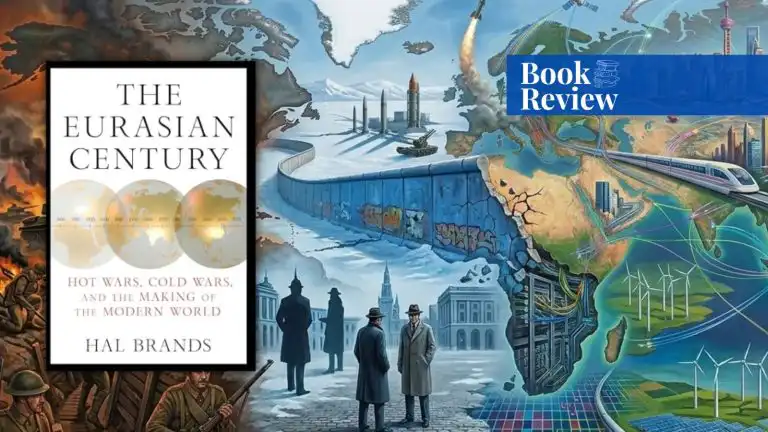
Hal Brands’ The Eurasian Century: Hot Wars, Cold Wars, and the Making of the Modern World is a sweeping geopolitical history that argues for the centrality of Eurasia in shaping modern international order. While the twentieth century is considered to be dominated by American power, Brands asserts that it is more appropriate to term it a Eurasian century. Eurasia, also called a “world island”, stretching from Asia’s eastern shores to Western Europe, and from the Arctic to the Indian Ocean, witnessed the most turbulent period including the devastating conflicts, ideological battles, and tectonic movements. The book follows the history of the twentieth century in which Eurasia has not only determined the course of global politics but also the ways in which global politics are now once again being challenged by Russia, China, and their allies.

Brands takes an approach to foreign policy based on a combination of historical scholarship and policy experience. He is the Henry A. Kissinger Distinguished Professor of Global Affairs at Johns Hopkins School of Advanced International Studies (SAIS) and is also an affiliated researcher, policy analyst, and commentator with the American Enterprise Institute and Bloomberg Opinion. His works, such as The Twilight Struggle: What the Cold War Teaches Us about Great-Power Rivalry and Danger Zone: The Coming Conflict with China, show a longstanding interest in evolving dynamics of geopolitics. His previous positions as the Special Assistant to the Secretary of Defence in Strategic Planning and the lead author of the Commission on the National Defence Strategy gave him familiarity with national security institutions, and his position on the Foreign Affairs Policy Board of the State Department indicates the continuation of policy involvement.
The most significant and primary theme of the book is that Eurasia is the pivot of the world order. Based on the writings of Halford Mackinder, the pioneer of the Heartland theory, Brands maintains that the possession of Eurasia has always been the most conclusive of prizes in world politics. This is attributed to the fact that the region has a disproportionate share of the global population, industrial potential, and natural resources. Brands asserts that a dominant power or coalition based in Eurasia could apply that strength to project power worldwide, coercing even other democracies far away. In the words of Mackinder, Brands described Eurasia as a space unlike any other.
The second theme is that the struggles of Eurasians are not regional but global in scope and implications. The book explores the major wars of the twentieth century, such as the two deadliest, World War I and World War II, as well as the Cold War. The author says the Cold War was horrific for developing regions, as it resulted in small wars spanning regions from Europe to Asia, Africa, and the Americas for hegemonic struggles. These conflicts throughout Eurasia in many aspects, contributed to the formation of today’s contemporary world and liberal order. Moreover, Brands explains them as battles of power between authoritarian states, which wanted to dominate Eurasia, and democratic alliances, which aimed to maintain stability and avert authoritarian rule.
A third theme is the cyclical conflict of authoritarian land powers and democratic maritime alliances. Imperial Germany, Nazi Germany, imperial Japan, and the Soviet Union wanted to control Eurasia, whereas offshore powers like Britain and the US, with continental partners in many cases, resisted. This tendency, Brands posits, persists today with an “axis of autocracies” connecting China, Russia, Iran and North Korea. It is not an official alliance, but is linked by mutual opposition against the US and is being strengthened since the Russian invasion of Ukraine with sustained actions of Iranian asymmetric strengths such as drones, missiles, proxies, North Korean ammunition, and Chinese economic support. This is seen by Brands to be a structural change and not a tactical cooperation, posing a challenge to the order established by the West. In the middle of the picture is China, whose economic power, assertiveness in the South China Sea, conflict with India, and claims to Taiwan indicate regional primacy and an aim to transform global governance in an authoritarian manner.
Lastly, the fourth theme of the book indicates that the lessons of history are critical to the present. Brands says that the plight of the twentieth century holds timeless lessons for the democracies of today. Autocracies that seek hegemony within Eurasia can eventually trigger strong anti-hegemonic alliances against them, though the outcomes remain uncertain. Thus, the response of democratic countries to emerging challenges will be determined by their capacity to learn the lessons of Eurasian power struggles of the last 120 years and apply them to the turbulent world of the future.
The book effectively links the past with the present-day challenges. Brands connects the world wars to the contemporary conflicts in Ukraine and the Western Pacific and makes them a part of the second Eurasian century. He balances this with geopolitical theorists like Mackinder, Mahan, and Spykman and considers their work as strategic frameworks, not as abstract theories. Brands is of the view that time and again Eurasia has remained at the core of global rivalry, and to give his argument an effective narrative strength, he uses historical scenes, such as Germany in 1917, Japan in 1941, the Soviet Union in 1947, and Russia in 2022.
Simultaneously, the policy orientation of the book can be interpreted by the readers in a different way. Brands cautions against the dangers of authoritarian bids for Eurasian primacy and urges democracies to learn the lessons of past struggles. Whereas some people will find this argument convincing and timely, others may perceive it as overemphasising the similarities between the past and the present. Through this, the book is both thorough in its historical synthesis and proactive in its policy-focused perspective that will both raise inquiry and contemplation.
The book is not without its limitations. It is largely based on an American lens. The narrative is less inclusive of the agency of regional actors and gives no space to non-Western voices. There is an overemphasis on geopolitics as well as geographical determinism, at the cost of other factors like economic interdependence, cyber, and transnational issues like climate change and pandemics. Such dynamics might not fit well in Mackinderian reasoning, but they are becoming more and more central to modern politics. Likewise, the framing of the book on democracy versus autocracy may simplify history and obscure that democracies have sometimes practised coercion or imperialism, and that the alliances in war are often deeply morally ambiguous.
Moreover, by emphasising the scale of Eurasia, the industrialisation of the region, and its natural resources, the author supports an established fact about the centrality of the region in the global power distribution. Although well expressed, this statement repeats a well-known concept of strategic thinking instead of being a new interpretation.
The Eurasian Century is a work on continuity as much as change. It emphasises the role of power plays in Eurasia, which have characterised international politics over the past century, and suggests that this dynamic remains in effect in modern international relations. Connecting the realities of the twentieth century to the issues of the twenty-first, Brands encourages readers to see the modern-day rivalries as a continuation of a certain path instead of an isolated phenomenon.
The book is not speculative about the future; it does not say that conflict across Eurasia is unavoidable. Rather, it provides a platform to get a sense of why some areas are still disputed and how coalitions between authoritarian nations can transform world orders of power. Although its analysis is mainly designed to appeal to the American audience, it can be applied to policymakers, scholars, and ordinary audiences around the world, seeking to make sense of the current state of security.
The Eurasian Century makes Eurasia the enduring fulcrum of world politics, projecting both a historical and contemporary significance. Regardless of whether or not one concurs with all of the interpretations made by Brands, the book offers an organised explanation as to why this landmass has been a recurrent centre of international competition and why it will probably continue to be the case for decades into the future.
If you want to submit your articles and/or research papers, please visit the Submissions page.
To stay updated with the latest jobs, CSS news, internships, scholarships, and current affairs articles, join our Community Forum!
Find our FREE quizzes and MCQs here!
The views and opinions expressed in this article/paper are the author’s own and do not necessarily reflect the editorial position of Paradigm Shift.
Ezba Walayat Khan is a Research Assistant at the Centre for Aerospace and Security Studies (CASS), Lahore, Pakistan. She can be reached at info@casslhr.com.