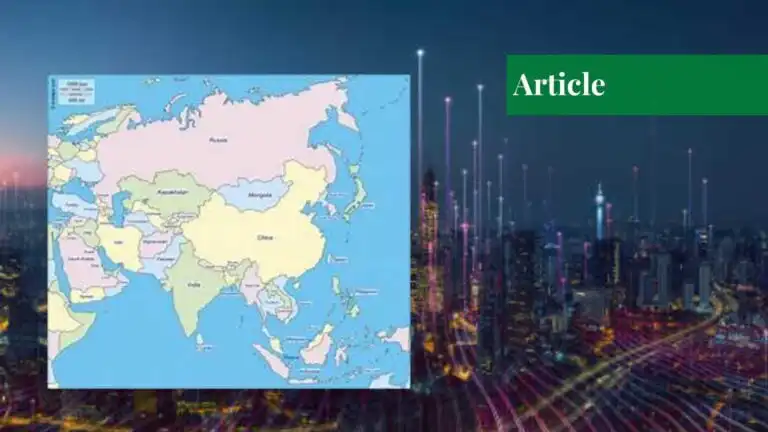
For the past few decades, the United States has been the most dominant and influential country in the world. The globe witnessed numerous wars and upheavals due to the unilateral decisions of the United States. However, the rise of China, Russia, Japan, and India, along with other economies of Asia, has resulted in the resurgence of the multipolar world order.
With the rapid rise of China, Russia, India, and Japan, and the expansion and popularity of BRICS, the future is Asian. This attention is not merely attributed to the wars and conflicts but is also due to the economic and technological advancement of Asian countries.
The region hosts almost 60 percent of the global population and accounts for almost 36 percent of the global GDP. China, Japan, and India are among the top ten largest economies in the world; China is the second largest economy in the world after the United States. Asia is on track to top 50 percent of global GDP by 2040 and drive 40 percent of the world’s consumption, representing a real shift in the world’s center of gravity.
The future is Asian because of the economic rise of these Asian countries through mutual trade. China and India have historical rivalries. However, despite this animosity, both countries have significant economic ties. Mutual trade between the two neighboring countries increased by 90.14 percent in the period between 2015 to 2022. Overall, mutual trade between the two sides increased by almost 8.5 percent in 2022, crossing the $100 billion mark for the 2nd time in a row. The two countries still have room for increasing their trade which can further elevate their economies.
Russia and India are historical trade partners. Both countries have cordial relations since the inception of the latter. Russia plays a pivotal role in the economic and technological rise of India, while the latter serves as one of the biggest markets for Russia. Trade volume between the two sides climaxed to 65 billion USD in 2023. Russia’s major investments in India are in the petrochemicals, oil and gas, steel, railways, and banking sectors, while Indian investments in Russia are mainly in pharmaceuticals, and oil and gas sectors.
ASEAN, established in 1967 and comprising Vietnam, Brunei, Indonesia, Malaysia, Singapore, Myanmar, the Philippines, and Thailand, is also a major economic bloc in the region. This bloc holds huge economic potential. The GDP of ASEAN countries has been thriving for years. In 2022, their collective GDP amounted to almost $3.63 trillion. The GDP of the ASEAN countries is increasing every year which represents the potential of thriving Asian countries.
Moreover, the Central Asian Republics (CARs) also hold significant mineral resources. The region possesses 30.07 percent of global chromium reserves, 38.6 percent of manganese ore, 20 percent of lead, 8.7 percent of titanium, 12.6 percent of zinc, 5.8 percent of aluminum, 5.3 percent of copper, 5.2 percent of molybdenum, and 5.3 percent of cobalt. All these minerals hold critical significance as they are used in clean green technologies worldwide. These mineral resources can not only prove lucrative for the economies of the CARs but can also elevate the economy of the regional countries, by increasing mutual trade and stability.
China’s Belt and Road Initiative (BRI) is also one of the major contributing reasons for the rise of Asia. BRI is spread across three continents, connecting Africa and Europe with Asia. China is rapidly developing infrastructure and industry and boosting energy production in different countries under this project. China-Pakistan Economic Corridor (CPEC) is the flagship project of the BRI and holds the potential to provide access to the sea route to the landlocked countries of Central Asia. Thus, the Central Asian countries and Russia can access the global markets in much less time and cost by connecting to this project.
Furthermore, the expansion of BRICS has also given a severe blow to the Western-led world order. The West, especially the United States, has always used these international institutions to gain political and strategic dominance over poor countries. The Western institutions have always served the interests of the Western countries. The United Nations has been unable to prevent the United States and its allies from violating international laws. This resulted in the inculcating of a feeling of insecurity and inferiority amongst the poor countries of the world. Therefore, the expansion of BRICS under the leadership of Russia, China, and India has provided a novel opportunity for third-world countries.
The overall image of the Asian economic giants is of inclusiveness toward the third-world nations. Russia and China are increasingly being victimized by the West. The United States is increasingly challenging China in the Indo-Pacific region, while Russia is also under US sanctions. The United States has a history of penalizing its rivals through economic sanctions. Thus, all the poor and developing countries are seeking to purge the shackles of Western influence.
The BRICS embodies almost 40 percent of the global population. In 2022, the collective GDP of the BRICS member countries was over 25.85 trillion, which was more than that of the United States. Moreover, the collective GDP of the BRICS is more than that of the G7 countries. The group is also responsible for 16 percent of global trade. Further expansion of the organization will increase its influence even more. 40 countries have already demonstrated their interest in the BRICS membership.
Technological advancement is also on the rise in Asia. The region witnessed 52 percent of global growth in tech-company revenues over the last decade. China, Japan, and South Korea are amongst the most technologically advanced countries in the region. Russia and China are among the top 5 major arms exporters in the world. The United States’ sanctions on resource-rich Afghanistan and Iran have also tilted them towards the Eastern bloc.
Russia is already following an inclusive policy towards Afghanistan and Iran, which can lead to regional stability and peace. Therefore, it will be cogent to hold that the Asian continent is the future of the world as Western influence is rapidly declining due to its coercive policies and illiberal values. However, climate change, regional conflicts, and global warming can impede the rise of Asian nations. Countries like China, Russia, and India need to take the lead to ensure regional stability and counter other non-traditional security threats through mutual cooperation and inclusivity.
If you want to submit your articles and/or research papers, please check the Submissions page.
The views and opinions expressed in this article/paper are the author’s own and do not necessarily reflect the editorial position of Paradigm Shift.
Abdullah Nisar holds a degree in journalism and mass communication from the International Islamic University, Islamabad. He is currently working as a freelance journalist.