Introduction
Ares, in Greek mythology, is considered the “spirit” of war, which controls and influences all warfare between mankind. He was bloodthirsty and an internecine-loving entity who rejoiced in the chaos of war. Indubitably, the perils of war are anathema to man and must be vehemently discouraged. However, when we take a glimpse of history, we realize that it hasn’t been a destructive political tool.
Many lessons have been learned, and it has been the driving impetus for mankind to progress in other fields such as science, management, political science, and the socio-economic aspects of society. War has expedited progress through the need for necessity. As Mike Duncan writes in his book, The Storm Before the Storm, in war and politics, you can only be on top if you can stay on top. Thus, perpetually striving to improve your strength is an imperative requisite of winning. This leads to strengthening yourself through the scientific development of the best weapons and equipment for offense and defensive measures.
The Chariot
Let’s go back in history to around 3000 BC, during the times of the Mesopotamians. The first sighting of a simple chariot is observed in one of their relics communicating a grand military parade. It must be a necessity of the time to be able to defend their lands and counter any looming threats with swiftness.
Clausewitz says, “The backbone of surprise is fusing speed with secrecy.” The Mesopotamians lived thousands of years before Clausewitz but they understood the necessity of speed during battle, which may have instigated them to put thought into swiftness, which eventually manifested the battle chariot.
Chariots did exist before being introduced to the battlefield; however, they required further amelioration in design for them to be far more maneuverable and speedy. Eventually, the new and improved chariot made its way into domestic use, the dénouement being the improvement of the transportation sector, which substantially impacted the economic sector’s wheel to spin a bit faster relative to pre-chariot improvements.
The Sarissa
Fast forward to the 400-300 BC period, the conquests of Alexander the Great took place. It’s crucial to understand that the victor always brings something new to the battlefield to catch their opponent off-guard. Alexander the Great never went by the book when conjuring up strategies to subdue the Persian army. Darius’s army would be numerically mightier in terms of soldiers. This kindled Alexander to always fight his battles in an unorthodox manner.
Moreover, there was one more critical factor that led to Alexander’s success in Persia. His father, Philip the Second, had introduced the “Sarissa”—a long spear that stretched almost 5 to 7 meters. These would be wielded by the phalanx of Alexander’s army, stationed usually on the far right; hence, synergizing the strength of the right wing of the army. Though the “Sarissa” had no domestic use and was solely a weapon of war, attributing to its utility, it helped gain Alexander instant dominion over all his captured territory, shaping history altogether. A prime example proves that whoever has the better edge over the opponent goes on to triumph in battle.
Introducing Military Reforms
The Roman Republic’s military faced many reforms, mostly targeting better regulation and management of the military. These reforms were passed down not only to contemporary militaries but also helped engender new methods and techniques for efficient management of corporate structure. Gaius Marius was the consul responsible for these reforms. He introduced a standard for every legion; for example, the symbol of an eagle.
This built strong legionary comradeship amongst the soldiers, distilling a sense of strong spirit, unity, and courage. The Roman army was transformed from a semi-professional to a fully professional fighting force. Furthermore, from the maniple system of military units, the cohort system was introduced. The cohort system is the equivalent of the modern battalion. Marius also introduced the idea of proper training of soldiers. Most of these reforms can be realized in the current state of militaries all over the world.
In the year 732, Abdur Rehman Al Ghafiqi, the governor of Andalus, led a Muslim army into Frankish territory to resume the Muslim expansion (Battle of Tours). The expedition did not succeed due to the support the Pope and Christian Europe provided to Charlemagne. However, certain excerpts can be derived from this encounter between both powers.
After the battle had ended, the spoils of war were collected by the Frankish soldiers. The Muslims were a powerful force not only in terms of military might but also in science and other scholarly fields. The Muslims were the first to introduce “armored cavalry.” This transfer of equipment after the defeat of Abdur Rehman Al Ghafiqi was transferred to Europe, enhancing their military prowess as well.
The Napoleonic Wars have majorly contributed to the advancement of military tactics, formations, and strategies. For example, the efficient utilization of the corps system was one of Napoleon’s most significant contributions to the arts of war. Napoleon’s march through the Alps is also a testament to pushing human abilities to the limit with inadequate and inappropriate equipment. Nevertheless, many ideas and innovative efforts were made to facilitate the logistics of the army owing to this.
By-products of the World Wars
The modern era that we live in has been greatly buttressed in terms of technology by World War I. The war was a catastrophe itself, nevertheless, after it was over, mankind had stepped up the ladder of progress by a gargantuan distance as it set in motion the development of many amenities that could be used domestically as well to better the living standards.
For example, Kotex a company that was established in 1920, two years after the war used cellucotton for sanitary napkins. Cellucotton was used for fabricating bandages that were used to treat bleeding soldiers because it had high absorption abilities. Owing to its high absorption it was also utilized for the production of sanitary napkins after the war.
Another important development was the introduction of blood banks. Prior to the war, if anyone needed blood, the donor would have to be found on sight and then a blood transfusion would take place. The war left many soldiers who were injured in need of blood instantly when being treated. Soldiers would die if a donor was not found in time. Eventually, blood banks were established so blood could be made readily available at the time of treatment.
There were destructive inventions as well, such as torpedoes. England had the most powerful navy at that time. It orchestrated a naval block of Germany. Necessity, being the mother of invention, enticed Germany to counter this predicament by inventing torpedoes that would be fired from U-boats. This resulted in many catastrophic naval defeats for the British.
World War II, just like World War I, engendered positive progress too in scholarly fields such as engineering. The invention of the RADAR is one of the most significant. Furthermore, another crucial development was the mass production of penicillin. However, as the Latin proverb goes, “agrescit medendo,” the remedy is worse than the disease; sometimes the cure may prove to be more fatal than the disease itself. This can be said for the invention of the nuclear bomb but it did also pave the way for the creation of nuclear energy.
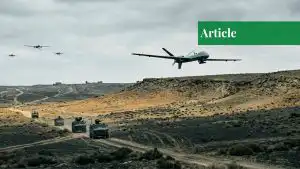
Contemporary warfare plus the advent of the digital era has widened the horizon of impending threats to national security. Adversaries may attack you anywhere at any time. The use of drones has quickly made its way into the domestic realm. Now, instead of carrying 114 Hellfire, it carries packages from Amazon to your doorstep or allows you to capture good-quality aerial videography instead of using an expensive helicopter for the same purpose.
Furthermore, the advancement of semiconductors is attributed to the US military. The US military uses the latest generation of semiconductors. Those semiconductors only make their way to the domestic market once the US military has developed the next generation. According to Moore’s law, the advancement of semiconductors is linear; hence, they can always be improved and made a lot more complex.
Cyberwarfare is a new battlefield, one that has shown its glimpses in the shape of STUXNET, the virus that destroyed multiple centrifuges of the Iranian nuclear facility. Though significant countermeasures have not yet been developed to tackle such threats, it should be well believed that they are in the works.
Explaining the Link Between War & Development
Now the question may be asked: How come the most significant developments have been the result of the battlefield? Apart from necessity, it is the fact that most countries superfluously fund their defense sectors, which enables them to venture into such innovative projects. Take, for example, the amount of money spent on the development of the F-35, a staggering 2 trillion dollars. This raises another question: Would awarding similar blank cheques to institutes that solely work on human development improvement bring about substantial change in the livelihood of people?
It is cogent that on one side war has been destructive but on the other, it has also manifested progress for the human race, ex tenebris lux (from darkness comes light). This being said would aggravate the chaos-loving spirit of Ares, making him throw a tantrum. As individuals too, we all wage wars internally and face predicaments that leave us disheveled and hopeless.
Life puts us through circumstances and trials as described perfectly in Franz Kafka’s novels, or situations described as “Kafkaesque.” However, remaining stagnant will not improve our condition; we cannot be indifferent to our trials like Joseph K. (from The Trial by Franz Kafka). We must learn from the human spirit of war to always one-up the adversary and progress, always anticipating the future and remaining versatile.
“The general who wins a battle makes many calculations in his temple before the battle is fought. The general who loses a battle makes but few calculations beforehand.”
Sun Tzu
If you want to submit your articles and/or research papers, please check the Submissions page.
The views and opinions expressed in this article/paper are the author’s own and do not necessarily reflect the editorial position of Paradigm Shift.

Mr Hamza Sharif graduated with a degree in Mechanical Engineering from HITEC University. His areas of interest are geopolitics, current affairs, and history.