

The Mismatch of Global Feminism
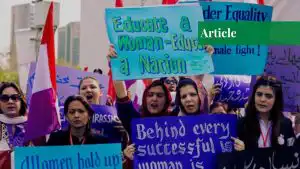
There are various ongoing debates about the origins of feminism and its intended audience within Pakistan. Some think feminism is a Western import, while others push the narrative of it being Pakistan’s favorite enemy, Israel’s agenda. From the religious aspect, some state that Islam has already given women rights. On the other hand, many are of the strong belief that the British are the only reason we stopped burning our widows. Most conversations surrounding gender equality tend to push the individualistic narrative that women ought to earn and climb the career ladder to be liberated. This narrative fits adequately into Western societies, but it has not been revolutionary in South Asia.
One way or another, most interpretations of feminism in Pakistan stem from either liberal or radical feminism. And those two are the forbidden fruits, such that neither of those branches of mainstream feminism is a fit for Pakistani society. So when most of the country associates feminism only with bra-burning protests, it becomes quite difficult to bring that conversation home, into Pakistani kitchens where the housewife lies.
The Erasure of Identity: From Person to Provider
I once recall a teacher in school asking me what my parents did for work. Naturally, I told her my father was in corporate, and my mother was a housewife. It did not occur to me at the time, but I later realized that I did not know my mother beyond her role as a caretaker. I did not even consider anything to be wrong for years because it was just the norm.
This is an unfortunate yet common truth for many women across the subcontinent. When you ask their husbands or kids who they are, you hear something along the lines of, “She is someone, I assume.” “She has a degree. Wait, she does? A master’s in education, wow!” “She must’ve had friends at some point, but I’d say her sister is her friend.” “Her hobbies? Cooking? Doing laundry? Oh, wait! I know! It’s sewing; she said she used to make dresses for us when we were little.”
This little conversation sums up exactly how a majority of housewives are unfortunately known. I kept observing the women around me who existed merely as entities, not as women. I thought to myself, there must be a word for this phenomenon. And there was an ignorant and outdated explanation when someone tried to understand.
Psychological Toll of the Housewife Syndrome
The housewife syndrome is now neither a professional diagnosis nor formal terminology; rather, it refers to the psychological and emotional turmoil that housewives experience due to their confinement to a domestic space. They experience symptoms including anxiety, depression, which can be high functioning, self-alienation, and a loss of self.
The term itself was originally coined by American doctors to describe the distress experienced by housewives in the 1940s and 1960s. These doctors believed unhappy women were a result of lost femininity or madness. After all, a house, a husband, a couple of beautiful children, and a lifetime of free labor are just what women needed to be happy, right? It wasn’t until the 70s that women themselves rejected the understanding of the housewife syndrome and protested that the true cause of women’s unhappiness was rooted in their cultural and societal oppression.
In the 2023 Bollywood film Laapataa Ladies, one scene perfectly encapsulates this issue. In a moment shared between Jaya and Deepak’s mom, Jaya compliments the latter on her cooking and asks why she doesn’t make her favorite dish from childhood. The mom replies, “Now women’s likes are supposed to count or something?” She then talks about how, after cooking for everyone else for such a long time, she’s forgotten what she likes.
Recently, the 2025 film Mrs. similarly brought the issue to light. Protagonist Richa cooked and cleaned, but that was not what made her unhappy. It was the eradication of her identity and self-worth that pushed her over the edge. The difference is that she got out. Her mother-in-law, however, was not awarded the luxury, as countless others are not either.
Whenever any debate takes place about the state of homemakers in Pakistan, it is almost always met with one of two sentiments: “Well, my mother is not oppressed,” and “So you want all women to work, eliminating the role of housewives?” But it’s important to note that the purpose of bringing up this topic is not to constantly argue about these issues, but rather, to liberate the very women they affect. The psychological and emotional suffering that homemakers endure is severe. As the unsung heroes of society, their labor is the foundation that allows the world to function, yet their struggles go unrecognized and unaddressed, with their work undervalued.
Though liberation itself looks different for every woman in every society, if one wants the homemaker in their life to not live in despair, they should start by learning about who they are or were in the first place. People in Pakistan are always at odds with labeling themselves as feminists, but I always found my reason at home.
If you want to submit your articles and/or research papers, please visit the Submissions page.
To stay updated with the latest jobs, CSS news, internships, scholarships, and current affairs articles, join our Community Forum!
The views and opinions expressed in this article/paper are the author’s own and do not necessarily reflect the editorial position of Paradigm Shift.

Manhal Zaka Khan is a writer currently interning at Paradigm Shift. She is pursuing a bachelor's degree in social sciences at SZABIST Karachi, majoring in international relations. Her writing interests encompass all areas of the social sciences, as she explores and examines the world through a critical and analytical perspective.