

On the 28th of February, the US-Israel’s killing of the Iranian supreme leader, Ayatullah Ali Khamenei, sparked another episode of tensions between Iran and the US-Israel. The conflict is edging towards its third month, with one dialogue in Islamabad on 12th April, while the possibility of a second round looming after the US president announces sending his team to Islamabad; still, the path ahead is foggy. One of the unsettling aspects of this attack was the risk of rising fuel prices and the global inflation that followed. Even the slightest aggressive activity in the conflict pushed the prices, pressing the global economy to the precipice, as the IMF warned that the global inflation is projected to rise to 4.4%, while the UNDP stated that more than 32 million people will be plunged into poverty by the economic fallout.
It seems that the attack was not on Iran, but on the juggernaut of the global economy, as the Strait of Hormuz channels one-fifth of the global oil. The war has inflicted a $50 billion blow to the global economy due to supply disruptions, prices fluctuate daily, and overall prices have increased by nearly 50%. The toll of the swinging prices fell on the whole world, but the developing countries are the ones who are badly hit by it. Among them, one is Pakistan, a country with meagre foreign exchange reserves, a slower economic rate, and political turmoil at home.

A conflict in the Middle East is never good news for Pakistan, a country highly dependent on Gulf oil with 80% of its oil imports coming from the arab world. The oil prices surged, reaching $120 per barrel by March 9, after Iran blocked the Strait. Pakistan found it hard to pour the Forex reserves to subsidize fuel for the public, given that it is operating on a razor-thin margin on the monetary front. The unbridled global prices broke the internal prices bubble as the government announced a rise in the petrol prices by 55 rupees per liter on March 7 and later a hike of 130 rupees on April 2nd, though later decreased by 80 PKR per liter.
Among the barrage of questions popping up on screens, the least asked question is “For how long will Pakistan stay like this?” Despite the snail-paced growth, the boat of the economy is finding it hard to sail against the ruthless tides of the global geopolitics, among which the US-Iran conflict is a fresh addition. This article analyzes the complex diplomatic balancing Islamabad tries to undergo in the face of global conflicts and investigates whether the roots of the vulnerability stem from the broader geopolitical world or lie within its own courtyard.
Between the Two Regional Rivals
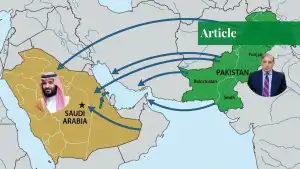
Among the most concerning factors that worry Islamabad is the long-standing rivalry between Saudi Arabia and Iran, both of them Pakistan’s strategic and economic allies. The Shia-Sunni Muslim conflict, exacerbated by the regional dominance over the oil trade, the 4-decade-old conflict is shaping the inner economic and political dices in Pakistan.
On one hand, Pakistan signed a defence pact with Saudi Arabia last year in September, strengthening the defence ties initiated in 1982, in which one of the articles states “an attack against one will be considered an attack against both,” mimicking the NATO treaty. In the recent conflict, Iran has directly attacked oil facilities and US centers in Saudi Arabia, a sheer violation of its sovereignty, which put Pakistan in a hard spot. Beyond the defence pact, Pakistan is overly economically dependent on the kingdom as more than 2.5 million Pakistanis earn a livelihood in the arab sands, sending heavy remittances back home, equalling 25% of total remittances the country receives.
The problems don’t end here, as in the past few years, Saudi Arabia has helped Pakistan to keep it financially stable, by providing a $3 billion rollout for the stability of its foreign exchange reserves. In 2018, Saudi aliviated $6 billion of debt in 2018, while in the economically tightened period of post-Imran ouster in 2022, Saudi Arabia provided $900 million in aid between April and November and $500 million for importing oil. Historically, the kingdom helped the country in 1998 when it announced its nuclear explosions, by then the economic assistance was of free oil, equaling 50,000 barrels per day for 12 months. In the past couple of years, around 0.5 to 0.6 million young Pakistani souls fled to the Gulf in pursuit of livelihood, among them the majority landed in the Kingdom.
On the other hand, Pakistan borders Iran, sharing a 900 km border with its most vulnerable and least developed province, while the latter was the first one to accept the newly independent country in 1947. For the moment being, Iran is the only neighbour with whom Pakistan has good ties. Peace with Iran is of greater importance to Pakistan, especially in moments when it has worsened relations with both neighbours, on the western border with Taliban-led Afghanistan, and on the eastern border, with the seasoned rival, India, with whom the country has gone through a clash in the past year. In the midst of all this, Islamabad won’t wish to open a new bleeding front, whose impact would penetrate and hurt deeply the already fractured, wounded Balochistan. However, the economic dependency on Iran is lower, despite the oil and gas-rich resources of the Shia-dominated, clergy-led republic, due to the US sanctions on it, another headache for Pakistan.
Pakistan got a sigh of relief in 2023 when, on March 10, China brokered peace between the two oil giants, who agreed on resuming diplomatic relations after 9 years. However, the fragile nature of the reapproachment didn’t go well. Any direct and indirect peace deal or dialogue benefits Pakistan in a substantive way. A report by the IPRI suggested that if Saudi Arabia joins China’s BRI project and invests in the CPEC, it will trigger economic growth for Pakistan. At least the peace between Iran and Saudi Arabia will allow Pakistan to proceed with open diplomacy and risk-free relations with both, keeping the western border safe while also pursuing its economic interests with the kingdom. The mystery of the oil giants’ relations is yet to be solved.
The larger picture: US-China rivalry
Pakistan’s relations with China are entitled as “A friendship higher than the Himalayas, deeper than the ocean, sweeter than honey, and stronger than steel,” which reflects the deepening ties between the two neighbours. Pakistan is greatly dependent on China, the latter being the largest bilateral debt provider as of 2025, with the total debt standing at $68.9 billion. The relations between the two have cemented after the CPEC signing in 2015, a flagship project of China’s $1 Trillion BRI project, in which China plans to pour $62 billion worth of investment in infrastructure, energy, human resources, and security development. Moreover, the bilateral trade between Pakistan and China is $23.1 billion, as of 2024, in which Pakistan exports goods worth merely $3.4 billion in return for a big chunk of $19.62 billion in imports. Pakistan’s core reliance is on its security apparatus, as Pakistan imports 82% of its military procurement from China, signaling China’s vitality in Pakistan’s defence architecture.
On the other hand, the history of Pakistan and US relations feels much like the friendship of an elephant and a fox, where the elephant is eager to dominate the jungle, and the fox maneuvers swiftly to get maximum benefit of the rage. In the 1950s, the US kindness towards Pakistan exceeded geopolitical realities and basketed the latter in the SEATO and CENTO. In the 1960s, it poured $2 billion in aid over Ayub’s led country, famously known as the industrially glittering age. In the 1970s, the relations worsened. Ironically, to Pakistan’s surprise, its most trusted global ally didn’t come to its help in the 1965 and 1971 wars, which fueled the mistrust. But for how long could the fox have lived without the Elephant? The 1980s saw the revitalizing of ties, the 1990s saw a widening chasm, worsened by Pakistan’s nuclear prowess, and the 2000s, after the deadly 9/11, Pakistan again became the center of attention of Washington. Till 2014, the US’s kindness knew no bounds; Pakistan got more than $33 Billion in which $7.5 billion was civilian funds.
The mutual trade is of greater importance to Pakistan, of which Pakistan exports $7 billion worth of goods and imports merely $3 billion. Trump’s second term saw some unexpected decisions, most of which brought devastating results for the world; however, a few of them were, thankfully, better. Among those was the Free Trade Agreement between Pakistan and the US, under which the US will invest in the oil exploration and mining in Pakistan’s crippled provinces, KPK and Balochistan, and will export oil worth $11 Billion, the first time in history, US Oil tankers will land on Pakistani ports. Surprisingly, in the Tariff enigma, Trump decreased tariffs on Pakistani goods from 29% to 19%.
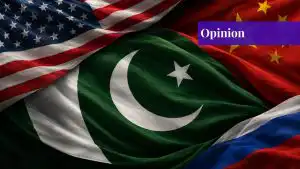
Growing Chinese regional influence in the region and on Pakistan’s fiscal throat, while Pakistan’s inveterate, one-sided romance with the US, will tighten the noose around Islamabad in the near future. Any global mishap between the two elephants will come at dire consequences for the fox. Which side it will take is the tale of the future, but it will burn the fox’s tail.
The Roots
The readers might have received an existential blow with the future of Pakistan. But some stars shine even in the darkest hour of the night. The problem is still in hand and is easy to solve.
Internal economic rupture, overreliance on remittances, flawed fiscal policies over the years, regional crisis, policy implementation gaps, and rapid population growth are the womb that gives birth to these debacles. Ranging between 1.5% to 2.5%, the population pace has derailed the country from a relatively stable economy to a crippling economy in the past 50 years, as the country failed to cope with the needs of a growing population. The result is the 26 million out-of-school children, over 5 million youth joblessness, and one of the highest brain-drain rates in the region. As of 2023, Pakistan’s ratio of the working age population was 60%, which was the lowest in South Asia, that also coupled with the median wage of only 40,000 rupees, which is insufficient for a single person to get fed in the face of growing inflation.
In the fiscal space, it seems Pakistan has not learned its history lessons. Still high reliance on foreign aid, debts, and remittances, while negligible investment in human development, the exacerbating pool of imports, and the dwindling exports. The intensity of this problem is reflected in the widening trade deficit, stretched to $28 billion, rose by 23%, while the overall public debt amounts 70% of the GDP as of January this year.
The economic growth has plunged due to the internal and external structural barriers. Insufficient bureaucracy, corruption, inadequate support for SMEs, a rigid labour market, tax complexities, a gap between the formal and informal economy, and regional inequalities all add to the pool of economic underdevelopment. While lowering FDI, which has seen a continuing decrease since 2008, overspending on the military budget due to geopolitical threats from seasoned rival, India, and newly-hatched enemy, Afghanistan, and a troubling atmosphere on the global stage, such as the Ukraine-Russia conflict, Israel-Palestine Issue, and now the US-Israel-Iran fissure, is pushing international commodities to threatening figures.
With all this, ill-equipped youth, mediocre educational practices, regional inequalities, mistrust of government institutions, and low-quality exports are keeping Pakistan in the center of the ocean, unable to sail to the shore with stability.
For how long Islamabad will operate on the mercy of others, no one knows; however, it is famously said in Urdu, “Himat-e-Mardan, Madad-e-Khuda”. I think every Pakistani institution must give heed to this before the ship sinks in the troubled water.
If you want to submit your articles and/or research papers, please visit the Submissions page.
To stay updated with the latest jobs, CSS news, internships, scholarships, and current affairs articles, join our Community Forum!
The views and opinions expressed in this article/paper are the author’s own and do not necessarily reflect the editorial position of Paradigm Shift.

Zohaib is a freelance journalist focused on the socio-economic dynamics of South Asia and Human Development. He has a degree in International Relations from the International Islamic University, Islamabad.