In recent years, the consequences of global climate change such as floods, cyclones, extreme temperatures, changes in sea levels, etc, have become apparent. Pakistan is not excluded from these dangerous impacts and is alarmingly vulnerable to them. Since 2022, citizens have witnessed a rise in floods, heat waves, and extreme summer rainfall. The country is ranked 38th most vulnerable and 32nd least ready to deal with the effects of climate change. It is now evident that climate change used to be a far-fetched problem, but it cannot be ignored anymore. The impact of climate change on the coastal areas of Pakistan needs to be analyzed.
Impact on Coastal Communities
Economic Impact on Fishing and Agriculture
Pakistan has over 10% of its population living near coastal areas, most of these communities depend on marine life and vegetation for survival. The Indus Delta, situated in the southern part of Pakistan, hosts one of the largest mangrove ecosystems. They act as breeding grounds for fish, which are commercially valued and are the main source of income for fishermen. However, rising ocean temperatures make it difficult for marine life to survive, increasing their depletion.
Fish in these coastal areas not only have economic value, but they are also a staple food for the fishermen’s families and other coastal communities, so the lack of marine life also threatens the communal food supply. With the rising sea levels and ocean acidification, these ecosystems are endangered.
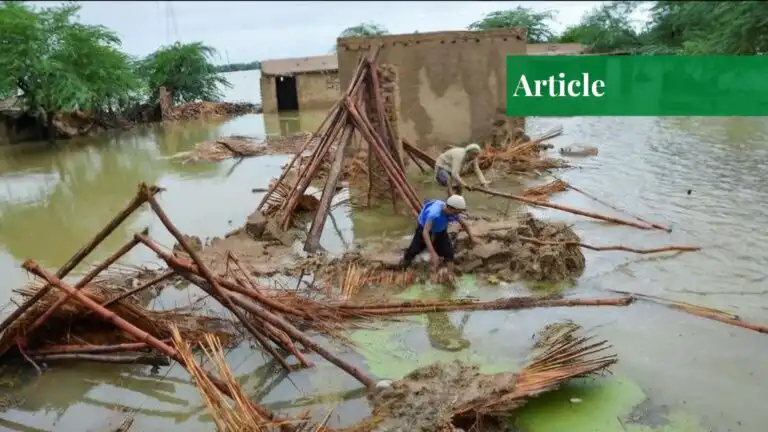
Mangrove forests also act as barriers against floods and help decrease the intensity of cyclones; their depletion can result in cyclones and floods being more dangerous and destructive for the coastal communities nearby. The residents are also more vulnerable to floods, and those that took place in 2022 are an example of how powerless these neighborhoods ultimately are in the face of natural disasters. Millions lost their houses, family members, and livestock during the tragedy. It was a warning that climate change may result in a variety of coastal hazards.
These dangers were not highlighted a couple of years ago, but community members have been raising their concerns for a long time. In 2015, Ghani Asif, a community representative from Jiwani, Balochistan, told Express Tribune that “the sea intrusion is taking away their land and damaging their fish.”
Coastal areas of Sindh and Balochistan are more prone to suffer from the direct impact of sea-level rise and rising temperatures. An environmentalist from Gwadar, Abdul Rahim Baloch, stated that the coastal areas are vulnerable to erosion, these areas include Gwadar, Pasni, and Gaddani. Rising water temperature leads sealife to migrate to cooler regions of the sea or even die in worst-case scenarios. Fisheries Resources Appraisal in Pakistan 2008-2013 (FRAP) stated that around 40-70% of the fish in the sea have gone extinct.
These coastal communities are also involved in agricultural activities that extreme temperatures, cycles of droughts, and floods have caused damage to. The intrusion of salt water into fertile soil during floods damages crops. Even if the deluge does not cause major harm, an increase in minor floods due to excessive rainfall during the monsoon season can be damaging to the crops and the coastal ecosystem.
In the Badin area of Pakistan, hundreds of acres of agricultural land have been deemed unproductive due to sea intrusion. Agriculture not only has an economic benefit for the coastal residents, but it is also a tradition, a livelihood source passed down to them from their ancestors.
A displacement pattern can also be identified in these regions, as many residents migrate or, worse, get displaced due to extreme weather conditions. After the floods and cyclones of 2010 and 2011, entire communities from Thatta, Badin, and Sajjwal migrated to Karachi.
Impact on Mental Health
There is an emotional value attached to the crops mentioned earlier. Hence, climate change can also damage the mental health of coastal residents. In her research article Emaan Fatima, a graduate of the International Baccalaureate Diploma Programme, outlined the impact of climate change on mental health.
She highlighted that studies show people with close ties to the natural environment are more likely to experience distress after suffering ecological losses. The article also emphasized that farming communities can be more vulnerable to mental disorders brought on by climate change. Hence, coastal communities that have a strong attachment to their land and nature are likely to face mental health issues after witnessing the devastating effects of changing climate.
The Way Forward
Blue carbon solutions to tackle climate change should be brought into the spotlight more. Blue carbon covers mangroves, tidal marshes, and seagrass, which play an important role in preventing coastal erosion. The ecosystems of Pakistan, in regions of Sindh and Balochistan, have the potential to store carbon dioxide. Hence, they open the possibility of “blue carbon” solutions for Pakistan.
Blue carbon ecosystems help reduce coastal erosion, as their plants can withstand extreme temperatures, and their root systems help break the intensity of storms and coastal flooding. Rapid blue carbon assessment highlights that the mangrove forests of Pakistan can store about 20 million tons of organic carbon. However, human activities such as rapid urban development have led to a decrease in such ecosystems.
Conservation strategies are extremely important to protect these valuable ecosystems from disappearing. Programs to rehabilitate coastal communities that have suffered drastic impacts of climate change should include mental health counseling as well, so these residents can emotionally cope with their situation and come to terms with it over time.
If you want to submit your articles, research papers, and book reviews, please check the Submissions page.
The views and opinions expressed in this article/paper are the author’s own and do not necessarily reflect the editorial position of Paradigm Shift.

Zara Zahid Khan is a law student at the Lahore University of Management Sciences. She is a freelance writer who enjoys writing about legal and political issues.