The new wave of hate and riots against immigrants in the UK arose due to several incidents that aggravated xenophobia and Islamophobia. These riots took a surge after the killings of three young girls on 29 July during a Taylor Swift dance workshop. The knife attack left nine other children wounded and in critical condition as well. A 17-year-old male suspect was arrested following the incident. The identity of the suspect was not revealed at the time because, as per the law in the UK, specifically Section 49 of the Children and Young Persons Act 1993, the identity of minors who have committed an offense has to be concealed.
However, the attacks promulgated an avalanche of misinformation on different social media platforms, such as X and Instagram. These posts claimed that the suspect in the case was a Muslim asylum seeker who had arrived in the UK on a boat. Sky News reported a tweet by the account “European Invasion,” which asserted that the attacker was an illegal migrant named Ali Al Shakati who came to the UK in 2024.
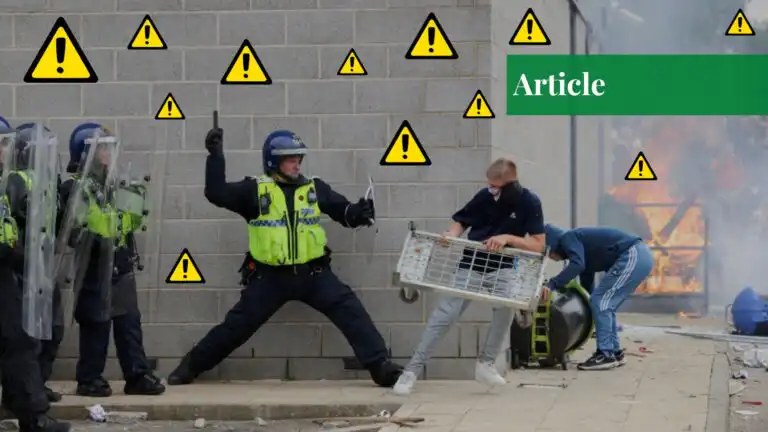
These baseless rumors, fueled by social media, led to far-right riots, which included a group of 100 attacking a mosque with bricks and other objects in Southport, resulting in 39 police officers being injured. The attackers were chanting anti-immigration and Islamophobic slogans such as “English Until I Die.” The Imam of the mosque was trapped inside the mosque till midnight and mentioned to reporters that “he was scared for his life and asked the Muslim community to remain home and pray for their safety.”
This attack led to an exceptional case hearing in which Judge Andrew Menary KC rejected the request to conceal the identity of the stabber in light of recent events, and it was revealed that the attacker was not an illegal Muslim immigrant but a boy, Axel Rudakabana, who was born in the UK. The misinformation that spread across TikTok and X was the main reason the riots went out of control. Far-right supporter Andrew Tate posted on X about how the accused is an “illegal migrant” as well, which led to many retweets and people engaging in negative discourse about the identity of the attacker.
Oppositional protests broke out against the anti-immigrant riots, leading to sporadic bursts of violence across the UK. The riots have occurred in multiple cities and towns in England and Belfast, Northern Ireland, rendering this period as the worst civil unrest in Britain after 13 years. This has forced police to arrest 400 people. The riots have led to police officers getting hurt and properties being burned and vandalized, including an asylum seekers’ host hotel. In the public domain, a total of 10 people have been cited to have been left with serious complications as a result of the violence.
The underlying issue here is how dangerous misinformation is, which can spread like wildfire through social media platforms and is spread and supported by popular accounts, including famous personalities. Elon Musk, owner of X, also shared a post on Twitter about the false identity of the attacker, which was posted by an account known as “endwokeness” with over 3 million followers. On 30 July, posters calling for a protest under the byline “Enough is Enough” began surfing through social media and called for people to join hands against immigration. Police forces took action, and by 8 August, over 480 arrests had been made, and 150 of them had been charged. London commissioner Mark Rowley commented that most of the arrested persons had criminal backgrounds. Apart from this, hate crimes took place in other parts of England as well, such as in Lancashire, where red paint was thrown on the headstones of a Muslim graveyard.
The instability in the UK is further asserted by the fact that the situation is characterized by unrest and violence in different towns and cities. Looting and fires have ensued, resulting in many arrests and injuries, with most of the affected buildings being mosques, libraries, and Citizens Advice. Shelters and hotels accommodating asylum seekers have also been bombed, which has contributed to extending the culture of hatred. The scenario has elicited a firm reaction from the government and the head of the state, Prime Minister Keir Starmer, who has set his eyes on apprehending the groups that instigated racially charged riots. Governmental statements indicate a commitment to fight “far-right thugs” and any form of lawlessness by sending a befitting message to ensure law and order is restored concerning the ongoing riots.
A display of humanity and community unity was shown by thousands of anti-racism groups protesting as well as protecting immigrants. Nevertheless, the wounds of these attacks are still fresh, and Muslim residents of the UK are still scared. Muslims are not the only targets, as Black citizens and other immigrants have also become the main targets.
The riots have brought into question the concept of immigration itself. Notions of belonging and patriotism were also brought to light. Most of these Muslims who were harmed were actually born in the UK; they have lived their whole lives in the country, which no longer feels safe. Al Jazeera reported how Friday, 9 August, which is a holy day for Muslims, was quiet, with few women attending prayers at their local mosques.
The riots in the UK have resulted in one horrendous event, mentioned above, concerning a hotel of asylum seekers that was attacked by an anti-immigrant lot. Most of the rioters invaded the hotel, tried to burn down the facility, and locked all the emergency exits. The intentional attack on the hotel indicates that immigrants are exposed to and endangered by society after the riots.
On 7 August, the police reported that over 100 more far-right gatherings could occur, tightening security protocols around several areas. Even though an increase in anti-racism protests and a high arrest rate have led to the riots coming to a halt for the time being, the problem remains. The hate against immigrant communities that was fueled during Brexit seems to have reignited in a dangerous form. Misinformation is a poison, but it is started by underlying hate and animosity.
Many older residents have not witnessed such violence since 1981 during the Brixton riots. A 54-year-old Gohar Ihsan Mir told Inkstick Media that he had not seen such violence since the 1980s. The Brixton riots began on 10 April 1981, with an angry crowd confronting the police after news spread of police brutality and assault against a black man. An arrest was made the same night the incident occurred, which only ramped up the violence. The violence and disorder went on for three days. The fight was between the protestors and the Metropolitan Police. Buildings were bombarded, cars were set on fire, and the protestors mainly consisted of young black men. More than 300 people were injured, and the damages cost around £7.5 million. The riots occurred during a time of unemployment and high racial tensions. The black community felt that they were treated unfairly by the police, and because of their race, they were disadvantaged.
The circumstances, such as high unemployment and racial tensions, especially after Brexit, are similar to the situation in the UK currently. However, the difference is that the disadvantaged community felt that it was time to take a stand for themselves, but in the recent riots, the immigrant community is being targeted. The violence that took place in 1981 was gruesome, and the fact that people are comparing the two eras is alarming.
It is a fact that Muslims are demonized and made scapegoats during a time of crisis in the country. When crime rates rise, immigrants and foreigners are blamed without remorse. Most of these attackers forget that most of the immigrant community has been residing in the UK for decades, and most of them are citizens. They deserve protection and security as much as any other inhabitant of the country.
There should be laws present to protect Muslims, especially in light of the recent acts of violence. This incident will likely leave psychological scars on the youth of the immigrant community. The riots have been halted, but the county is still on alert because hateful sentiments against immigrants and Muslims cannot vanish easily.
Because of this, the future of UK immigrants depends on the continued struggle by the government to stop the violence. One significant measure proposed by the government is the statement that the riots’ culprits will be brought to justice. The government’s pledge to implement measures aimed at resolving the cause of the riots socially as well as the assurance of the rights and safety of all communities in the country will be central in defining the future of the United Kingdom to immigrants. The British Government has the responsibility of coming up with a clear and decisive plan for promoting fairness, justice, and unity among the citizens.
As the authorities gradually try to stabilize the situation and crack down on the rioters, it is essential to focus on the prevention of discrimination and establishment of righteousness, as well as the promotion of respect, understanding, and unity.
If you want to submit your articles, research papers, and book reviews, please check the Submissions page.
The views and opinions expressed in this article/paper are the author’s own and do not necessarily reflect the editorial position of Paradigm Shift.

Tayyaba Rehan is a student at the National Defence University. She is currently pursuing her degree in defense and strategic studies. She has worked with multiple governmental and non-governmental organizations. Her articles have been published in national as well as international publications.

Zara Zahid Khan is a law student at the Lahore University of Management Sciences. She is a freelance writer who enjoys writing about legal and political issues.