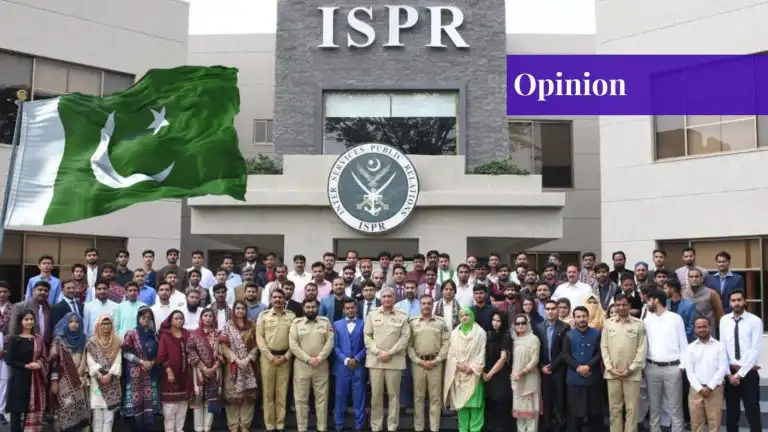
For many people, particularly in times dominated by social media debates and political polarization, any initiative that seeks to engage young people with state institutions is often viewed with skepticism. Some see it as an education, some see it as public relations. Many dismiss it entirely as an exercise in narrative-building.

Apparently, as we live in an age where institutions are routinely questioned, narratives are contested, and trust has become an increasingly scarce commodity. Such skepticism may appear unsurprising, yet the comment also prompted me to consider a larger question:
What happens when institutions and citizens stop understanding one another?
The answer lies in what I describe as institutional distance: the gap between how institutions perceive themselves and how they are perceived by the societies they serve. Today, this distance is growing. People increasingly form opinions through short video clips, algorithm-driven feeds, social media commentary, and fragmented information.
Institutions, on the other hand, often communicate through official statements, reports, and formal channels that struggle to compete in a fast-moving digital landscape. The result is a paradox of the information age.
The ISPR Summer Internship brought together thousands of students from universities across Pakistan. Participants were exposed to discussions on media, national security, economic challenges, regional dynamics, and the role of various state institutions. We not only listened to practitioners, policymakers, military officers, and communication professionals, but also had the opportunity to directly engage and question them. We visited places that most students only hear about through news reports or social media clips.
One of the moments that stayed with me was our interaction with a senior officer. During the session, he simply said that the discussion here would be under Chatham House rules, and asked whatever you want. And the students did. For such an institution, this openness was not expected. Participants asked about civil-military relations, political involvement, and such things that are usually not discussed in rooms like these. Now this raised a larger and more important question:
Why would a state invest resources in bringing thousands of university students into direct contact with its institutions?
The answer, I believe, lies in a challenge confronting states across the world: the growing communication gap between institutions and citizens. Historically, states relied upon institutions to communicate policy and manage public confidence. While disagreements between citizens and institutions have always existed, these disagreements typically occurred within shared informational environments.
Today, however, societies act in an entirely different way. Because never before have societies possessed such vast access to information. Yet rarely have institutions and citizens appeared so disconnected in their understanding of one another. An important fact is that this challenge is neither uniquely Pakistani nor uniquely military.
Across the world, governments are grappling with declining public trust and increasing polarization, regardless of how powerful or influential any state is. Which means that states can possess significant material resources while simultaneously suffering from deficits of trust.
This is where the debate surrounding “narrative-building” becomes interesting. The term itself has acquired a somewhat negative reputation. Mention narrative-building, and many immediately think of manipulation, propaganda, or attempts to shape public opinion.
Yet narratives are not unique to governments. Narratives are not limited to government institutions. Instead, every institution, every political party, every individual curating a social media profile is in the business of constructing a narrative.
The question, therefore, is not whether narratives exist. The question is whose narratives we encounter, how they are constructed, and whether we possess the critical capacity to evaluate them. This is where engagement initiatives deserve closer examination. Perhaps such initiatives emerge as a solution for modern states that cannot afford growing informational distances between institutions and citizens.
Programs such as the ISPR Summer Internship are often viewed exclusively through the lens of image-building. While such interpretations are understandable, they may overlook a broader function. These initiatives can also be understood as attempts to reduce institutional distance.
They provide opportunities for direct interaction between citizens, especially students and institutions, that are otherwise done through secondary sources. They expose participants to perspectives, processes, and realities that may not be visible through conventional media consumption. Importantly, exposure does not automatically produce acceptance. Nor should it.
A healthy society requires critical thinking, scrutiny, and debate. However, meaningful criticism is strengthened, not weakened, by knowledge. The objective should not be to produce citizens who agree with institutions on every issue; instead, the objective should be to produce citizens who understand institutions sufficiently to engage with them thoughtfully.
Moreover, while understanding national security, it is mostly dominated by traditional concepts such as military strength, economic resources, and technological capabilities. Today, contemporary security environments increasingly extend into the informational and societal domains.
Disinformation campaigns, information warfare, digital manipulation, and growing social fragmentation have demonstrated that national resilience depends not only on what a state possesses but also on what its citizens believe. A society marked by deep institutional distance becomes more vulnerable to misunderstanding, polarization, and external influence, whereas one in which institutions and citizens maintain meaningful channels of communication is often better equipped to withstand periods of uncertainty.
Many countries invest in civic education, public engagement initiatives, national service frameworks, and strategic communication programs; Pakistan is no exception.
It is operating in an increasingly contested information environment, and it faces the challenge of citizens receiving information from a multitude of sources, domestic and international media, social platforms, influencers, political actors, and countless digital channels.
Within such a landscape, institutional distance can expand rapidly if meaningful engagement and dialogue are absent.
Coming back to the comment, “Internship? Narrative-building classes.” Perhaps there was an element of truth in the observation. Narratives were undoubtedly present.
Yet after reflection upon my experience, I find myself less concerned with whether narratives exist and more concerned with whether dialogue exists.
In times defined by information abundance yet understanding scarcity, reducing institutional distance may prove to be one of the most important governance challenges of our time.
Narratives are inevitable. Institutional distance is not.
If you want to submit your articles and/or research papers, please visit the Submissions page.
To stay updated with the latest jobs, CSS news, internships, scholarships, and current affairs articles, join our Community Forum!
The views and opinions expressed in this article/paper are the author’s own and do not necessarily reflect the editorial position of Paradigm Shift.

Abdul Momin Rasul is an MPhil scholar of international relations at Bahauddin Zakariya University (BZU), Multan. His writing focuses on global order, peacebuilding, security studies, and contemporary geopolitical shifts.