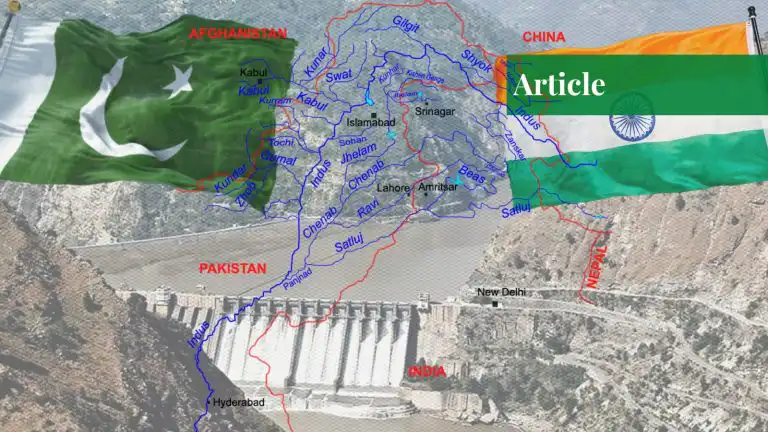
There is a specific mechanism connecting the legal fight over the Indus Water Treaty to the growing possibility of an actual military conflict, and most commentary on this subject misses it because it treats the two as separate stories. One story is about courts, articles, and jurisdiction. The other is about generals, ministers, and war talk. They are not separate. The legal deadlock is what created the space for the war talk, and understanding that sequence is the whole point of calling this hydrological lawfare in the first place.
The Onset of Hydrological Lawfare
Start with the deadlock itself. When India put the treaty on hold on 23 April 2025, it did not end the treaty the way the treaty says it should be ended. Article 12 says both countries have to agree before anything changes. It does not let one side stop the treaty on its own. Pakistan took this point to the Permanent Court of Arbitration. In June 2025, the court agreed with Pakistan. It said the treaty does not allow one country to pause it alone. India did not comply. It rejected the ruling by declaring the court illegitimate.
A year later, in May 2026, the same court issued a further award limiting India’s reservoir control under the treaty, and India rejected that too, on the same grounds. This is lawfare, not two governments arguing about water in good faith before a shared referee, but one government using a court it agreed to when the treaty was signed, and the other government walking out of that court’s jurisdiction the moment it stopped ruling in its favor.
Lawfare’s Institutional Vacuum
Here is why that matters beyond the courtroom. A functioning legal mechanism exists to absorb disputes so they do not have to be resolved through pressure or force. That is its entire purpose. Once India removed itself from that mechanism, Pakistan lost its only formal channel for making India answer for specific actions on the river, things like the abrupt flow variations on the Chenab that Pakistan has now raised through official channels several times since 2025.
With no working court, no functioning Permanent Indus Commission, and no neutral expert process actively engaged, both governments were left with only one register left to communicate in, which is public rhetoric aimed at their own populations and at international opinion. That is exactly where the ecoterrorism narrative stepped in, not as decoration, but as a replacement for the legal process that had just been abandoned.
The Eco-Terrorism Narrative: New Delhi’s Version
On the Indian side, the narrative does specific work. Describing the treaty suspension as inseparable from counterterrorism, as in Prime Minister Modi’s statement that water and blood cannot flow together, allows India to justify withholding water without ever having to defend that withholding as a legal act, because it has already been recast as a moral one. It also sets a bar for restoration, the credible and irreversible cessation of terrorism, that has no clear definition and no clear endpoint, which means the treaty can stay suspended indefinitely without India ever having to say so directly. India’s Ministry of External Affairs has repeated this similar formulation in briefings through July 2026.
The Eco-Terrorism Narrative: Islamabad’s Version
On the Pakistani side, the narrative does different but equally strategic work. Framing flow manipulation as an act of war, as several officials have done, and describing prospective dam construction as a military target, as the army chief has done, raises the political cost of what would otherwise look like a slow bureaucratic erosion of Pakistan’s water rights. It turns a treaty dispute into a matter that domestic audiences and international observers are told to treat as urgent and existential, which is also why Pakistan organized an international seminar in Islamabad at the end of June 2026 specifically to argue that India’s position violates international law. Both narratives are doing the job that the legal process used to do, building justification and pressure, except now without any neutral body checking whether the underlying claims are accurate.
Navigating Kinetic Risk
This is the actual bridge between hydrological lawfare and kinetic risk, and it runs through language rather than through any single provocative act. Once water infrastructure is described in the vocabulary of terrorism and warfare by senior officials on both sides, ordinary technical decisions stop being read as engineering choices and start being read as signals. A reservoir flush during a legal deadlock is no longer just a reservoir flush.
Pakistan’s Defense Minister Khawaja Asif said that Pakistan would go to war over water if national security were threatened, even while stating current conditions do not meet that threshold. This is not neutral information either. It is a marker laid down for how the next ambiguous incident on the river will be interpreted, and it lowers the threshold for that interpretation to tip toward confrontation rather than toward a phone call between commissioners who, under normal treaty operation, would have been meeting regularly to sort exactly this kind of disagreement out through routine channels.
Evaluating the Grievances
None of this means both sides are equally at fault or that the underlying claims are equally weightless. India’s security grievance following the Pahalgam attack is real, and no honest assessment can treat it as manufactured. Pakistan’s dependence on the Indus system for the vast majority of its irrigated agriculture and hydropower is also real, and no honest assessment can wave that away either.
What can be judged more sharply is how each government has chosen to pursue its position once the underlying grievance was established. India had a working arbitration mechanism available and chose to reject its rulings rather than argue its case within them. Pakistan has repeatedly asserted intent behind India’s operational decisions without offering independently verifiable technical evidence to a neutral party, relying instead on the seriousness of the accusation itself to do the persuasive work. Both choices trade a slower, harder path toward resolution for a faster, more visible path toward pressure, and both choices are what pushed this dispute out of the courtroom and into a register where war has become a phrase that senior officials use in public, even conditionally.
Beyond Lawfare: Rebuilding the Treaty
Repairing this does not require either government to abandon its underlying position. It requires rebuilding the parts of the treaty architecture that absorb disputes before they need rhetoric to carry them. That means restoring functional meetings of the Permanent Indus Commission for technical questions specifically, insulated from the larger abeyance dispute, so that flow variation complaints have somewhere to go other than a press conference.
It means establishing a neutral technical monitoring arrangement that both governments can accept without either side conceding the broader legal argument so that claims about intent can actually be tested against data. And it means both governments recognize that every time a minister uses the language of war to describe a water dispute, the political cost of eventually walking that dispute back through ordinary diplomacy rises a little further until the only paths left open are the ones that got called out loud in the first place.
If you want to submit your articles and/or research papers, please visit the Submissions page.
To stay updated with the latest jobs, CSS news, internships, scholarships, and current affairs articles, join our Community Forum!
The views and opinions expressed in this article/paper are the author’s own and do not necessarily reflect the editorial position of Paradigm Shift.

Bilal Malik is a student of BS International Relations at the University of Central Punjab, Lahore, Pakistan, with a focus on South Asian security and regional conflict dynamics. His commentary has appeared in Middle East Monitor. His current research interests center on the intersection of international law, water governance, and strategic escalation risk in contested river basins, particularly the India-Pakistan security relationship.