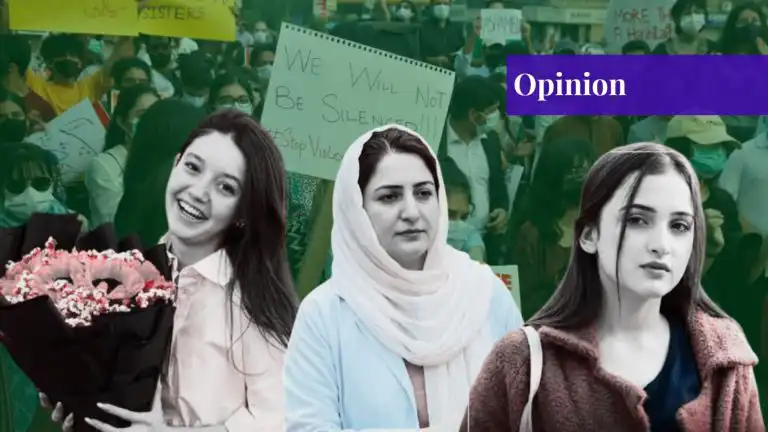
When does every woman realise her country has failed her? When the aftermath of the horrific acid attack on Dr Mahnoor, an event so catastrophically heartbreaking that the pain echoes through us all, directs us to our social media platforms, where we can only helplessly express a fraction of this outrage, knowing that Dr Mahnoor’s life is forever changed for the worse. When one of the most widely circulated posts is not an official law enforcement statement, government action, or a campaign highlighting the need for swift action.
No, you see, a woman realises her country has failed her when one of the most widely circulated posts is a guide titled “Acid Attack First Aid”. A step-by-step video explaining what to do when acid is thrown on your face.
Step 1: Wash the affected area continuously with water.
Step 2: Remove contaminated clothing.
Step 3: Seek immediate medical attention.
Yes, this post is well-intentioned, practical, and relevant. But why did I have to use the word “relevant” to describe it in the first place? There should absolutely be no context in which a well-meaning, well-informed video such as this is referred to as “relevant”. Its widespread circulation poses the question we all want to ask: Why have we, as a society, become better at teaching women to survive violence rather than ensuring it never has to happen in the first place?
This is not the first time this question has arisen. Take the events of the past few weeks alone: a mother and daughter burnt alive by their family members, a woman murdered by her husband for refusing intimacy, and the young domestic worker who was brutally assaulted by her employer’s son and died from complications when an unqualified practitioner attempted to terminate the pregnancy. The gruesome details differ, but the pattern remains the same. Every case sparks public outrage and demands immediate accountability and justice, but eventually fades into silence until the next tragic headline arrives.
It is becoming increasingly difficult to label these as isolated incidents when this violence continues to occur with such alarming frequency. Domestic abuse, acid attacks, marital rape, assault, cyberstalking, workplace harassment, honour killings, and forced marriages. Call it what you want, but these are not isolated incidents; they stem from the same underlying attitudes of power, control, entitlement, and the lack of accountability that remain rampant around us.
This is why we cannot view violence against women as beginning and ending with individual perpetrators. While swift justice and accountability for those who commit these horrendous crimes are a non-negotiable demand, we cannot ignore the broader societal environment that allows this violence to persist.
Yes, institutional shortcomings are a massive part of the problem. Despite Pakistan having several legislations addressing various forms of Gender-Based Violence (GBV), implementation remains weak. Public confidence in justice systems will falter when survivors continue to encounter barriers while reporting, when investigations are slow, and legal proceedings stretch on endlessly. Serving swift justice in response to these inhumane actions is the most effective way to deliver a wake-up call. Yet, we cannot only point fingers at our justice systems, when this violence is also sustained because societal attitudes continue to excuse and normalise harmful behaviour unless it escalates into a “headline-worthy” crime.
Even when these discussions do happen, they are often framed towards how women can act differently: how we can protect ourselves by avoiding certain places, wearing different clothing, travelling differently, and now apparently learning first aid in the event of an acid attack. When will we divert our attention to the norms that make these precautions inevitable in the first place?
If we are serious about preventing violence against women, our collective efforts should not only revolve around training girls how to be safe, but also extend to teaching boys emotional regulation, empathy, accountability, and respect for one’s boundaries. We must all actively work to dismantle the misogynistic undertones that continue to circulate in classrooms, workplaces, and online spaces and discourage ideas that normalise harassment as a response to rejection, ideas that pass off misogyny as “locker room” humour, and ideas that promote control, violence, and rage as a desirable part of “manhood”.
This is not about framing men and women as opposing sides in this conversation. If even a small percentage of the sentiments being expressed by those whose only response to such crimes is “not all of us” were directed toward standing with the survivors and actively working to dismantle the system that allows such violence to persist, we would all be moving in the right direction. The perpetuating violence in our society takes many forms and does not stop to consider one’s gender, race, ethnicity, or religion. However, there is an important difference between not participating in said violence and actively opposing the culture that allows it to exist.
This responsibility belongs to all of us. To the parents, educators, media organisations, religious leaders, community leaders, and to the youth. Violence against women is a societal issue, and so the solution becomes a societal responsibility that each of us must bear, whether we wish to acknowledge it or not. Because violence has never existed in a vacuum, and with each passing day, that brings forward a new devastating headline and is met with inaction, the culture enabling violence gets a little stronger.
Unless this issue is addressed at its root, women will continue sharing posts on how to survive acid attacks, how to navigate harassment, and how to avoid violence. The question I leave you with here is not why these guides are being circulated; it is why their necessity feels so normal.
If you want to submit your articles and/or research papers, please visit the Submissions page.
To stay updated with the latest jobs, CSS news, internships, scholarships, and current affairs articles, join our Community Forum!
The views and opinions expressed in this article/paper are the author’s own and do not necessarily reflect the editorial position of Paradigm Shift.
Fatima Hayat Malik is currently pursuing an MSc in Global Mental Health from the University of Glasgow.
She obtained her undergraduate degree in Psychology from the National University of Sciences and Technology (NUST), Islamabad.