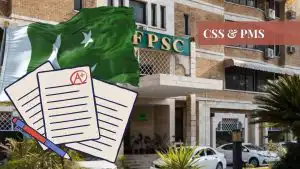
Pakistan produces hundreds of thousands of graduates each year. A small number of them decide to pursue something significantly harder than a regular career—they sit for the CSS examination.
The CSS Exam, one of the most prestigious competitive examinations in Pakistan, is designed to recruit candidates for various civil services. It not only tests candidates’ knowledge and analytical abilities but also evaluates their overall suitability for government positions.
Every year, roughly 15,000 to 20,000 candidates attempt CSS. The pass rate is approximately 2 to 3 percent—roughly 350 to 400 out of 15,000 candidates succeed. Those who pass enter the federal bureaucracy as BPS-17 officers with careers spanning police, foreign service, administration, taxation, customs and other branches of government.
This guide covers everything about CSS in 2026—what it is, who can apply, how it works, what subjects are involved, what the marks look like, and what preparation actually requires.
What Is CSS & Who Conducts It
The Federal Public Service Commission (FPSC) is a constitutional body established under Article 242 of the Constitution of Pakistan. Its core mandate is to recruit officers for the federal government through merit-based competitive examinations. FPSC is headquartered in Islamabad and operates independently to ensure fair, transparent, and competitive selection for Pakistan’s civil services.
The competitive civil service examination system originated during British rule. After Pakistan’s independence in 1947, the system was retained to recruit officers on merit. In 197,3 FPSC formally took responsibility for conducting the CSS exam under the new constitution. Since then, the syllabus and structure have evolved continuously to match modern governance requirements.
CSS stands for Central Superior Services. It is the only legal route to become a top-rank federal government officer at the BPS-17 level. The exam is held once a year, and the timeline from application to final allocation typically spans 8 to 12 months.
Eligibility Criteria: Who Can Apply
Before appearing in the CSS exam, each candidate must meet three core eligibility requirements—nationality, educational qualification, and age. Failing any one of these disqualifies you at the application stage.
Nationality
The applicant must be a citizen of Pakistan. Candidates with dual nationality who hold Pakistani citizenship may apply but must renounce foreign citizenship before appointment.
Educational Qualification
The applicant must possess a Bachelor’s Degree with at least a 2nd Division or Grade C. This degree must be from a university recognized by the Higher Education Commission of Pakistan. An equivalent qualification of 14 years of formal education is also accepted. A candidate holding a 3rd Division or Grade D in their bachelor’s degree can only apply if they have subsequently secured a Higher Division or Grade in their master’s degree.
Foreign degrees require an HEC equivalence certificate before they are accepted as valid qualifications for the CSS application.
Age Limit
The biggest change in 2026 is the age limit extension from 30 to 35 years. FPSC also increased the maximum attempts from 3 to 5. These changes help more people try for civil service positions. Some candidates get two extra years up to age 37.
The standard age range is 21 to 35 years on the date of application. Candidates currently serving as government employees with a minimum of two years of continuous service are eligible for age relaxation. Note that employees of banks, WAPDA, regulatory authorities, and autonomous bodies are not eligible for this relaxation.
Attempts
A candidate is restricted to a maximum of five attempts at the CSS examination. A chance is considered consumed if the candidate appears in even one paper of the exam.
The Three Stages of CSS: How the Exam Works
The exam has three stages—MPT screening, a written examination carrying 1,200 marks, and a viva voce carrying 300 marks.
Stage 1: Mandatory Psychological Test (MPT)
The MPT is the initial screening stage. It is a written psychological assessment conducted before the written examination. Candidates who do not clear the MPT are not permitted to sit for the written papers. The test evaluates personality traits, psychological stability, and suitability for administrative responsibility.
Stage 2: Written Examination
The written examination is the core of CSS. Compulsory subjects account for 600 marks while optional subjects cover the remaining 600 marks.
Compulsory Subjects (600 marks total)
There are six compulsory subjects totalling 600 marks. These are English Essay, English Precis and Composition, General Science and Ability, Current Affairs, Pakistan Affairs, and Islamic Studies or Comparative Study of Major Religions.
All candidates must attempt these six subjects regardless of their optional subject choices. These papers test the foundational knowledge and communication skills that every civil servant is expected to possess.
Optional Subjects (600 marks total)
Candidates select optional subjects from seven subject groups. CSS subjects are split into seven groups. The syllabus has not changed since 2016, but understanding these groups helps you pick the right subjects.
The seven groups cover a wide range of disciplines including social sciences, law, sciences, languages, economics, public administration and regional studies. Candidates choose six optional papers — one from each group or in permitted combinations — totalling 600 marks.
Stage 3: Viva Voce (Interview)
The viva voce is conducted by a board of senior civil servants and subject experts at FPSC. It carries 300 marks and tests the candidate’s personality, general awareness, communication ability, and overall suitability for a senior administrative role. Candidates who pass the written examination are called for the viva voce and must perform adequately in the interview to be included in the final merit list.
Marking System and Passing Requirements
The total marks for CSS are 1,500—600 for compulsory subjects, 600 for optional subjects, and 300 for the viva voce.
CSS has strict passing rules across all stages. Candidates must achieve minimum passing marks in each paper individually as well as in the aggregate. Failing a single paper eliminates the candidate regardless of performance in other papers. The strict individual paper requirement means that performing brilliantly in some subjects does not compensate for failure in another.
The aggregate passing percentage required in the written examination is 40 percent in compulsory subjects and 40 percent in optional subjects separately. The final merit list is prepared after combining the written examination score and the viva voce score.
The 12 Service Groups: Where Successful Candidates Go
Successful candidates enter as BPS-17 officers in one of 12 federal service groups.
These groups cover the full range of federal government functions. The most sought-after groups among CSS candidates are consistently the Pakistan Administrative Service (PAS) — the successor to the former Civil Service of Pakistan — and the Police Service of Pakistan (PSP). These two attract the highest-scoring candidates in the final merit.
Other groups include the Foreign Service of Pakistan, Inland Revenue Service, Pakistan Customs Service, Office Management Group, Military Lands and Cantonment Group, Commerce and Trade Group, Information Group, Postal Group, Railways Commerce and Transport Group and Secretariat Group.
Allocation to a specific group depends on the candidate’s final merit position and their stated preferences. Higher merit gives candidates access to their preferred service groups.
How to Prepare for CSS: A Realistic Approach
CSS preparation requires a minimum of one to two years of consistent dedicated work. Several things distinguish candidates who pass from those who don’t.
Start with the compulsory subjects.
English Essay and English Precis carry 200 of the 600 compulsory marks, and both require skills that develop slowly over time rather than through last-minute reading. Regular editorial reading and daily writing practice are not optional — they are the core of CSS preparation.
For English essays, read editorials, practice essay writing daily, and analyze essays solved by high-scorers and exam-toppers. For English Precis and Composition—solve previous CSS papers and practice precis writing. For General Science and Ability—cover basic science topics, practice reasoning questions and solve MCQs. For current affairs—read daily newspapers, monthly current affairs magazines and government reports. For Pakistan affairs, study Pakistan’s history and geography thoroughly.
Choose optional subjects carefully.
Analyze the syllabus first—is it lengthy or short? Does the content seem difficult or relatively easy for you to grasp? Review the past 10 years of exam papers for each subject. Determine the nature of the questions. Subjects with straightforward questions are often preferred over those with tricky questions. Investigate scoring trends — it is strongly advised against selecting subjects that consistently result in poor scores for most candidates. Your personal interest in the subject is also vital.
Past papers are not optional reading.
Ten years of past papers for every subject you’re attempting reveal the actual question patterns, marks distribution, and the type of analysis that FPSC rewards. Candidates who skip past paper analysis consistently underperform relative to their actual knowledge level.
Time management in the exam is a separate skill.
CSS papers are three hours long, and candidates must produce structured analytical responses under time pressure. Practicing under timed conditions before the exam is the only reliable way to develop this skill.
Key Facts at a Glance
| Detail | Information |
| Conducting Body | Federal Public Service Commission (FPSC) |
| Frequency | Annual |
| Age Limit | 21 to 35 years (2026) |
| Maximum Attempts | 5 attempts |
| Minimum Qualification | Bachelor’s degree, 2nd Division from an HEC-recognized university |
| Total Marks | 1,500 |
| Written Examination Marks | 1,200 |
| Viva Voce Marks | 300 |
| Compulsory Subjects | 6 subjects — 600 marks |
| Optional Subjects | 6 subjects — 600 marks |
| Entry Grade | BPS-17 |
| Pass Rate | Approximately 2 to 3 percent |
| Service Groups | 12 federal service groups |
FAQs
Yes, but with a condition. A candidate with a third division or Grade D in their bachelor’s degree can only apply if they subsequently secured a higher division or Grade in their master’s degree. The master’s result effectively compensates for the lower undergraduate performance and makes the candidate eligible.
Yes. A chance is considered consumed the moment a candidate appears in even a single paper of the CSS examination. This means withdrawing after sitting for one paper still reduces your remaining attempts by one. Candidates should be certain before appearing because there is no provision to reverse a consumed attempt.
The MPT — Mandatory Psychological Test — is a written screening assessment conducted before the written examination. It evaluates psychological suitability and personality. Candidates who fail the MPT cannot proceed to the written papers. The viva voce is the interview stage conducted after the written examination at FPSC. It carries 300 marks and evaluates personality, communication & overall suitability for senior administrative responsibility. These are two completely separate stages with different purposes.
If you want to submit your articles and/or research papers, please visit the Submissions page.
To stay updated with the latest jobs, CSS news, internships, scholarships, and current affairs articles, join our Community Forum!
The views and opinions expressed in this article/paper are the author’s own and do not necessarily reflect the editorial position of Paradigm Shift.
Paradigm Shift is an official staff account.