
Pakistan remains a fascinating paradox: despite enduring a perpetual leadership crisis, the country still fares better than many of its peers. One could endlessly debate the reasons: be it an adaptable state machinery, a hybrid governance model that makes a “messiah” redundant, or the geopolitical interests of external powers that preclude the rise of genuine leadership. Such debates, however, are always exhaustive, subjective, and speculative.
To move beyond prejudice and guesswork, the clearest way to understand Pakistan’s resilience—nay, its instability—is through a cold, retrospective look at the type of leaders who have held its reins. While asking how a nation survives a chronic leadership deficit is relevant, the deeper deliberation is, however, more important and relevant, i.e., “Is individual leadership truly important to carve out a national course? And where is that leadership more critical — in the military or the civilian sphere?” Exploring this discourse may well define the path Pakistan must choose to rise in the comity of nations.
The Historical Trap
In ‘The Lessons of History’ (1968), historians Will and Ariel Durant warned: “Most history is guessing, and the rest is prejudice.”
For anyone trying to understand Pakistan’s instability, that warning hits hard. State textbooks paint history as a tidy story of unity interrupted by corrupt politicians, forcing “saviors” to step in. The partisan social media turns it into a shouting match where one camp’s hero is the other’s traitor. Both rely on selective storytelling, yet neither explains the hard empirical fact: since 1947, not a single elected Prime Minister (PM) in Pakistan has completed a full five-year constitutional term. Bilawal Bhutto Zardari’s recent prayer that Shehbaz Sharif become the first PM to complete the elusive five-year term may well become an exception, however, with a big “if”: that he continues to receive blessings from heaven.
Why Leadership Matters: A Universal Yardstick
Before judging the past rulers, we must define what leadership is meant to achieve. A state with entrenched bureaucratic machinery like Pakistan can survive on autopilot — taxes get collected, courts function, and borders remain guarded, yet survival is not ascent. True progress (ascent)
is invariably through sustainable mechanisms driven by well-regulated policies and thoughtful leadership. As the maxim goes, “While management maintains a system, leadership transforms it.”
Durable statecraft does not depend on whether a leader wears a uniform or a business suit; it depends on measurable fundamentals. Combining operational principles of military leadership with modern political science gives us an objective 10-Point Leadership Rubric:
Command & Execution Principles. These remain the non-negotiable fundamentals derived from military doctrine, organisational theory, and command manuals:
- Know Your Job (Domain Mastery & Strategic Clarity): Stress the need for mastery of statecraft, economics, and the law, rather than relying on improvisation.
- Know Your People (Empathy & Cultural Understanding): An essential imperative! A leader cannot govern a diverse population if they are isolated in an echo chamber of sycophants.
- Look After Their Welfare (Public Duty over Self-Preservation): In statecraft, this translates into prioritizing human development, justice, and economic dignity over elite privilege.
- Lead From the Front (Accountability & Crisis Ownership): It implies absorbing responsibility when a plan fails, rather than scapegoating subordinates and institutions.
- Set a Personal Example (Integrity & Institutional Restraint): A leader’s personal conduct sets the moral standard for the entire state apparatus.
- Sound Judgment & Decisiveness: Assessing strategic risks objectively under pressure without ego-driven or reckless gambles.
- Build Cohesion & Morale: Uniting diverse regions/factions behind a shared national purpose, rather than polarizing society to stay in power.
Political Science Pillars. The core academic tenets of sustainable leadership remain:
- Rational-Legal Legitimacy (Weber): Strengthening the Constitution, Parliament, and the Courts so the institutions outlive the individual rulers.
- Organizational Capacity (Greenstein): Building competent teams and encouraging honest dissent rather than loyalist cronies.
- Institutional Forbearance (Levitsky): Practicing self-restraint and refusing to weaponize laws or state agencies to crush political rivals.
Auditing the Past: A Tale of Split Scores
Grading Pakistan’s history against this rubric reveals why the country remains stuck in survival mode. Rather than a clash between “good” and “bad” people, Pakistan has suffered from a compartmentalization of leadership traits:
The Founding Constitutionalists (1947-1951): They scored high on Personal Example (#5) and Legitimacy (#8), but exited prematurely before Organizational Capacity (#9) could take root in political parties.
The Bureaucratic Administrators (1951-1958): Given their techno-organisational expertise (#1), they were able to maintain basic state continuity, but crippled nascent democracy by violating Legitimacy (#8) and Forbearance (#10) through repeated assembly dissolutions.
The Military Modernizers (1958-1971, 1977-1988, 1999-2008): Though they delivered unity of command, administrative speed, and macroeconomic spurts (#9), the extra-constitutional rule not only violated their Legitimacy (#8), but they also struggled with forging Cohesion (#7) across diverse provinces, and ultimately left political vacuums upon their departures.
The Populist, Dynastic, and Hybrid Dispensations (1971-1977, 1988-1999, 2008-Present):
- Civilian leaders anchored their power in the ballot box, and while they achieved landmark constitutional consensus – such as the 1973 Constitution and the 18th Amendment (#7, #8), once in office, they centralized parties around personalities (#9) and routinely weaponized state institutions against rivals (#10). No wonder the names of Sharifs, Bhuttos, Khans, and the dynastic religio-political leaders have spanned over generations, monopolizing political space and transforming their parties into personal fiefs and cults.
- Meanwhile, the recent hybrid experiments have tried to merge institutional stability with civilian governance, yet the tension between administrative efficiency and popular mandate persists.
In short: those who possessed Unity of Command lacked Constitutional Legitimacy, while those with Popular Legitimacy lacked Institutional Forbearance.
Military vs. Civilian: The Domain Dilemma
Where, then, is leadership more critical? As the rubric shows, the answer lies not in superiority, but in functional design:
The Military Domain (The Shield): Intrinsically designed for existential security and crisis response. In a volatile region like Pakistan, the adherence to military command principles — rapid execution (#4), strategic judgment (#6), and organizational discipline (#9) — is virtually non-
negotiable. However, it is equally true that the economy cannot be commanded to innovate and grow, or the diverse provinces be forced to stay united through top-down directives — these require a different set of domain parameters.
The Civilian Domain (The Engine): This zone is structured on consensus and legitimacy. The long-term prosperity, human welfare (#3), and federal harmony (#7) require representative leadership rooted in rational-legal legitimacy (#8).
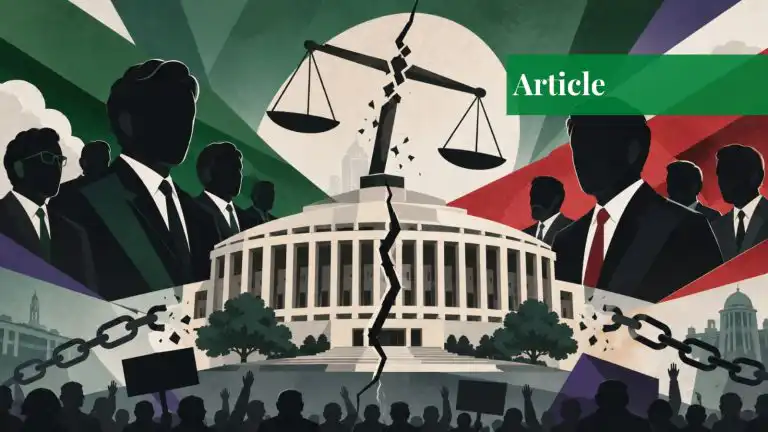
Pakistan’s crises, hence, stem from domain encroachment – the playbook is all too familiar: when civilian governance failures create vacuums, and military interventions attempt to substitute command efficiency for political legitimacy, neither domain can successfully perform the other’s job.
The Way Forward
To rise in the comity of nations, Pakistan must abandon its search for a singular “messiah” — rather, build systems and institutions through which springs a successive crop of leadership. It is therefore imperative to embrace four takeaways:
- Build Systems, Not Fiefdoms & Cults: Replace charismatic populism with Organizational Capacity (#9), i.e., strong political parties and civil institutions that outlive individuals.
- Respect Constitutional Boundaries: Let military leadership focus on defense and security, while civilian leaders earn their space through competent governance (#1) and public welfare (#3).
- Practice Institutional Forbearance (#10): End the weaponization of courts, accountability bodies, and state agencies against political opponents.
- Align Ends, Ways and Means: Match national ambitions with sustainable economic resources through long-term policy continuity.
The bottom line is that while Pakistan’s survival proves its innate resilience, the resilience is, however, only the floor, not the ceiling. It is only by measuring the leadership against universal standards, rather than partisan loyalty, and adhering to the timeless leadership fundamentals that Pakistan can finally turn survival into true ascent.
If you want to submit your articles and/or research papers, please visit the Submissions page.
To stay updated with the latest jobs, CSS news, internships, scholarships, and current affairs articles, join our Community Forum!
Find our FREE quizzes and MCQs here!
The views and opinions expressed in this article/paper are the author’s own and do not necessarily reflect the editorial position of Paradigm Shift.

Brigadier Syed Mushtaq Ahmed (Retd) has extensive experience in areas of national security, intelligence and strategic issues. He has worked as a senior research analyst in a strategic organisation and has a niche for writing research articles and analytical assessments, specializing in counterintelligence, counter-terrorism and nuclear security.