
July 2026 saw the EU introduce new restrictions on Sudan’s gold trade as part of a broader effort to undermine the financial networks that are fuelling the country’s civil war. The war in Sudan is clearly no longer just a military or political conflict; it is an economic one too. Since April 2023, there has been fighting between the Sudanese Armed Forces (SAF) and the Rapid Support Forces (RSF), which has had a devastating impact on the country, leading to the mass displacement of the population and the destruction of vital infrastructure. The economy has effectively collapsed, and yet both sides in the conflict have continued to fight. The question then becomes: how on earth can a country in such a state of economic collapse continue to wage war?
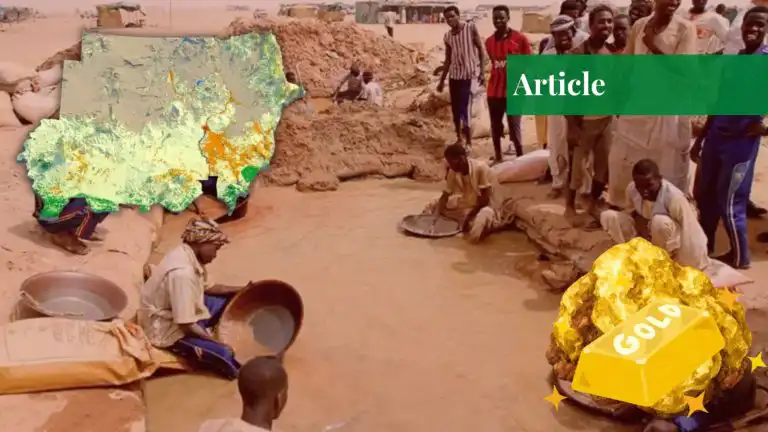
One of the key elements of the answer is down below the surface in Sudan’s soil. Gold has become an important economic asset for military-linked businesses, traders, and armed groups. The conflict started as a fight for power and control, but access to gold revenues has been a major factor in keeping the conflict going. The conflict cannot simply be resolved through negotiations between the various generals. It will also require a fundamental shift in the economic arrangements that allow the armed groups to stay in business.
Gold was never Sudan’s primary export commodity. Prior to the secession of South Sudan in 2011, oil was the major economic driver in Sudan. With the separation of South Sudan, the production of oil within Sudan’s borders was significantly reduced, and this created a major economic problem for the Sudanese state. It was then that gold became of greater importance as a source of revenue.
Gold slowly became one of Sudan’s most important export commodities. Mining on a large and small scale went on in various parts of the country, including Northern Sudan, Darfur and Kordofan. For many ordinary Sudanese people, it was a source of employment and income in an economy which was otherwise very much afflicted by unemployment and lack of opportunities.
The expansion of gold production also created scope for powerful political and military actors. The state was in a very poor position to monitor production and to collect revenue in a transparent manner due to weak regulation, corruption, and the existence of informal trading networks.
The significance of gold was really brought home during the ongoing civil war. The Sudanese mining authorities put the 2025 production at some 70 tonnes. The officially recorded exports were only some 14.7 tonnes. This huge gap does, of course, not prove that all of the unrecorded gold was in fact smuggled; it just highlights the difficulty of regulating a valuable commodity in a war zone. The issue isn’t really how much gold Sudan produces per se; it’s who produces it, who trades it, and who benefits financially.
The link between Sudan’s gold sector and armed groups predates the current conflict. Under the rule of Omar al-Bashir, the state supported a number of security outfits in order to maintain its grip on power. Among these were the militia networks which would eventually become the Rapid Support Forces (RSF) under Mohamed Hamdan Dagalo (Hemedti). Over time, Hemedti and his associated business networks became deeply embedded in the gold sector. Al-Junaid is a prime example of a company with links to his family. A Chatham House report from March 2025 detailed how RSF-linked networks had a stake in the gold sector through mining, control of trading routes, and arrangements for the payment of miners and traders.
Gold-related income provided the RSF with a degree of financial independence from the Sudanese regular military institutions. That independence had significant political ramifications.
In many countries, armed groups are reliant on the state for their salaries, their equipment, and their funding. That creates a degree of state control over them. Where an armed group has its own sources of revenue, however, it is less dependent on the state’s financial institutions. The RSF’s economic networks were a key factor in enabling it to become a powerful organisation capable of challenging the Sudanese Army. When the friction between Hemedti and SAF commander Abdel Fattah al-Burhan became such in 2023, the RSF wasn’t simply a militia that the state was funding. It had its own military structure, its own commercial relationships, and its own sources of financial muscle.
Gold didn’t cause the war, but it did contribute to the economic independence that enabled the RSF to become such a serious rival to the national army. The national army itself has also had considerable economic interests. C4ADS research published in April 2025 looked at the financial networks linked to Sudan’s mining sector and found that both sides were, in fact, benefiting from the mining economy. The war economy is therefore not simply an illicit commercial network operating outside the state. It is a war economy in which the competing military institutions have their political clout in part derived from their economic clout.
For the SAF, access to state institutions, export routes, and military-linked businesses can be a significant source of income. For the RSF, control of the mining areas and the informal commercial networks is a potential source of revenue.
The distinction matters because the two organizations operate under very different financial arrangements, even though both benefit from the same natural resource. Gold-related revenue doesn’t necessarily lead to military spending. That said, financial resources can maintain personnel, buy supplies, and keep the force ready. Control of economically valuable territory therefore matters not just for military positioning but also for financial survival. This creates a very dangerous relationship between the competition for territory and the economic incentives that are in play. Armed groups may have a reason to hold on to areas which produce resources even where the continued fighting would be extremely costly to the civilian population.
Sudan’s gold economy goes well beyond Sudan’s borders. Gold mined in the country can go through a number of traders, commercial intermediaries, and international markets.
The UAE has long been a key destination for Sudanese gold exports. As per the Reuters report from October 2025, the UAE took in nearly 90% of Sudan’s officially reported gold exports in the first half of that year (some 8.8 tonnes worth $840m). This highlights the importance of Sudan’s international trading relationships to its gold sector. It is of course necessary to draw the line between legitimate commercial exports and those which are in fact being used to fund armed organisations.
The fact that there is a major international gold market doesn’t in itself mean that every shipment is going to the conflict. The issue is that where there is poor oversight, informal trading and opaque ownership structures, it’s possible for armed actors or their associates to benefit from commercial activity without any accountability. Gold is of course extremely difficult to regulate as it can be moved, refined and traded across jurisdictions. Once gold enters the international supply chain, it can be very difficult to trace back to its original source and to work out who actually made a profit from it. So Sudan’s war economy isn’t just in the Sudanese mines either. It’s embedded in the wider commercial and financial systems. This creates an international obligation to enhance transparency without unduly disrupting legitimate economic activity.
The link between gold and the Sudanese conflict becomes more apparent when you look at the incentives of the various armed groups. The SAF and RSF have on numerous occasions shown their unwillingness to give up political and military power. Their rivalry is essentially about who controls Sudan’s security institutions and who will ultimately be in charge of the country. However, economic resources can affect how long such rivalries go on. An armed group with its own independent sources of income would be in a far stronger position to withstand economic pressure and to maintain its military operations. This in no way means that access to gold guarantees military victory. It doesn’t in the slightest mean that armed leaders are in any way predisposed to go on waging war.
Independent revenue can alleviate the financial pressures which might otherwise lead to compromise. This puts the peace process in a very difficult position. Even if the international mediators were to get the military commanders to talk about a ceasefire, the underlying financial networks may well still be in place. Organizations which have control over valuable assets could go on to rebuild their capacity or resist any arrangements which would threaten their economic interests.
So a peace agreement which deals with political authority but ignores the economic structures which are linked to the military is unlikely to produce any real long-term stability. Sudan is a case in point which shows that ending the armed conflict and the destruction of the economic base of the conflict are two related but very different things. International governments have come to realise the importance of Sudan’s financial networks. In July 2026, the EU announced restrictions on Sudan’s gold trade, covering restrictions on gold imports as well as certain supplies and services relating to mining.
The UK also imposed sanctions on individuals and companies believed to be supporting financial and procurement networks linked to the conflict. These are measures indicative of a move to deal with the economic resources that may be able to sustain the Sudanese armed groups. However, sanctions on their own are not going to end the war. Sudan’s gold industry comprises informal mining, cross-border traders, and commercial networks which are very difficult to monitor. Restricting official trade without more effective enforcement could see some of the trade move into less transparent channels. Indeed, a large number of Sudanese civilians are engaged in artisanal mining as a source of income.
Broad restrictions that would reduce legitimate mining income could actually exacerbate the economic hardship without in any way eliminating the revenue of the armed groups. This is a policy conundrum, really. How do you go about dismantling the financial networks which are so closely linked to the military without doing any damage to the civilians who are already suffering as a result of the conflict? A better approach would be to mix targeted financial sanctions with greater monitoring of the gold supply chains, more transparency around company ownership, and co-operation with the major gold trading markets. Such measures should differentiate between the ordinary miner and the miner who is part of a business directly linked to an armed group. At the same time, economic sanctions must be matched with diplomatic efforts to achieve a political settlement. Financial pressure can affect the calculations of armed actors but can’t by itself settle the contest for political power.
The Sudanese civil war started as a contest between two very powerful military groups for control of the country. Its ongoing nature, however, cannot be explained by reference to a military struggle alone. Gold has become an important part of the economic environment in which the conflict operates. Military-linked businesses, mining interests, informal trading networks, and international commercial relationships provide opportunities for armed actors to access financial resources despite widespread economic destruction.
Yet gold is not the sole cause of Sudan’s prolonged conflict. Political ambitions, institutional weakness, historical grievances, and external military assistance remain important factors. The central challenge is that Sudan’s military and economic power structures have become deeply interconnected. Consequently, negotiations that focus exclusively on political arrangements may leave important sources of military influence untouched. A sustainable peace will require not only ending the fighting but also establishing civilian oversight, transparent resource management, and accountability over military-linked economic activities. Sudan’s war may be fought with weapons, but its continuation is also shaped by the financial networks that help keep those weapons in use.
If you want to submit your articles and/or research papers, please visit the Submissions page.
To stay updated with the latest jobs, CSS news, internships, scholarships, and current affairs articles, join our Community Forum!
Find our FREE quizzes and MCQs here!
The views and opinions expressed in this article/paper are the author’s own and do not necessarily reflect the editorial position of Paradigm Shift.

Abraiz Ali Ahmad is an international relations student at the University of Gujrat, with a strong interest in regional security, geopolitics, and connectivity. He enjoys looking beyond official statements and headlines to understand the interests, vulnerabilities, and consequences shaping regional developments. His particular areas of interest include South Asia, Central Asia, and the Middle East, especially where conflict, infrastructure, and geopolitics intersect.