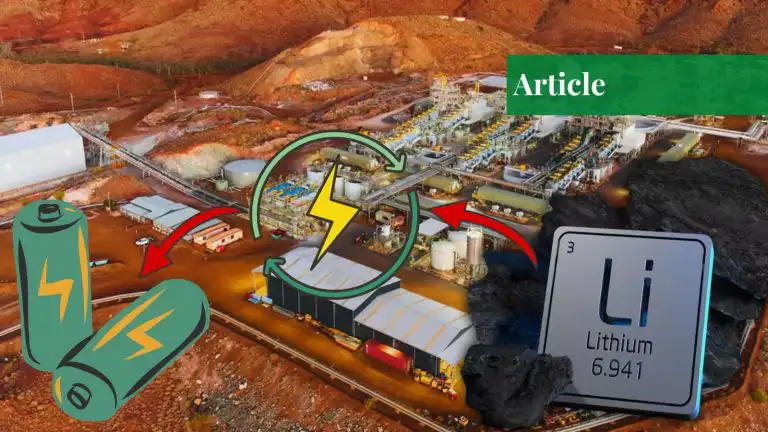
A hundred years ago, the world fought bloody wars over oil wells. Today, the battle is quieter, but no less intense. The new struggle isn’t for the oil fields in the deserts but in the salt flats of Chile, in the mountain mines of the Democratic Republic of Congo, and behind closed doors in the negotiation rooms in Beijing and Brussels. The major commodity at the centre of all is LITHIUM. It is lightweight, unglamorous and more crucial than ever. Where oil shaped the previous century through the combustion engine, Lithium is shaping the current one through the battery. And just as oil did not merely power cars but moulded entire geopolitical orders, lithium has already begun to redraw the map of global power.

Lithium’s importance to the 21st century is clear in a report of the World Energy Outlook. It says that global lithium demand is set to increase 40 times by 2040, and the battery market is expected to reach $400 billion by 2030. These high projected values indicate that the power dominance depends on using lithium (in EV batteries) in a technopolar world order, as lithium, cobalt, nickel and manganese make up around 8 kg of a single EV battery. The “Lithium Triangle” in South America, which includes Chile, Bolivia and Argentina, holds over 50% of the global lithium reserves. Moreover, Australia alone holds 24% of the world’s lithium reserves. The very reason that makes the geography of these regions a centre of attraction for global powers (USA, China) and there is competition among them for a hold over these areas
However, owning the resource and controlling the resource are two entirely different things. This distinction is very important in the global lithium supply chain. China understood this early. While Western nations were still debating climate policy, Beijing was busy building factories, refineries, and supply chains that the energy transition would depend on. Today, China processes around 60-70% of the world’s lithium and manufactures nearly 80% of all EV batteries. Even though Chile and Argentina have the reserves, they still lack the factories to process them. But Bolivia, which lives on the world’s largest single lithium deposit, has nationalised the sector. This has effectively locked out foreign investment and has left its lithium untouched. The Republic of Congo also produces over 70% of the world’s cobalt, yet remains one of the poorest countries. Chinese mining firms are steadily filling the space Western companies have left in Congo. This means that lithium from Argentina or Chile is most likely to pass through a Chinese facility before it reaches Europe or America. Although in the race for lithium, the USA is a recent player, it holds dominance over the REE reserves of Australia, Canada and Denmark. The pattern is old and familiar — the Global South has the resources, but someone else holds the power.
While more than half of the world is currently powered by Chinese batteries, the lithium era is already creating new winners in unexpected places. Indonesia, the world’s largest nickel producer, banned raw nickel exports in 2020. This forced foreign firms to build local smelters. As a result, Indonesia’s EV battery investment rose to $15 billion in 2023. In 2023, lithium deposits were also discovered in Jammu and Kashmir, which were claimed to be one of the largest fields in Asia. India has also secured mining rights in Argentina. For a country trying to build its own EV battery, this timing couldn’t be better. Even the European Union, long dependent on imported materials, banned the import of raw materials under its Critical Raw Materials Act 2024 to reduce Chinese supply chain dominance. The competition is no longer just about who has the lithium. It is about who has the capacity to turn it into something valuable.
Oil created petrostates that shaped geopolitical power beyond the USA (KSA, UAE, Kuwait), and lithium can do the same, but with certain limits. Lithium is recyclable. As battery technology improves, the amount of lithium needed will begin to decrease. Energy transition to solar and wind would also reduce dependence on lithium-powered batteries. This means the time frame of real benefit for lithium-rich nations is probably 20 to 30 years — not a century. The challenge for these nations is whether they will capture value within this time span or merely extract raw materials for others to benefit from, as happened with oil.
The energy transition is one of the most important shifts of this century. But transitions do not distribute their benefits equally. Currently, the countries that hold the most lithium are not the same countries that capture the most value from it. This gap — between who has the resources and who controls them — is the central geopolitical question of the coming decades. For nations across Latin America, Asia and Africa, the choice is to invest in processing, build local industry, and refuse to be a raw-material supplier to wealthier nations. The green energy future is coming for sure. The only question is whether the Global South will help build it — or dig out raw materials and watch someone else cash in.
If you want to submit your articles and/or research papers, please visit the Submissions page.
To stay updated with the latest jobs, CSS news, internships, scholarships, and current affairs articles, join our Community Forum!
The views and opinions expressed in this article/paper are the author’s own and do not necessarily reflect the editorial position of Paradigm Shift.

Kissa Zehra is an MPhil scholar in Environmental Sciences at Quaid-e-Azam University, Islamabad. Her research interests include climate change, environmental sustainability, geopolitics, and public policy. She has previously contributed articles to platforms like Jahangir's World Times and Jarida Today.