
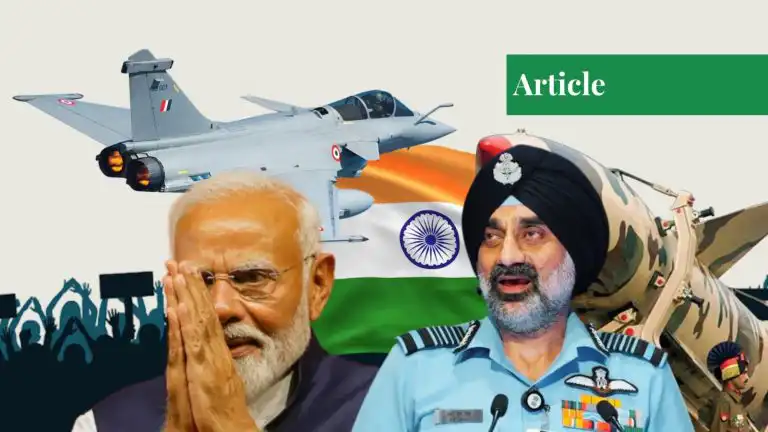
In Narendra Modi’s India, honours seem to depend less on battlefield results than on how well a story fits the government’s narrative. In February 2019, Wing Commander Abhinandan Varthaman’s MIG-21 aircraft was shot down over Pakistan, captured, and later released by Islamabad as a goodwill gesture. New Delhi responded by awarding him the Vir Chakra, one of its highest gallantry awards, and he was later promoted and eventually retired to pursue a career in commercial flying. After the May 2025 conflict, known in Pakistan as Marka-e-Haq, the Indian government again distributed gallantry awards to air force personnel, even though India’s own Chief of Defence Staff later acknowledged aircraft losses. Setbacks against Pakistan have been repackaged as heroism, because the political story matters more than the military record. Against this background, consider how the government is treating Air Chief Marshal A.P. Singh, the outgoing chief of the Indian Air Force, whose main offence appears to be that he told the truth.
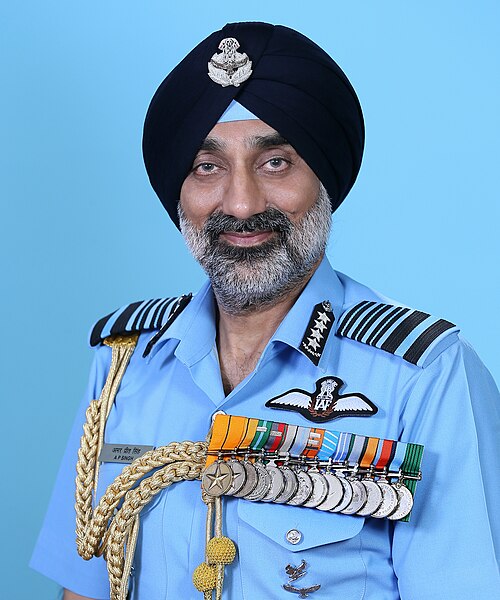
Singh retires on October 31 and was expected to be given the customary farewell round at the Air Force Golf Course on Lok Kalyan Marg, of which the air chief is traditionally patron-in-chief. According to a report in the Indian press, the 18-hole course near the Prime Minister’s residence has been shut since Monday and will stay closed until further notice, leaving his farewell in limbo. Officially, the closure is part of a drive by the Land and Development Office to reclaim government land in the high-security zone. The Delhi Race Club was taken over in August, the Jaipur Polo Ground has been reclaimed, and the Delhi Gymkhana Club’s lease was ended in May on the grounds of strengthening defence infrastructure. Yet the timing is remarkable. A course that has existed for decades was closed days before the farewell of a sitting air chief, with no indication of when it will reopen. A government that wanted to avoid embarrassment could easily have allowed the farewell first. Its silence suggests either striking carelessness or a deliberate signal.
That signal, if intended, is not hard to read. Since taking command on September 30, 2024, Singh has repeatedly done what few senior officers in Modi’s India dare to do: he has spoken plainly. He warned about India’s widening capability gap with China and the shrinking number of fighter squadrons, now well below the sanctioned strength of 42. He openly criticised delays in deliveries of the indigenous Tejas fighter and said defence projects are seldom completed on time. He highlighted weak research and development, shortages of skilled personnel, and the gap between the government’s Atmanirbhar Bharat promises and the realities of its defence industry. These were not political attacks. They were warnings from the officer responsible for defending India’s skies. A confident government would have acted on them. This government, it seems, would rather close a golf course than open a debate.
The episode fits a wider pattern. The BJP and its ideological parent, the Rashtriya Swayamsevak Sangh, promote the vision of Akhand Bharat, an undivided India extending into the territory of today’s neighbouring states. A mural in India’s new parliament building in 2023, seen as reflecting that idea, drew objections from Nepal, Pakistan and Bangladesh. But expansionist maps cannot hide depleted squadrons, delayed fighters and the lessons of May 2025, when Pakistan’s calibrated response denied New Delhi the quick victory it expected. A government that dreams of redrawing borders while silencing warnings about its own military weaknesses is choosing propaganda over preparedness. For the region, that combination is dangerous: grand ideological ambitions backed by fragile capabilities make miscalculation more likely, not less.
The deeper message is about who is safe in Modi’s India. Air Chief Marshal Singh, a Sikh officer, has served his country for around four decades and reached its highest air force rank. If such an officer can be treated with this casual disregard for raising legitimate concerns, it raises a troubling question for everyone else. Human rights groups and international observers have repeatedly documented the pressures faced by Muslims, Christians and Sikhs under the current government, from mob violence and demolitions to the treatment of protesting farmers and the violence in Manipur. If a decorated air chief is not secure from political displeasure, then minorities are clearly not, and even Hindus who question the ruling narrative cannot feel safe. A state that rewards loyalty after defeat and punishes honesty after service is not strengthening its armed forces. It is teaching them that silence is safer than truth. Air Chief Marshal Singh’s warnings will outlast his tenure. The real question is whether India’s government will listen to them, or simply wait for the next defeat to rewrite.
If you want to submit your articles and/or research papers, please visit the Submissions page.
To stay updated with the latest jobs, CSS news, internships, scholarships, and current affairs articles, join our Community Forum!
Find our FREE quizzes and MCQs here!
The views and opinions expressed in this article/paper are the author’s own and do not necessarily reflect the editorial position of Paradigm Shift.

Omay Aimen is an independent researcher with a background in Political Science, specializing in national and regional security with a focus on critical strategic affairs.