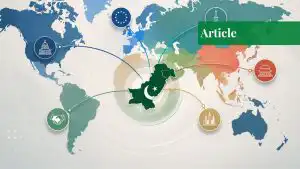
Islamabad, February 19: As the global order shifts, Pakistan must adopt a pragmatic, multivector foreign policy to balance regional and global relationships while enhancing its international standing. This approach, coupled with internal balance, enables mutually beneficial cooperation with powers like Russia and leverages opportunities while addressing challenges. However, it also reinforces the need for a more inclusive global order that accommodates emerging powers and diverse regional interests.

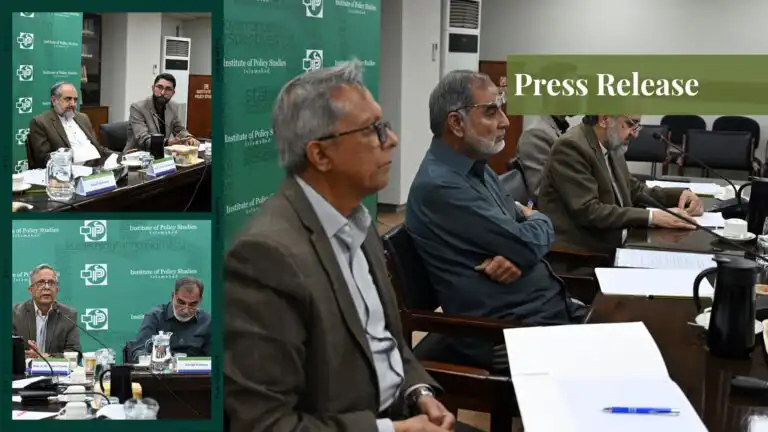
This was discussed during a hybrid seminar, “The Evolving Pakistan-Russia Relationship in a Changing Global Order,” at the Institute of Policy Studies (IPS), Islamabad. The seminar was held as part of the 1st Pakistani-Russian International Conference, jointly organized by the Institute of International Relations, Kazan Federal University, Russia, and the Department of International Relations, Federal Urdu University of Arts, Science and Technology (FUUAST), Karachi.
The session, chaired by Prof Dr Fakhr-ul-Islam, former director Pakistan Study Centre, University of Peshawar, was addressed by Khalid Rahman, chairman IPS, Ambassador (r) Syed Abrar Hussain, vice chairman, IPS, Prof Dr Adam Saud, dean Faculty of Humanities and Social Sciences, Bahria University, Islamabad, Brig (r) Tughral Yamin, former associate dean, Centre of International Peace and Stability, NUST, Dr Saira Nawaz Abbasi, senior assistant professor, Bahria University, Islamabad, and Taimur Fahad Khan, research associate, Institute of Strategic Studies, Islamabad.

In his keynote address, Dr Adam Saud noted that the global transition of power and strategic alignments is leading the world toward multipolarity. This transition unfolds various avenues of cooperation for countries to advance their national interests and marks the importance of maintaining balanced relationships with regional and global powers. However, this can only be pursued through a multivector foreign policy for Pakistan.
He stressed the need for Pakistan to prioritize economic and political stability as a foundation for sustained foreign engagements under this approach. In this context, Russia presents viable opportunities to build on defence cooperation, energy partnerships like the Pakistan Stream Gas Pipeline and discounted Russian crude oil imports, trade, technology, infrastructure, and agriculture collaborations, and potential trilateral projects with China, such as the Trans-Afghan Railway and North-South Transport Corridor.
However, with this evolving landscape, several challenges persist, including Russia’s ties with India, sanctions affecting joint projects, low bilateral trade, limited people-to-people connectivity, terrorism, energy security, and geopolitical realignments.
Brig (r) Tughral Yamin noted that disrupted supply chains, higher prices of commodities like wheat, edible oil, and fuel, halted defence contracts, and increased geopolitical pressures after the Russia-Ukraine War also adversely affected Pakistan’s economic ties with Ukraine. However, he noted that Pakistan adopted a pragmatic approach, in line with its broader multivector foreign policy, by diversifying its imports, shifting to Russia and Kazakhstan for wheat supplies, and recalibrating its diplomatic strategy to balance ties with Russia and Ukraine. This has enabled it to navigate challenges while safeguarding economic and strategic interests.
Endorsing this, Dr Saira Nawaz emphasized that Pakistan and Russia can also address shared challenges by leveraging international forums like the SCO, BRICS, and UN. This would strengthen bilateral ties, enhance strategic autonomy, diversify alliances, and counterbalance Western influence while advancing shared goals.
While supporting this viewpoint, Taimur Fahad stressed that the priority must be addressing domestic challenges to strengthen Pakistan’s global positioning. To maximize these opportunities, internal balance manifested by institutional strength, rule of law, economic resilience, social cohesion, human development, and infrastructure development are crucial for Pakistan.
In concluding remarks, Khalid Rahman highlighted that while the global system has undergone significant shifts since 1945, the core governance paradigm, centred on national interests, remains largely unchanged. He noted that the prevailing paradigm fails to offer a sustainable model for long-term stability. In this context, Pakistan and Russia’s evolving engagement approaches underscore the need for an alternative governance approach that prioritizes human-centric development, equitable global policies, and inclusive multilateralism that accommodates emerging powers and diverse regional interests.
If you want to submit your articles and/or research papers, please check the Submissions page.

The Institute of Policy Studies (IPS) is an autonomous, not-for-profit civil society organization dedicated to promoting policy-oriented research, dialogue, and human & technological development for better governance. IPS provides a forum for informed discussion and dialogue on national and international issues. The contributions spanning over forty-three years and the overall impact signifies the importance of pragmatic research on policy issues. The institute highlights the role of think tanks in modern democratic polities.