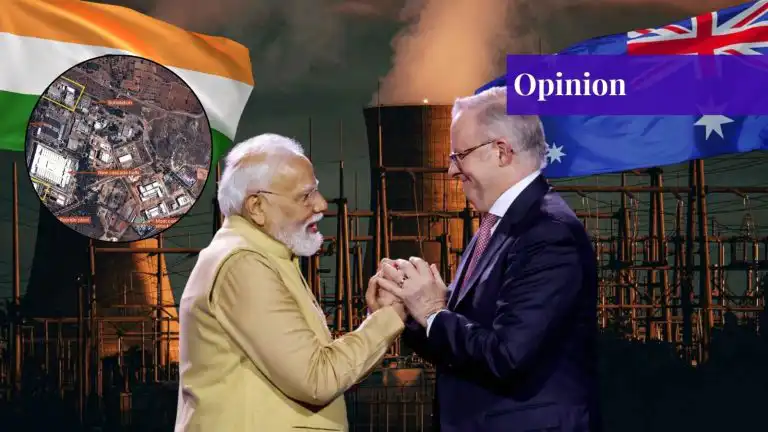
On July 9, 2026, during Prime Minister Narendra Modi’s visit to Australia, Australian Prime Minister Anthony Albanese announced the sale of uranium to India under the 2015 Australia-India Nuclear Cooperation Agreement. The agreement aims to expand non-fossil fuel power generation while ensuring compliance with International Atomic Energy Agency (IAEA) safeguards and the peaceful use of nuclear energy. However, history suggests that peaceful nuclear cooperation has, at times, contributed indirectly to the strengthening of military nuclear capabilities. Australia’s decision to supply uranium to India has therefore renewed serious concerns about the global non-proliferation regime, transparency, and broader strategic stability in South Asia.

Uranium acquired for peaceful purposes could indirectly contribute to military capabilities despite being subject to IAEA safeguards. India maintains separate civilian and military nuclear facilities, making it difficult to distinguish which reactors serve which purposes, particularly because India retains the sovereign right to designate facilities as civilian or military. This framework allows India to allot more of its domestically produced uranium resources to shadow military purposes while authorizing Australian-supplied uranium to be used in protected civilian reactors under IAEA safety measures. Thus, a resource-substitution effect could increase the availability of fissile material for covert military purposes. It raises concerns about the global non-proliferation standards because India has never signed the Nuclear Non-Proliferation Treaty (NPT). Following the 2008 US-India Civil Nuclear Agreement, similar reservations emerged. The agreement may have overly benefited India, critics argued, because it lacked acceptable safety measures to limit its nuclear weapons program.
India claimed that any US assistance would be used exclusively for peaceful nuclear energy. According to the Congressional Research Service report, “there are no measures in this agreement to restrain India’s nuclear weapons program.” Experts argued that the partnership accepted unnecessary risks without any competent regulations, as historical experience also validates these concerns. India in 1974 maintained that its nuclear program was peaceful. Yet, it conducted a plutonium-based nuclear explosive test using the CIRUS reactor.
Uranium supplied under the Australia-India Nuclear Cooperation Agreement, though itself cannot legally be used for weapons production, concerns persist regarding its indirect consequences. Technical experts noted that several Indian power reactors and related facilities could support covert military activities because they remain outside IAEA regulations. India received a waiver from the Nuclear Suppliers Group (NSG), despite being a non-signatory to the NPT. It had granted India access to international uranium markets and dual-use nuclear technologies. Broader questions have been raised regarding the accountability, consistency, and credibility of the global non-proliferation norms due to this exemption.
The Australian administration has reaffirmed that the uranium sale to India will be carried out under IAEA safeguards and restricted exclusively to peaceful civilian use. The agreement will support India’s green energy transition while providing Australia with a stable market for its uranium resources. The IAEA has also maintained that India has a good non-proliferation record. Nevertheless, the principal concern is not the direct diversion of Australian uranium to nuclear weapons production but the resource-substitution effect. The deal doesn’t limit India’s nuclear weapons program and fissile material produced by India over the decades. The agreement appears to be insufficiently comprehensive and has potential implications for the global non-proliferation regime.
According to the International Panel on Fissile Material, India continues to operate plutonium-production and uranium-enrichment facilities outside the IAEA safeguards framework, and is believed to possess an estimated stockpile of around 11 tonnes of separated plutonium in unsafeguarded nuclear facilities. These capabilities could provide India with the technical capacity to expand its nuclear arsenal. As a result, even protected civilian nuclear cooperation may have unintended strategic implications.
It raises several important questions about the uniformity and integrity of the global non-proliferation framework due to these uneven concessions. South Asian countries may interpret it as a threat to their security. As a response, they would advance their own nuclear forces, missile capabilities, and related technologies. These measures could intensify the security dilemma and fuel regional instability while spurring an arms race, misbalancing power relations between India and Pakistan. It can also weaken confidence-building measures, amplify Pakistan’s security concerns, and undermine regional stability. Within the broader QUAD security architecture, the partnership between Australia and India is expanding under the civilian nuclear cooperation agreement. The agreement, beyond its stated objectives of economic security and climate adaptation, can carry substantial geopolitical interests.
The question is not whether peaceful nuclear cooperation could support nuclear activities, but rather the inconsistent norms and standards of the IAEA. History demonstrates that these discrepancies could lead to unintended technological and strategic consequences. A uniform global non-proliferation regime should be designed to apply coherent rules on all states without any discrimination driven by geopolitical interests. Otherwise, such arrangements intended to advance the clean-energy transition may inadvertently lead to regional insecurity, arms competition, and the erosion of confidence in the global non-proliferation architecture.
If you want to submit your articles and/or research papers, please visit the Submissions page.
To stay updated with the latest jobs, CSS news, internships, scholarships, and current affairs articles, join our Community Forum!
The views and opinions expressed in this article/paper are the author’s own and do not necessarily reflect the editorial position of Paradigm Shift.