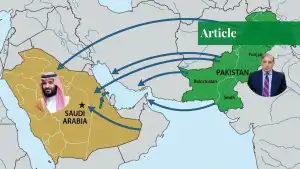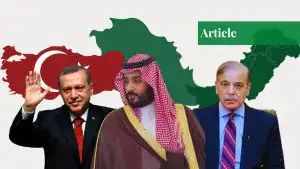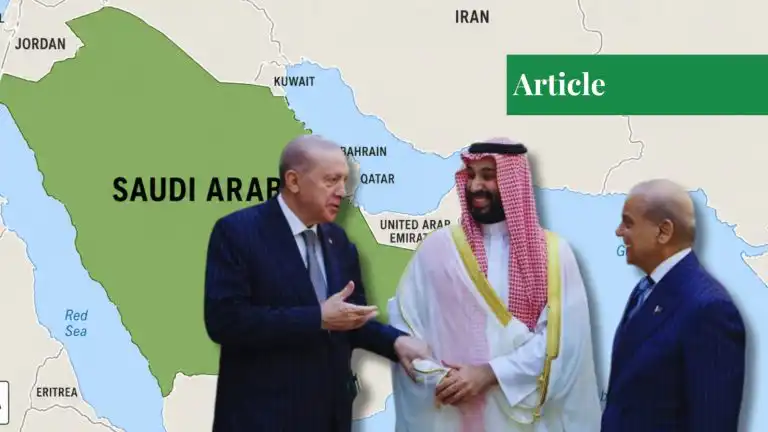
Saudi Arabia, Pakistan, and Turkiye signed the Mecca Joint Defence Agreement on August 7, 2026, which states that an armed attack on any one of the three countries is an attack on all three countries. The pact on border security cooperation is a bilateral Saudi-Pakistan deal signed in September last year that has been extended to become a trilateral accord in the face of a regional war that has seen missiles fired against Gulf oil exporters since the United States and Israel launched their two strikes on Iran on February 28. Saudi Arabia’s immediate interest is quite clear: Facing attacks by Iran and its allies and an oil embargo by them and others, Riyadh wants enhanced deterrence and a wider range of security assurances. The piece suggests that though the deal is an honest and meaningful deterrence pact, there are limits on what it can achieve in terms of the collective-defense provision, since Pakistan and Turkiye have good reasons to take Saudi Arabia’s security seriously but without waging a full war with Iran. The theory of omnibalancing presented by Steven David explains the reasons behind Pakistan’s caution, whereas Turkiye’s stance is an example of strategic hedging.
Saudi Arabia: Seeking Deterrence, Not War
Saudi Arabia’s is the clearest of the three reasons. One of the senior Saudi officials told Reuters that the original bilateral agreement with Pakistan was an “institutionalisation of longstanding and deep cooperation,” but on being asked whether it provided an umbrella for nuclear weapons, the official replied, “a comprehensive defensive agreement that encompasses all military means. Saudi Arabia, under the Mecca Pact, has additional military credibility as Pakistan brings nuclear deterrence and Turkey brings its military power in the region, without having to deal with Iran all on its own. The move was designed to combine “deterrence and diplomacy” and not open confrontation, analysts told Al Jazeera.
Pakistan’s Omnibalancing Act
The situation in Pakistan is more complex, and it is here that the limits of the pact are most evident. Islamabad has long-lasting security ties with the Saudi capital, with formalization as early as the 1982 bilateral security cooperation agreement, which allowed Pakistan’s training and advisory services on Saudi territory. The Foreign Office took great care to emphasize the public perception of the defence accord with Saudi Arabia as “not against a third country” but a stepping stone for regional peace. Both Turkey and Pakistan have been spared major direct attacks in the war and are concerned about the spiraling tensions that could impact their own security and economic well-being, Reuters reports said.
This is not indecision; it is just a sensible reaction. Islamabad is already engaging with active militancy on its Afghan border and an unresolved rivalry with India. Speaking about this, Steven David’s Omnibalancing theory comes in handy: States in Pakistan’s situation do not balance against one external threat alone; they are balancing several external threats and also internal fragility, and adjusting their commitments accordingly. It cannot afford to open the third front.
This is not a declaration of Pakistan’s disaffection towards Saudi Arabia. The Umrah pilgrimage, which the PM performed in Mecca along with the signing of the agreement, is a gesture rich in symbolism and one of solidarity, while Pakistan has already sent troops to Saudi Arabia in a defensive role. What sets these two apart is that protecting their ally Saudi Arabia is not the same as attacking their enemy Iran. Pakistan seems to be prepared to do the former but is careful not to do the latter, as omnibalancing would suggest.
Turkiye’s Strategic Hedge
The Turkish calculation is different, but the results are the same. The agreement is defensive rather than offensive, not aimed at any one party and open to other regional nations, a clear attempt to deflect criticism from Iran, despite the three signatories’ known worries over Israel building up its military presence in the region. Not just military confrontation with any one state, but also a boost to economic ties between the three countries, as an Al Jazeera correspondent reported from Ankara, was the expectation as part of the deal.
Strategic hedging is a good explanation of this: Turkiye does not fully align itself with any one camp, but rather ensures that it has a successful relationship with several at the same time — strengthening its relationship with Saudi Arabia and Pakistan while maintaining one with Iran. A lighter version of Christensen and Snyder’s buck-passing theory is also apparent here: Turkey can enjoy the benefit of the deterrence aspect of the pact without having to take on the role of the state that faces Tehran head-on in military terms.
“An Attack on All” – What Does This Mean?
If the trigger points of the pact are not clear, Saudi Arabia could consider the agreement a powerful “message” deterrent. However, Pakistan and Turkiye may not be ready to be frontline defenders against Iran. The pact is not just symbolic, but a serious deterrent, and the military ceilings have not yet been put to the test.
Conclusion: Deterrence with Limits
Saudi Arabia wants deterrence, Pakistan wants to support Riyadh without opening a third front against Iran, and Turkiye wants flexibility without being pulled into a war it did not choose; omnibalancing explains Pakistan’s caution, strategic hedging explains Turkiye’s. Beyond the three signatories, the pact could still reshape the wider region: India is already assessing its implications, and reports suggest Egypt may be next to join. The pact may create a chain of new alliances and pacts, as the security dilemma explains this well: the defensive move of one can be seen as offensive by others, and they will act accordingly. The agreement’s real limitation is that its text specifies no concrete military obligations, so how far Pakistan and Turkey would actually go remains untested. The credibility of the Mecca Pact will not be decided by the words signed in Mecca, but by what Pakistan and Turkey do when a military action is needed.
If you want to submit your articles and/or research papers, please visit the Submissions page.
To stay updated with the latest jobs, CSS news, internships, scholarships, and current affairs articles, join our Community Forum!
The views and opinions expressed in this article/paper are the author’s own and do not necessarily reflect the editorial position of Paradigm Shift.